💡 Key Takeaways
- Rowing works roughly 85% of your muscles at once with no impact, so a 20-30 minute session is one of the most time-efficient full-body cardio hits a busy desk-worker can get.
- The posterior-chain drive — legs, then hip hinge, then a back swing that pulls your shoulders open — directly counters the rounded, hip-flexor-tight posture eight sitting hours bake in.
- Start the damper at 3-4 and a stroke rate of 18-22 spm; learn the legs-body-arms sequence first, because the back you protect is the one your desk already strains.
- No single workout cancels a day of sitting — pair short rows with movement snacks and lunch walks; consistency, not intensity, is what moves the needle.
The question lands in a lot of search bars around 3pm: "Does my workout even count if I sit at a desk all day?" Honest answer in three sentences. One gym session does not undo eight to ten hours of sitting, and believing it does is its own trap. But rowing is unusually good value for a time-pressed desk-worker, because it trains a huge amount of muscle and your aerobic system at once, with no impact, in twenty to thirty minutes. And the movement itself — driving from the legs and opening the chest against a rounded posture — works directly against what the chair did to you.
So the erg isn't magic, but it is efficient and it is targeted. The rest of this answers the questions a desk-bound trainee actually has: how it fights the sitting damage, when to row around a 9-to-6, and how to start without wrecking the back the desk already aggravates.
1. Does Sitting All Day Cancel Out a Row? The Honest Answer
Let's deal with the anxiety first. Long sedentary bouts blunt insulin sensitivity and fat-handling enzymes even in people who train, which is where the gloomy "sitting is the new smoking" headlines come from. A single rowing session does not reverse a whole day of that — anyone promising it does is selling something. So no, one workout doesn't cancel ten sitting hours.
But that's the wrong scoreboard. The point isn't to erase sitting in one heroic effort; it's to interrupt it often and to keep your aerobic fitness high, because higher cardiorespiratory fitness tracks strongly with lower long-term mortality. That's where the erg shines twice over. As a workout, it gives you a big metabolic stimulus fast — driving a large muscle mass hard pushes your heart rate and energy expenditure up quickly, so a short row is genuinely productive. And the broader habit of breaking up sitting with movement is its own win, separate from any single session. Think of it as two levers: the focused row that builds your engine, and the scattered movement that keeps the desk from doing its quiet damage. Our guide to building fitness habits that stick is worth a read for the second lever — the consistency is what compounds, not the occasional hard effort.
2. How the Rowing Stroke Counters Eight Hours of Sitting
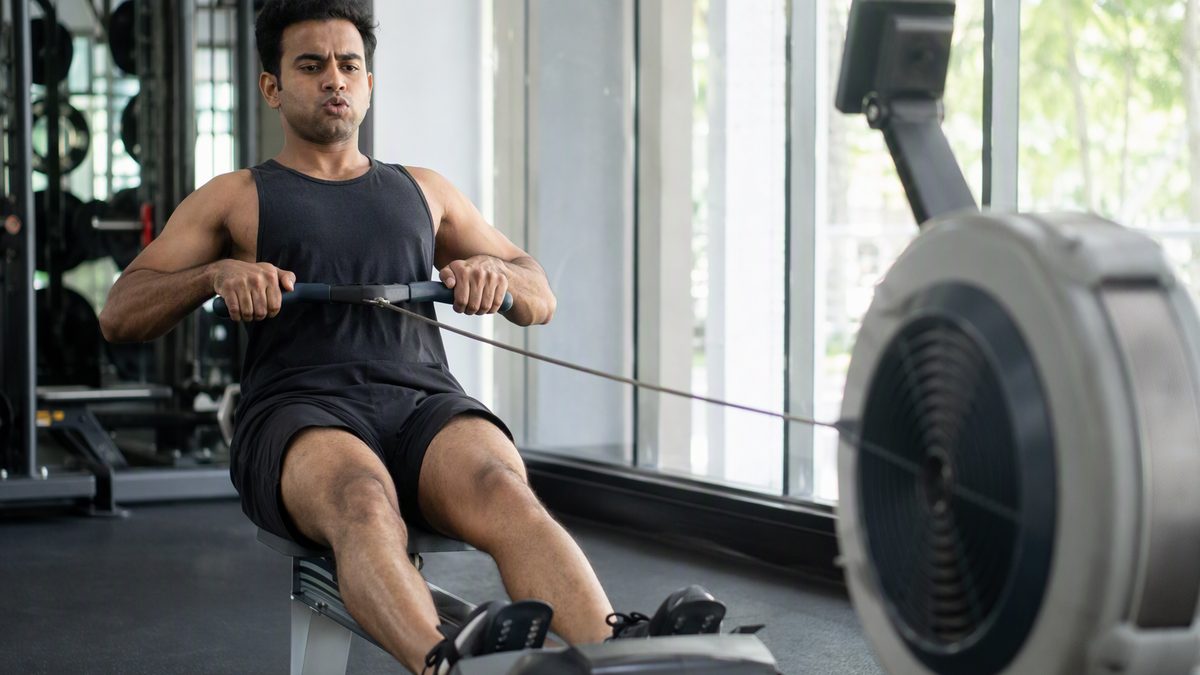
Sitting builds a specific posture: hip flexors shorten, the upper back rounds, the chest closes, and the deep core switches off. The rowing stroke is almost a direct antidote, which is the part most desk-workers don't realize. Look at what each phase does. The drive starts with a powerful leg press that fires the glutes and quads your chair lets sleep. As the legs straighten, you swing the torso open from the hips — a hip hinge and extension that lengthens the very hip flexors sitting keeps short. The finish draws the handle to the chest, retracting your shoulder blades and pulling you out of the rounded-forward posture the screen drags you into.
Then the recovery reverses it under control, asking your core and back to manage the slide forward with a neutral spine instead of a slump. Done well, that's eight to ten quality hip extensions and shoulder retractions per minute, against the opposite shape you held all day. Two things make or break the benefit. First, posture: keep a neutral spine and hinge from the hips — if you round your lower back to reach the catch, you'll reinforce the slump and load the lumbar spine, which is the last thing a desk-aggravated back needs. Second, sequence: legs, then body, then arms on the drive; arms, then body, then legs on the recovery. Get those right and the stroke becomes corrective movement, not just cardio.
3. Slotting the Erg Into a 9-to-6 (and Movement Snacks at the Desk)
The honest constraint is time and energy windows, so build around them rather than fighting them. You realistically have a before-work slot, a lunch slot, or an after-work slot of 30-60 minutes, plus the dead hours at your desk. Use the erg for the focused session and use micro-movement for the rest. Everything below sits at a 3-4 damper unless you're deliberately doing intervals.
| Slot | Session | Duration | Damper / rate |
|---|---|---|---|
| Before work (Mon) | UT2 steady row, wake the body up | 20-25 min | 3-4 / 18-22 spm |
| Lunch (Tue) | Short intervals: 8 x 250 m / 90 s easy | 20 min + warm-up | 4-5 / 26-30 spm |
| After work (Wed) | UT2 steady, de-stress pace | 25-30 min | 3-4 / 18-20 spm |
| Lunch (Thu) | Easy row + mobility, undo the morning | 20 min | 3-4 / 18 spm |
| After work (Fri) | 30 s hard / 30 s easy x 10 | 20 min + warm-up | 4-5 / 28-32 spm |
| Any desk hour | Movement snack: stand, hip hinges, walk | 2-3 min, hourly | — |
| Weekend | Longer easy row or a lunch walk | 35-45 min | 3-4 / 18-22 spm |
Most of the rowing should be easy steady-state, with one or two short interval days for time-efficient fitness — and the desk-hour movement snacks run alongside, not instead. They genuinely matter: standing and moving for a couple of minutes each hour blunts the metabolic cost of prolonged sitting better than a single workout can on its own. Beginners should master easy steady-state before doing hard intervals; don't jump to the sprint days in week one.
4. Beginner Mistakes, the 3pm Slump, and When to See Someone
The mistakes desk-workers make on the erg are predictable, so head them off. Cranking the damper to 10 because it feels serious — wrong; that just grinds your low back and teaches nothing, so start at 3-4. Pulling with the arms instead of driving with the legs — the arms are the weakest link and gas out fast; power comes from the floor up. Rushing the slide so the recovery is faster than the drive — aim for the recovery to take about twice as long as the drive. And rounding the back to reach further at the catch, which loads the exact spot your desk already aggravates. Fix sequence and posture before you chase splits.
On the 3pm slump: that afternoon energy crash is partly the sitting itself, partly blood-sugar swings, partly poor sleep pushed late by screens. A short lunchtime row genuinely helps — even easy aerobic movement lifts alertness for the afternoon — and so does simply standing and walking on the hour. But don't paper over a deeper sleep or stress problem with caffeine and call it solved. Finally, a real caution: if you've been sedentary for years or carry cardiac or cardiometabolic risk, get medical clearance before doing any maximal-effort intervals, and build your volume up gradually to protect your back. And if desk-related neck or back pain persists or changes, that deserves a clinician's eyes — the erg is a fitness tool, not a treatment for an injury.
Desk-Worker Questions About the Rowing Machine
Does sitting all day cancel out my rowing workout?
No single workout fully reverses a day of sitting, but that's the wrong way to score it. Prolonged sitting blunts your metabolism even if you train, so the goal is to keep your aerobic fitness high and to interrupt the sitting often. A short row gives a big full-body stimulus fast, and higher cardiorespiratory fitness strongly tracks lower long-term mortality. Pair the focused row with movement snacks every hour — together they beat either one alone.
When should I row around a 9-to-6 schedule?
Use whichever window you'll actually keep — before work, at lunch, or after — for 20 to 30 minutes, since consistency beats perfect timing for a desk-worker. A morning row wakes the body up; a lunch session breaks the sitting block and lifts your afternoon; an evening row de-stresses. Keep most sessions easy steady-state with one or two short interval days, and fill the dead desk hours with brief movement snacks to undo the sitting between workouts.
Can movement snacks at my desk actually help, or do I need the gym?
They genuinely help, and they're not a substitute for training — they're a separate lever. Standing and moving for two or three minutes each hour blunts the metabolic damage of prolonged sitting in a way one daily workout can't. So do both: keep your focused rows for building fitness, and scatter hip hinges, stands and short walks through the workday to break up the sitting. The combination is what protects a desk-bound body over the long run.
Why am I exhausted at 3pm, and will rowing fix it?
The afternoon slump is partly the sitting itself, partly blood-sugar swings, and partly sleep pushed late by screens. A short lunchtime row reliably helps — even easy aerobic movement lifts afternoon alertness — and standing and walking on the hour helps too. But rowing won't fix a real sleep or stress deficit underneath the slump. Use the erg to add energy and movement, and treat genuinely poor sleep as the root issue it usually is.
Disclaimer: This article is for educational purposes only and is not medical advice. Consult a qualified healthcare professional before starting any supplement, nutrition, or training protocol — especially if you are pregnant or breastfeeding, under 18, taking medication, or managing a health condition.
Scientific References & Clinical Sources
- Joyner MJ, Coyle EF. Endurance exercise performance: the physiology of champions. J Physiol, 2008. PMID: 17901124
- Mandsager K, et al. Association of Cardiorespiratory Fitness With Long-term Mortality Among Adults Undergoing Exercise Treadmill Testing. JAMA Netw Open, 2018. PMID: 30646252
- Tabata I, et al. Effects of moderate-intensity endurance and high-intensity intermittent training on anaerobic capacity and VO2max. Med Sci Sports Exerc, 1996. PMID: 8897392
- Keating SE, et al. A systematic review and meta-analysis of HIIT versus continuous training for fat loss. Obes Rev, 2017. PMID: 28401638
- Buchheit M, Laursen PB. High-intensity interval training, solutions to the programming puzzle: Part I: cardiopulmonary emphasis. Sports Med, 2013. PMID: 23539308

