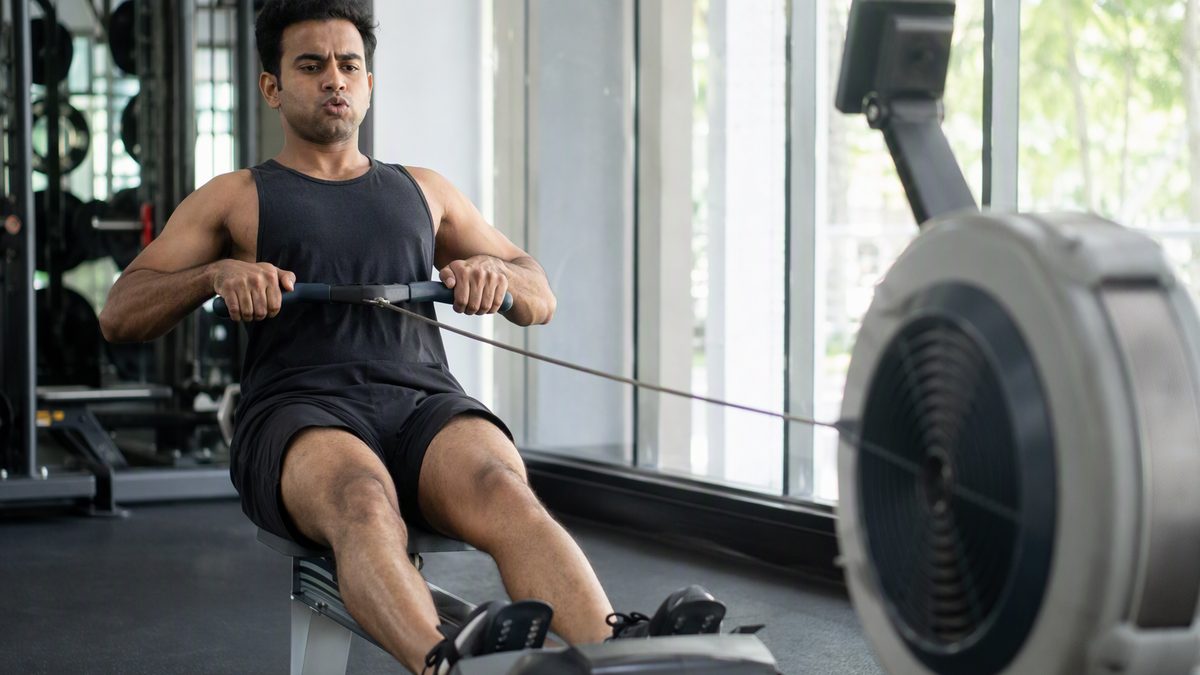
💡 Key Takeaways
- The erg is leg-driven (roughly 60% legs, 30% trunk, 10% arms), so it adds full-body aerobic volume without loading the shoulder the way more pool yardage or pulling dryland does.
- Damper is gearing, not difficulty: set it at 3-5 and earn intensity through leg drive, not by yanking the handle and re-stressing your catch muscles.
- Keep most erg work easy UT2 steady state (18-22 spm, 60-70% max HR); cap hard interval rows at 1-2 per week on non-pool-quality days, 48 hours apart.
- Sweat losses on the erg are real and visible unlike in the pool, so rehydrate after dryland rows the same way you should after a hard morning set.
The shoulder is the swimmer's bottleneck, and most cross-training quietly makes it worse. You already log thousands of strokes a week, so when you want extra aerobic volume the obvious answers - more pool meters, pull sets, lat-heavy dryland - all funnel load straight back into the joint that's already absorbing the most. The result is a familiar bind: you want a bigger engine, but the very tissue that's most fatigued is the one being asked to build it.
Rowing solves that bind better than almost any other machine. It is a near-whole-body, low-impact cardio movement powered from the legs and posterior chain, not the arms - so it raises your heart rate and trains your aerobic system hard while the shoulders mostly just transmit force at the finish. You get the breathing, the leg burn and the calorie cost of serious cardio with a fraction of the rotator-cuff cost of more swimming. Used right, the erg lets you add training volume, build durability for the back half of races, and keep moving on days a grumpy shoulder needs the water but not the pull.
1. Why the Erg Spares the Shoulder You Overload in the Pool
Start with where the power comes from. A rowing stroke is a leg-press, then a hip-and-back swing, then a short arm draw - coaching consensus puts the split at roughly 60% legs, 30% trunk and core, and only 10% arms. The arms finish the stroke; they don't drive it. That is the opposite of swimming, where the upper body does the propulsive work and the shoulder eats the volume. So when you trade a pull set for an erg piece, you move the engine load off the cuff and onto the big lower-body and posterior-chain muscles that have plenty of capacity to spare.
The second gift is low impact. The seat glides, your feet stay strapped, and there is no heel-strike or ground-reaction pounding the way running adds it. You can push genuinely high work rates with very little joint stress - similar joint-friendliness to cycling, but with far more muscle mass involved, which is why it feels harder and burns more for the time. For a swimmer that means real aerobic volume that doesn't tax the shoulder and doesn't beat up the legs for your next kick set. The one caveat: low-impact is not no-risk. Rounding your back at the catch loads the lumbar spine, so technique still matters - just in a way that has nothing to do with your stroke.
2. Damper, Drag and the Catch-Muscle Trap
Here is the mistake that sends swimmers straight back into shoulder trouble: cranking the damper to 10 and trying to muscle the handle. The damper lever does not set the resistance. It controls how much air enters the flywheel housing, which changes the drag factor - the feel, the gearing - like gears on a bike, not the absolute difficulty. How hard the row is comes from how hard you pull each stroke, not from the number on the lever. A high damper feels heavy and grindy, rewards yanking, and fatigues the low back faster with poor form; a low damper feels light and spinny and rewards smooth leg drive.
For you the practical point is sharp: a high damper plus an arm-dominant pull is exactly the pattern that re-loads the same lat and shoulder tissue you came to the erg to rest. Set the damper at 3-5, where most competitive rowers train because it mimics on-water rowing and rewards good leg-driven technique. Then make the legs do the work. You can get an equally hard or harder cardio effort at a moderate damper by driving faster and harder with the legs while the arms stay relaxed until the finish. Two faults to police, both shoulder-relevant: early arm pull (bending the elbows before the legs have driven, which breaks the kinetic chain) and over-gripping with shrugged shoulders. Loose hands, late arms, legs first.
3. Slotting Erg Volume Around 5am Practice
Treat the erg as easy aerobic infrastructure, not another quality session competing with your pool work. Most of it should be UT2 steady state - long, continuous, conversational rowing at a low stroke rate, the rowing version of zone 2. That base is cheap to recover from and won't compromise your next swim. Keep hard erg intervals to a small dose, scheduled away from your hardest pool sets, and scale any heart-rate figures to your tested max.
| Erg session | Piece | Effort / stroke rate | Weekly dose for a swimmer |
|---|---|---|---|
| UT2 steady state | 20-40 min continuous | 60-70% max HR, 18-22 spm, conversational | 2-3, including shoulder-rest days |
| Aerobic intervals | 4 x 4 min / 3 min easy | Hard but repeatable, 24-28 spm | 1, on a non-pool-quality day |
| Short power intervals | 8 x 250m / equal rest | Near-max leg drive, 28-32 spm | Optional, 1 every other week |
| 2K benchmark | 2000m time trial | All-out, paced by 500m split | Every 6-8 weeks, not in meet week |
Two scheduling rules keep this from backfiring. First, never bolt a hard erg piece onto the morning of a hard swim set - put your two or three weekly hard efforts, pool and erg combined, on separate days with 48 hours between them, because the same systems need that long to recover. Second, use the erg as your default on shoulder-management days: when a coach pulls you from a heavy pull set, a 30-minute UT2 row keeps your aerobic volume up without touching the joint. Taper culture applies here too - drop erg volume the same week you taper for a meet.
4. Sweat, Fueling and When to Back Off
The erg fixes one of swimming's sneakiest problems: you can finally see your sweat. In the pool the losses are invisible but real, and plenty of swimmers finish a hard morning meaningfully dehydrated without a single visible drop. On the erg the puddle under the rail makes the point obvious - keep a bottle on the monitor arm and rehydrate after dryland rows exactly as you should after a tough set. Get some carbohydrate in before any early erg work too; empty-stomach hard rowing before 6am degrades both quality and recovery, the same trap as under-fueling a morning double.
On goals, one honest note. If part of why you're rowing is leaning out, the erg helps because lots of muscle worked plus low impact lets you sustain more total work comfortably - but the calorie counter on the monitor is only an estimate from your power output and a generic formula, and it tends to over-state for lighter athletes. Total energy balance and consistency drive body composition, not the machine's number, and hard intervals and easy steady work come out broadly comparable for fat loss when energy is matched. Pick your erg mix for the aerobic engine and the shoulder rest, and let consistency do the rest. Last, a real stop signal: rowing should never reproduce the shoulder pain that alters your stroke. If a row pinches the joint or you feel low-back strain that doesn't ease with cleaner sequencing, stop and get it assessed rather than pushing through.
Pool-Deck Questions About Rowing for Dryland
Will the erg help my 50 free or just give me general fitness?
Both, by different routes. Short power intervals - hard 250s with full rest - sharpen the fast leg-driven force that overlaps with sprint power output. Easy UT2 volume builds the aerobic base that restores you faster between hard efforts, so you can hold more quality sprint reps in a pool set before your stroke falls apart. The erg won't replace water speed work, but as cross-training it raises the engine under your sprint without adding shoulder load, which more pulling can't claim.
Do I really sweat enough on the erg to bother hydrating?
Yes, and unlike the pool you'll see it. A hard steady-state or interval row raises sweat losses just like land cardio, and the puddle under the rail makes obvious what the water hides. Finishing a tough erg piece dehydrated is common and it degrades both performance and recovery. Keep a bottle on the monitor arm, sip on the recovery slide during long pieces, and rehydrate afterward - especially before a swim double later the same day.
How do I fit erg work around 5am practice without wrecking my swims?
Treat most erg time as easy UT2 volume that doesn't compete with the pool, and use it on shoulder-rest days when you'd otherwise skip pulling. Keep hard erg intervals to one or two weekly, scheduled away from your hardest swim sets, with 48 hours between any two hard efforts. Fuel it like a morning double: some carbohydrate before, food soon after. The erg's job is added aerobic base and a shoulder break, not another quality session to recover from.
Does extra water weight from rowing change my feel in the water?
Any change is small and not a reason to skip the erg. What actually alters your feel is fatigue degrading technique - a shortening stroke or a tired catch from too much shoulder load. Rowing helps there, because it builds your aerobic engine while sparing the shoulder, so you arrive at pool sets fresher in the joint that matters most. Drive the erg from your legs at a moderate damper and it improves your durability without meaningfully touching how the water feels.
Disclaimer: This article is for educational purposes only and is not medical advice. Consult a qualified healthcare professional before starting any supplement, nutrition, or training protocol — especially if you are pregnant or breastfeeding, under 18, taking medication, or managing a health condition.
Scientific References & Clinical Sources
- Joyner MJ, Coyle EF. Endurance exercise performance: the physiology of champions. J Physiol, 2008. PMID: 17901124
- Tabata I, et al. Effects of moderate-intensity endurance and high-intensity intermittent training on anaerobic capacity and VO2max. Med Sci Sports Exerc, 1996. PMID: 8897392
- Murlasits Z, et al. The physiological effects of concurrent strength and endurance training sequence: a systematic review and meta-analysis. J Sports Sci, 2018. PMID: 28783467
- Mandsager K, et al. Association of Cardiorespiratory Fitness With Long-term Mortality Among Adults Undergoing Exercise Treadmill Testing. JAMA Netw Open, 2018. PMID: 30646252
- Keating SE, et al. A systematic review and meta-analysis of HIIT versus continuous training for fat loss. Obes Rev, 2017. PMID: 28401638
Want a plan built around your training history? UltraFit360's free AI workout planner creates and adjusts programs for you.

