💡 Key Takeaways
- Expect a usable 2K erg benchmark and rising watts at the same heart rate within 4-6 weeks - the erg adds measurable aerobic volume without adding run impact.
- Keep most erg rowing easy UT2 (18-22 spm, 60-70% max HR) so it slots into your aerobic base; reserve 1-2 hard erg sessions weekly, 48 hours apart from each other.
- Damper is gearing, not difficulty - set it 3-5 and drive with the legs; intensity comes from watts you produce, tracked as pace per 500m, not the lever number.
- Hard erg work interferes somewhat with concurrent strength, so separate priority lifting from hard rows by keeping them on different days.
Here is what you can actually measure when you add the erg. Within two or three sessions you'll have a baseline 2K split - rowing's standard 6-to-8-minute benchmark - and a feel for the watts you hold at a given heart rate. Over four to six weeks of mostly easy rowing, that's the number that moves: more power at the same heart rate, which is the same aerobic signal you chase on the bike and the run, read on a fourth instrument. You get all of it with zero foot-strike, which is the part that makes this interesting for a body already absorbing a heavy run load.
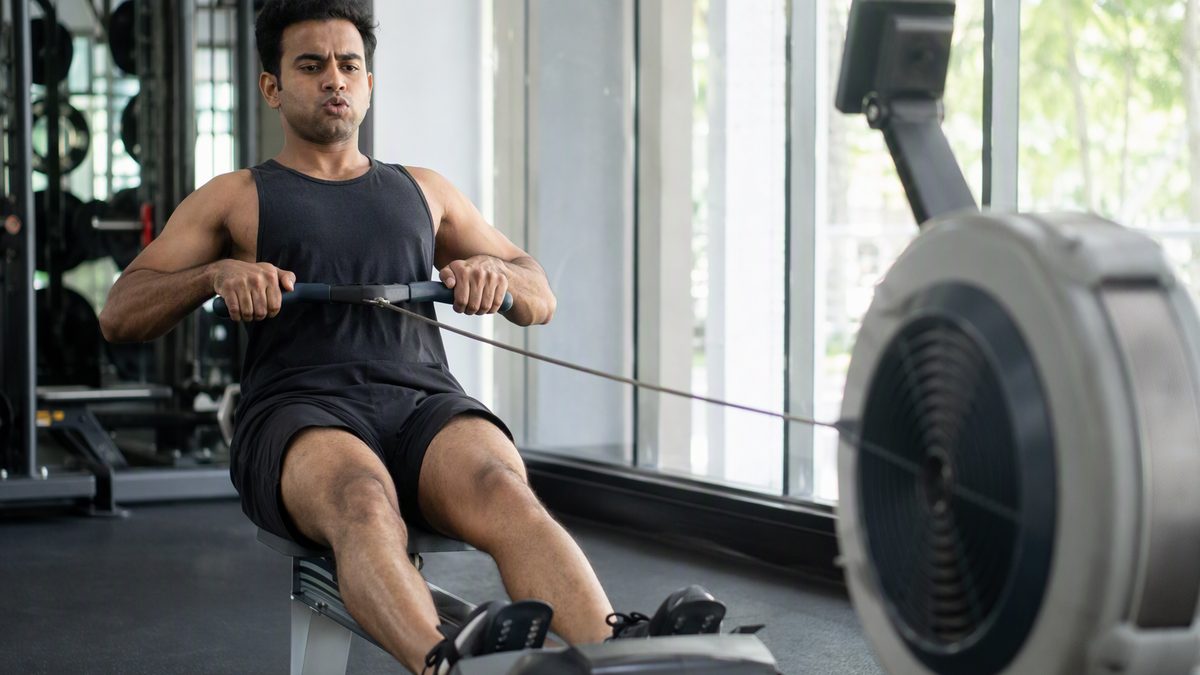
Rowing is near-whole-body, low-impact, high-output cardio driven from the legs and posterior chain. For a triathlete already juggling nine to thirteen sessions a week across three sports on one recovery budget, the erg is not a fourth discipline to master - it's a way to add aerobic volume and intervals without the impact cost of more running or the road-time logistics of more cycling. This guide is built around what the monitor shows you: the splits and watts to expect, where rowing slots into a polarized week, the science behind those numbers, and the scenarios - brick weeks, travel, niggles - where the erg earns its place.
1. What the Monitor Shows You in the First Six Weeks
Track four numbers from session one: pace as time per 500m (your split), watts, stroke rate, and heart rate. The split is your universal currency - pace and watts are the same thing expressed two ways - and stroke rate tells you how you're producing that power. Early on, log a 2K time trial as a benchmark; for most fit triathletes that's a hard six-to-eight-minute effort, and it gives you a anchor to set training paces and re-test against.
The adaptation you're looking for is simple and it shows up fast. Hold an easy steady-state effort at a fixed heart rate, and over four to six weeks of consistent UT2 volume your watts at that heart rate climb while the effort feels the same. That rising power-at-fixed-HR is the textbook signal of aerobic improvement - more mitochondria, more capillaries, better fat oxidation - and it's the same engine that lowers your bike and run splits. On the erg you can read it cleanly because there's no wind, no hills, no GPS drift. One honest measurement caveat: the calorie counter is an estimate from your watts through a generic formula and doesn't know your weight or efficiency, so it over-states for lighter athletes - judge progress by split and watts, never by the calorie number.
2. Your Three-Sport Week With the Erg Added
Slot rowing into the polarized structure you already use: a large majority of easy aerobic volume, a small dose of hard work. The erg's role is to add UT2 base and the occasional interval session without run impact, then get out of the way on your highest-priority swim, bike and run days. Keep hard erg sessions away from your key brick and long days, and scale heart-rate figures to your tested max.
| Erg session | Piece | Effort / stroke rate | Weekly dose |
|---|---|---|---|
| UT2 steady state | 30-45 min continuous | 60-70% max HR, 18-22 spm | 1-3, replacing impact volume |
| Aerobic intervals | 4 x 4 min / 2-3 min easy | Hard, repeatable, 24-28 spm | 1, on a non-key day |
| Threshold pyramid | 250-500-750-1000-750-500-250m | Climbing then descending pace | Optional, in place of an interval week |
| 2K test | 2000m time trial | All-out, paced by 500m split | Every 6-8 weeks, not race or brick week |
Two rules protect your recovery budget. Keep any two hard sessions - across all four modalities - at least 48 hours apart, since the same energy systems need that long to bounce back; the erg is most valuable as easy volume precisely because it's cheap to recover from and won't blunt tomorrow's run. And remember concurrent-training interference: hard endurance work can dampen concurrent strength gains, so keep your priority lifting on a separate day from hard rows rather than stacking them. In a brick week, drop the erg to easy UT2 only or skip it - the long ride and run are the priority and the erg should never steal from them.
3. The Science Behind the Numbers You're Watching
Why does mostly-easy rowing move your splits? Because the aerobic base - the mitochondrial density, capillarization and fat-oxidation machinery you build from accumulated easy volume - is the platform every harder effort sits on, and the polarized model that elite endurance athletes follow puts the large majority of training at exactly that easy intensity. UT2 rowing adds to that base without the eccentric impact that more running piles onto your legs, which is the whole point: aerobic volume at a lower mechanical cost.
The hard sessions earn their small slice for a different reason. Interval rowing delivers time-efficient gains in VO2max and the top-end capacity that pure easy volume can't reach, and the work-to-rest design principles transfer directly from the broader interval-training literature - longer reps bias the aerobic load, shorter sharper ones bias anaerobic. That's why a 4x4 builds different qualities than 8x250m. Rowing recruits an unusually large fraction of total muscle mass per stroke, so it taxes the cardiorespiratory system heavily for the time invested, which is part of why a hard erg piece feels - and pays off - like a serious workout. Manage intensity with your recovery markers too: when resting heart rate, HRV or leg heaviness say you're under-recovered, swap a planned hard row for easy UT2 rather than forcing it. And get medical clearance before maximal 2K efforts if you carry any cardiac or cardiometabolic risk, since maximal exertion transiently raises cardiac risk even as higher fitness lowers long-term mortality.
4. Brick Weeks, Travel and Niggles: When the Erg Wins
Three triathlete scenarios make the erg more than a novelty. First, accumulated impact: when your legs are flat from a heavy run block but your aerobic system can take more, an easy UT2 row adds volume without another foot-strike, and the rising watts at fixed heart rate prove the base is still building. Second, travel - the single most disruptive thing in your calendar. A hotel or race-venue gym almost always has an erg, the protocol is identical anywhere, and a 30-minute UT2 piece keeps your engine ticking when the pool is closed and the roads are unfamiliar. Default rules beat decisions when you're jet-lagged.
Third, niggles. A grumbling Achilles, shin or knee that needs a few impact-free days doesn't have to mean lost fitness - the erg is low-impact and leg-driven, so you can hold serious aerobic volume while the tissue settles. Two cautions keep this clean. Race-day GI distress comes from untested fueling, so treat any new pre-row nutrition as a training experiment, never a race-week surprise. And rowing has its own technique risk: rounding the lower back at the catch loads the lumbar spine, so hold a neutral spine, hinge from the hips, and keep a moderate damper. If you ever feel rib soreness from very high erg volume - a recognized overuse injury in high-mileage rowers - that's a signal to cap the rowing, not push through it. Used as added easy volume rather than a fourth event to peak, the erg is one of the safest ways a triathlete can train more.
Multisport Questions About the Erg
Which of my three disciplines benefits most from rowing?
The run benefits most in practice, because the erg replaces impact volume with impact-free aerobic work - you build the same engine without the foot-strike that limits how much you can run. The bike gains too, since rowing is leg-driven and trains overlapping aerobic and posterior-chain capacity. The swim overlaps least mechanically, but the general aerobic base helps everything. Think of the erg as engine volume that pays into all three, with the run getting the biggest practical break.
How do I use the erg across doubles and brick days?
On double days, make the erg the easy session - a UT2 piece pairs well with one quality swim, bike or run without overloading recovery. Keep hard erg intervals off your key brick and long days entirely; in a brick week, drop the erg to easy volume or skip it so the long ride and run stay the priority. Keep any two hard sessions across all modalities 48 hours apart, and don't stack a hard row on a priority lifting day.
Should I do a 2K test, and how do I fit it in?
Yes - the 2K is rowing's benchmark and gives you a clean number to track aerobic progress against, re-tested every six to eight weeks. Treat it as a hard quality session: schedule it on a fresh day, not in a brick week, race week or after a hard run. If you carry any cardiac or cardiometabolic risk, get medical clearance before maximal efforts. Watch your split fall over a training block as confirmation your easy volume is working.
Will rowing add weight that hurts my run split?
Any change is small, and the trade favors you. The erg is mostly leg-driven aerobic conditioning, not a hypertrophy stimulus, and at a moderate damper with easy volume it builds engine, not bulk. What actually helps your run split is more impact-free aerobic volume and stronger legs, both of which the erg delivers. Judge the effect by your rising watts at fixed heart rate and your falling run splits, not by a number on the scale that barely moves.
Disclaimer: This article is for educational purposes only and is not medical advice. Consult a qualified healthcare professional before starting any supplement, nutrition, or training protocol — especially if you are pregnant or breastfeeding, under 18, taking medication, or managing a health condition.
Scientific References & Clinical Sources
- Joyner MJ, Coyle EF. Endurance exercise performance: the physiology of champions. J Physiol, 2008. PMID: 17901124
- Tabata I, et al. Effects of moderate-intensity endurance and high-intensity intermittent training on anaerobic capacity and VO2max. Med Sci Sports Exerc, 1996. PMID: 8897392
- Buchheit M, Laursen PB. High-intensity interval training, solutions to the programming puzzle: Part I: cardiopulmonary emphasis. Sports Med, 2013. PMID: 23539308
- Murlasits Z, et al. The physiological effects of concurrent strength and endurance training sequence: a systematic review and meta-analysis. J Sports Sci, 2018. PMID: 28783467
- Mandsager K, et al. Association of Cardiorespiratory Fitness With Long-term Mortality Among Adults Undergoing Exercise Treadmill Testing. JAMA Netw Open, 2018. PMID: 30646252

