💡 Key Takeaways
- Myth busted: rowing through full ranges doesn't make you stiff or bulky - it's hip-hinge mobility plus leg-driven cardio that supports your practice.
- The erg builds the stability and stamina hypermobile yogis often lack; flexibility without strength is the real injury risk, not rowing.
- Keep most rowing easy UT2 (18-22 spm, 60-70% max HR); the leg-driven stroke teaches hip-hinge and a neutral spine, both useful on the mat.
- Rowing sweat is real and visible - hydrate after rows the way you must after hot yoga, and don't row hard fasted before a demanding session.
A lot of dedicated yogis quietly decide the rowing machine isn't for them, and usually for one of two reasons: a fear that pulling a handle will make them stiff and 'bulky', undoing years of opening the body, or a sense that a clanking cardio machine just isn't yogic. Both feelings are understandable, and both are myths. Rowing won't shorten your muscles or armour your shoulders, and the idea that evidence-based conditioning sits outside a thoughtful practice is exactly the kind of belief that leaves a strong, mobile body missing one ingredient: stability and stamina under load.
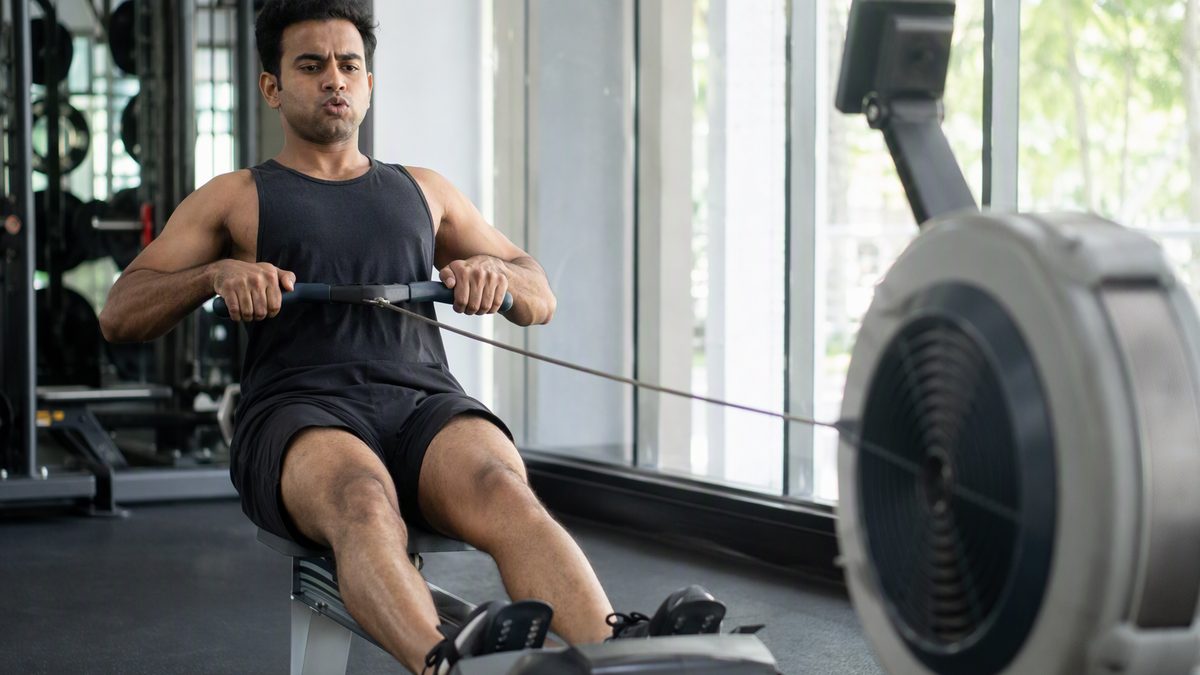
Here's the reframe. Rowing is full-body, low-impact, leg-driven cardio that moves you through a big, repeated hip-hinge - the same neutral-spine hinge you cue in your forward folds - while building the kind of strength and aerobic stamina that supports, rather than threatens, a flexible body. For the many practitioners who are more flexible than they are stable, that's not a contradiction with the mat; it's the missing half. This guide takes the myths a yogi actually holds about the erg and dismantles them one by one, then shows how to use the machine in a way that complements your practice, your hot-room sweat, and your fasted mornings.
1. Myth: "Rowing Will Make Me Stiff and Bulky"
The fear is that pulling against resistance shortens muscles and adds bulk that closes down your range. Neither holds up. Rowing moves you through a full range every single stroke - a deep hip-hinge and knee bend at the catch, a long extension at the finish - so it trains strength across range rather than in a shortened position; that's mobility under load, not the enemy of it. And the 'bulky' worry misreads what the erg is: it's primarily cardio, a leg-driven endurance movement, not a hypertrophy program. At a moderate damper with mostly easy volume, you're building an aerobic engine and stamina, not adding the mass that would change how your body looks or moves.
What rowing actually offers a yogi is the thing flexibility alone can't provide: stability. Long isometric holds and a hypermobile range are wonderful, but without strength to control those ranges, joints are exposed - and the genuine injury risk for many practitioners is too much mobility with too little control, not too little stretch. The erg's leg-driven power and trunk engagement build strength that helps you own your end ranges instead of just falling into them. Far from undoing your practice, it shores up its weakest seam. The stiff-and-bulky story is the opposite of what well-programmed rowing does.
2. Myth: "The Erg Has Nothing to Teach My Practice"
This myth assumes cardio and yoga live in separate worlds. On the erg, they overlap more than you'd expect - starting with the spine. The single biggest technique fault in rowing is rounding or hunching the lower back at the catch, which loads the lumbar spine; the fix is a neutral spine and a hinge from the hips, not a slump - precisely the cue you give a student folding forward. Row well and you're rehearsing a strong hip-hinge against load hundreds of times, which carries straight back to your forward folds and your lifting mechanics off the mat.
The sequencing has a lesson too. A good stroke is legs, then body, then arms on the drive, reversed on a deliberately slower recovery - power initiated from the floor up, with the arms only finishing. Coaching consensus puts it at roughly 60% legs, 30% trunk, 10% arms, so it's a lower-body and core movement, not an arm-yank. The recovery should take about twice as long as the drive, a controlled, breath-paced reset that will feel oddly familiar to anyone who paces movement with breath. And the common myth that a frantic high stroke rate means a hard workout is the rowing version of confusing busyness with depth - power per stroke matters more than speed, just as a held, controlled posture teaches more than a rushed flow. The erg isn't separate from your practice; it speaks a related language.
3. A Practice-Friendly Erg Plan
Slot rowing around your mat work as the strength-and-stamina complement, not a competitor for your recovery. Most of it should be easy UT2 steady-state, which is low-cost to recover from and won't leave you flat for tomorrow's practice; a small dose of harder intervals builds top-end stamina. Keep the damper at 3-5, drive from the legs with a neutral spine, and scale heart-rate figures to your tested max.
| Session | Piece | Effort / stroke rate | Weekly dose |
|---|---|---|---|
| UT2 steady state | 20-40 min continuous | 60-70% max HR, 18-22 spm | 2-3, complements daily practice |
| Aerobic intervals | 4 x 4 min / 2-3 min easy | Hard, repeatable, 24-28 spm | 1, on a lighter mat day |
| Short intervals | 8 x 250m / equal rest | Near-max leg drive, 28-32 spm | Optional, every other week |
| 2K benchmark | 2000m time trial | All-out, paced by 500m split | Every 6-8 weeks |
Two rules keep it harmonious with your practice. Most rowing easy, with only one or two hard sessions a week and 48 hours between them, so the erg adds stamina without stealing the energy your practice needs. And mind timing around intense mat days: don't stack a hard interval row onto a heavy hot-yoga or arm-balance-loaded session, since both already tax your shoulders and core. On retreats or teacher training - where load can spike suddenly - drop the erg to easy steady-state or skip it, the same way you'd respect any sudden jump in volume. If you want a broader view of fitting structured training into a movement practice, see our guide to building fitness habits.
4. Hot-Room Sweat, Fasted Mornings and Joint Cautions
Hydration is where the erg and the hot room share a real safety theme. Hot classes can cost you one to two litres of sweat, and rowing produces real, visible sweat of its own - you'll see it pooling under the rail. Underestimating either is the trap. Replace fluids and electrolytes after hot practice, keep a bottle on the erg monitor and rehydrate after rows, and never stack a hard fasted row on top of an already-dehydrated post-hot-yoga state - that's how a small fluid deficit becomes a spiral.
Fasted mornings need a clear head too. Many practitioners train fasted by tradition, and an easy steady-state row sits fine in that window - it's gentle and low-fuel. But a hard interval session or a 2K is a different demand; doing those on an empty stomach degrades both the quality of the work and your recovery, so save the hard efforts for after you've eaten, or fuel a little beforehand. Two joint cautions specific to your body: hypermobility means your answer to most aches is stability work, not more stretch, and the erg supports that - but keep the neutral-spine hinge honest, because rounding the back at the catch is the one rowing fault that can hurt you. And if you carry any cardiac or cardiometabolic risk, get medical clearance before maximal 2K efforts. Used with that awareness, the erg adds exactly what a strong, flexible, mindful practitioner tends to lack: durable strength and an aerobic engine, without costing you the mat.
Mat-Side Questions About the Erg
Does rowing fit a fasted morning practice?
An easy steady-state row fits a fasted morning fine - it's gentle and low-fuel, much like a calm flow. Hard interval rows and 2K tests are different; doing those fasted degrades both the work and your recovery, so save them for after you've eaten or fuel a little beforehand. Whatever the intensity, keep a bottle on the monitor: rowing produces real, visible sweat, and starting a session already short on fluids - especially before or after hot yoga - is the setup you want to avoid.
Will rowing make me bulky or stiff and hurt my flexibility?
No. The erg is leg-driven cardio, not a hypertrophy program, so at a moderate damper with mostly easy volume it builds an aerobic engine and stamina, not the mass that would change how you move. And because every stroke takes you through a full hip-hinge and knee range, it trains strength across range rather than shortening you. For most practitioners the real risk is mobility without control - rowing adds exactly the stability and strength that lets you own your ranges safely.
Will it help my hot-yoga fatigue?
Indirectly, yes - a bigger aerobic base and more muscular stamina mean you fatigue less in long holds and heat. But the most common hot-room fatigue driver is dehydration, and rowing won't fix that; if anything it adds its own sweat losses. So pair the erg with serious fluid and electrolyte replacement after hot classes, never stack a hard fasted row onto a dehydrated post-practice state, and keep most of your rowing easy so it builds capacity without draining the energy your hot practice needs.
Do yogis even need the rowing machine?
You don't need it, but it fills a common gap. Many dedicated practitioners are highly flexible yet under-strong and under-conditioned, and that imbalance - mobility without stability - is itself an injury risk. The erg builds leg-driven strength, trunk stability and an aerobic engine that support your end ranges instead of threatening them, all at low impact. Framed as a complement rather than a replacement, it shores up the part of physical practice that stretching alone can't reach. Most rowing easy keeps it harmonious with the mat.
Disclaimer: This article is for educational purposes only and is not medical advice. Consult a qualified healthcare professional before starting any supplement, nutrition, or training protocol — especially if you are pregnant or breastfeeding, under 18, taking medication, or managing a health condition.
Scientific References & Clinical Sources
- Joyner MJ, Coyle EF. Endurance exercise performance: the physiology of champions. J Physiol, 2008. PMID: 17901124
- Tabata I, et al. Effects of moderate-intensity endurance and high-intensity intermittent training on anaerobic capacity and VO2max. Med Sci Sports Exerc, 1996. PMID: 8897392
- Mandsager K, et al. Association of Cardiorespiratory Fitness With Long-term Mortality Among Adults Undergoing Exercise Treadmill Testing. JAMA Netw Open, 2018. PMID: 30646252
- Keating SE, et al. A systematic review and meta-analysis of HIIT versus continuous training for fat loss. Obes Rev, 2017. PMID: 28401638
- Buchheit M, Laursen PB. High-intensity interval training, solutions to the programming puzzle: Part I: cardiopulmonary emphasis. Sports Med, 2013. PMID: 23539308

