💡 Key Takeaways
- Rucking converts time you already spend walking — commute, airport, calls — into zone-2-ish cardio plus a load-bearing stimulus, with no gym and no extra calendar slot.
- Set one default that travels: pack at about 10% of bodyweight (roughly 18-22 lb), worn high and tight, walked tall, 30-40 minutes, two to three times a week.
- It is low-impact, so it stacks on top of a stressful week without the recovery cost or joint pounding of running, and it interferes less with strength work than hard cardio.
- Walk on the call, not before it: a phone meeting taken on foot with a pack is the single most calendar-proof version of this.
Picture a typical week: a 6am call, a flight Tuesday, a client dinner Wednesday, and a calendar with no clean hour for the gym. The cardio that survives that week is not the cardio that needs a gym, a shower buffer, and ninety undisturbed minutes. It is the cardio you can wear.
Rucking — walking with a weighted backpack — slots into the gaps you already have. The walk to the office, a loop of the terminal between flights, a phone meeting taken on foot, a 35-minute block before the hotel restaurant opens. Add a pack and that ordinary walking becomes real aerobic work plus a strength-and-bone stimulus, all at a conversational pace you can hold while thinking or talking.
This page is built around your actual week. We will place rucks into commute, travel and call windows, then set one default rule so it requires no decisions, plus the recovery and posture points that keep it sustainable under chronic stress.
1. Slotting Rucks Into the Commute, the Airport, the 6am Block
Walk through a real week and the openings are obvious once you are looking for them. The point is to attach the ruck to time that already exists rather than carving out a new block you will cancel.
- The commute. If any part of your door-to-desk involves walking, wear a loaded pack for it. A 25-30 minute loaded walk to or from the office is a full zone-2 session that costs you zero extra calendar.
- The phone meeting. Take a recurring call on foot with the pack on. You are conditioning while you would otherwise be sitting — the highest-leverage swap on this list.
- The airport. Skip the lounge chair; walk the terminal with your carry-on backpack loaded. Long layovers become training.
- The 6am window. A 35-minute ruck before a hotel day starts beats a rushed treadmill block, needs no equipment but a pack, and gets you outside before the day eats you.
- The client-dinner offset. A 20-minute loaded walk before dinner is a low-effort way to keep moving on a day you will not see a gym.
Because rucking is low-impact and low-intensity, it recovers easily and does not demand a recovery day the way hard intervals would — so it tolerates being stacked onto an already heavy week.
2. One Default Rule: Same Pack, Same Posture, Anywhere
Decision fatigue kills executive routines, so the goal is a single default you never have to think about: pack at about 10% of bodyweight, worn high and tight, walked tall, 30-40 minutes, two to three times a week. Same rule in your city, a hotel, or an airport. Here is the dose, scaled to a few bodyweights so you can set it once.
| Bodyweight | Starting load (~10%) | Duration | Distance | Frequency |
|---|---|---|---|---|
| 180 lb | 18 lb | 30-40 min | 1.5-2.5 mi | 2-3x per week |
| 200 lb | 20 lb | 30-40 min | 1.5-2.5 mi | 2-3x per week |
| 220 lb | 22 lb | 30-40 min | 1.5-2.5 mi | 2-3x per week |
| Deconditioned start | Empty pack to 5% | 20-25 min | 1-1.5 mi | 1-2x per week |
Once the default load feels easy for the full distance, progress slowly — about 5 lb every couple of weeks, and only one variable at a time. A general-fitness ceiling sits around a quarter to a third of bodyweight, but you do not need to chase it; the value is in the habit, not the number. Keep one pair of ruck plates at home and a packable weight (or just books and water bottles, kept high and flat) in your travel bag, and the rule never breaks.
3. Why This Beats the Hotel Treadmill for Stressed Executives
The case for rucking over your usual hotel-gym cardio is partly logistical and partly physiological. Logistically it wins because it needs no equipment beyond a pack and works in any city, terminal or timezone — it is the most travel-proof cardio there is. Physiologically, the conversational, zone-2-ish effort it produces — around 60-70% of max heart rate — is exactly the kind of low-intensity aerobic work that builds your aerobic base, improves fat metabolism and supports the cardiovascular and metabolic health that chronic stress, poor sleep and business-dinner alcohol steadily erode. Even modest doses of this kind of activity lower cardiovascular risk and improve glucose control, and higher cardiorespiratory fitness tracks strongly with lower long-term mortality — a metric worth more than any quarterly number.
Two more executive-specific points. First, low-intensity loaded walking interferes far less with strength gains than high-intensity cardio does, so it complements your lifting rather than competing with it. Second, a word of caution about how you run your week: rucking is not a license to keep stacking stimulants over sleep debt. If your travel is wrecking your sleep, the highest-value move is protecting sleep, not adding caffeine — and your annual executive physical is a natural checkpoint to see whether the training is moving your biomarkers. If habit-stacking is your weak point, our guide to building fitness habits covers anchoring a ruck to a fixed point in your day.
4. Posture and Pack Fit When You're Always Rushing
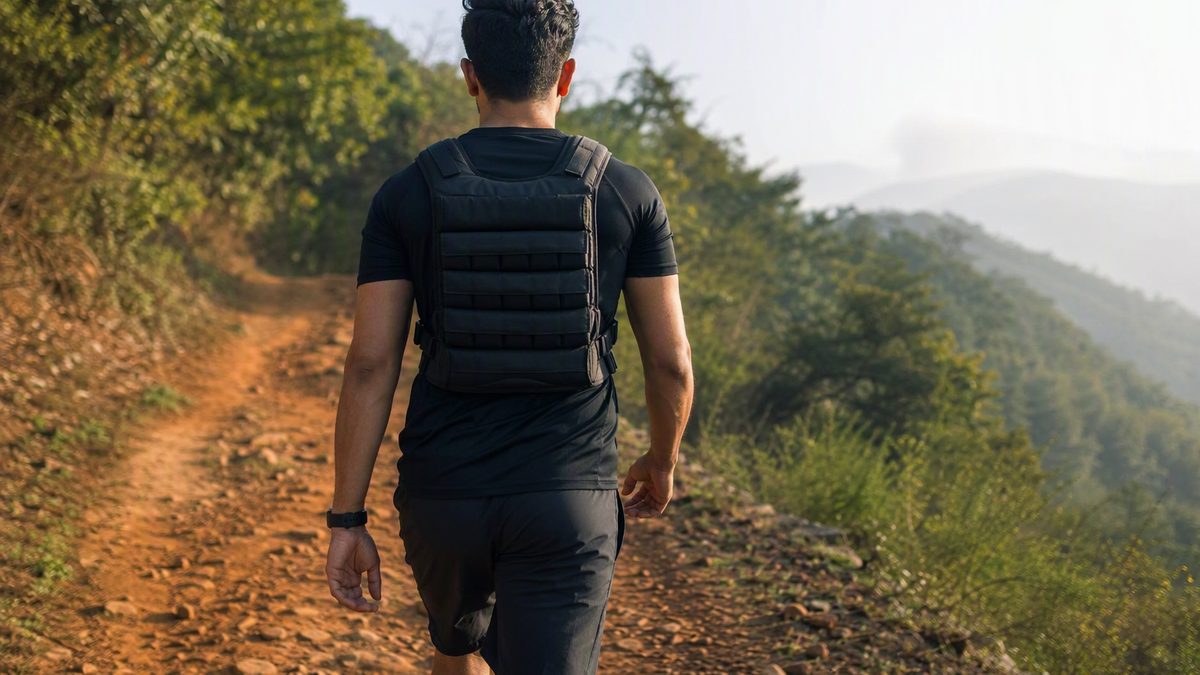
The failure mode for a rushed executive is throwing a heavy laptop bag over one shoulder and calling it a ruck. Do not. Lopsided, low-slung load is how the low back and shoulders get hurt. Two minutes of setup protects you. Ride the pack high, with weight centered between the shoulder blades, not sagging onto the low back. Cinch the straps tight so nothing bounces or pulls you backward, and use a waist belt if the pack has one to share load to the hips. Keep the weight high and flat — plates or a tight, packed load — not loose gear shifting around low in the bag.
Then the cardinal form rule, which is easy to forget when you are walking and reading email: walk tall with a neutral spine, and never lean forward to counter the weight. That forward lean is the most common cause of rucking back pain. Shoulders back, core gently braced, normal stride, eyes up. Use supportive, broken-in shoes — not the dress shoes you flew in — and moisture-wicking socks to avoid blisters on travel days. If you have a history of disc or shoulder problems, start very light or get clearance first, and stop on any sharp or radiating pain or arm numbness. Hydrate on a schedule, especially on travel days and after alcohol, since both leave you drier than you feel.
Rucking Questions Busy Executives Ask
What's the minimum effective rucking routine when I travel?
Wear a backpack loaded to about 10% of bodyweight for any walking you already do — the terminal, the walk to a meeting, a 30-minute loop before a hotel day starts. Two to three sessions of 30-40 minutes a week maintains real aerobic fitness. Because it is low-impact and low-intensity, even one or two travel-week rucks keep the engine running. The trick is attaching it to existing movement, not scheduling a separate workout you will skip.
Can I keep this up across time zones?
Yes — that is rucking's strength. It needs no gym, no equipment beyond a pack, and works in any city or terminal, so the default rule travels with you: same load, same posture, anywhere. A morning ruck also gets you outside into daylight, which helps reset your body clock after a long flight. Just keep the effort conversational and hydrate well, since travel and altitude leave you drier than you feel.
Does alcohol at client dinners ruin this?
It does not erase the training, but it works against the recovery and metabolic gains you are after, and it leaves you dehydrated. A practical approach: take a 20-minute loaded walk before the dinner, hydrate deliberately around the drinks, and do not stack a hard session on top of a poorly slept, hungover morning. Rucking is forgiving enough to absorb an imperfect week — just do not let business dinners quietly become every night.
What single metric should I watch?
Resting heart rate or heart-rate variability from your wearable is the most useful single signal, because it reflects how your training, travel, sleep and stress are netting out. A steadily lower resting heart rate over weeks suggests the aerobic work is landing; a persistently elevated one usually means sleep and stress are winning and you should ease off rather than push. Your annual executive physical adds a deeper biomarker checkpoint.
Disclaimer: This article is for educational purposes only and is not medical advice. Consult a qualified healthcare professional before starting any supplement, nutrition, or training protocol — especially if you are pregnant or breastfeeding, under 18, taking medication, or managing a health condition.
Scientific References & Clinical Sources
- Ludlow LW, Weyand PG. Walking economy is predictably determined by speed, grade, and gravitational load. J Appl Physiol (1985), 2017. PMID: 28729390
- Mandsager K, et al. Association of Cardiorespiratory Fitness With Long-term Mortality Among Adults Undergoing Exercise Treadmill Testing. JAMA Netw Open, 2018. PMID: 30646252
- Williams PT, Thompson PD. Relationship of walking and running LISS to cardiovascular risk factors. Arterioscler Thromb Vasc Biol, 2013. PMID: 23559628
- Toledo FG, et al. Effects of physical activity and weight loss on skeletal muscle mitochondria and relationship with glucose control in type 2 diabetes. Diabetes, 2007. PMID: 17536069
- San-Millán I, Brooks GA. Assessment of Metabolic Flexibility by Means of Measuring Blood Lactate, Fat, and Carbohydrate Oxidation Responses to Exercise in Professional Endurance Athletes and Less-Fit Individuals. Sports Med, 2018. PMID: 28623613

