💡 Key Takeaways
- Start around 10% of bodyweight (roughly 15-20 lb) on flat ground for 30-45 min at a conversational 60-70% max HR — the same easy zone that builds your climbing base.
- Rucking is not redundant cross-training: it adds weight-bearing aerobic volume your bike never gives you, loading glutes, hamstrings, spine and bone the saddle unweights.
- Loaded walking burns roughly 2-3x a plain walk's calories at the same pace (PMID 28729390), so you bank real base miles on no-ride or recovery days, low-impact.
- Progress one variable at a time, cap general-fitness load near a quarter of bodyweight, keep the pack high and posture tall, and don't ruck the day before a big epic.
Plenty of riders assume walking with a backpack is pointless next to a hard climb — if you want aerobic work, why not just ride? It is a fair objection, and on the surface rucking looks like a slower, weaker version of what your bike already does. The myth is that off-bike cardio cannot meaningfully carry over to riding.
It is wrong in a specific, useful way. The bike is a non-weight-bearing, fixed-position machine: it builds a phenomenal aerobic engine but leaves your skeleton unloaded and your posterior chain working through a narrow, seated range. Rucking adds the one thing cycling structurally cannot — weight-bearing aerobic volume that loads bone, glutes, hamstrings and trunk while keeping the easy intensity that builds your climbing base.
Below: why loaded walking is not redundant for a cyclist, the exact load and pace numbers, how it builds the standing-climb posterior chain, and where it slots around big weekend rides without leaving you flat.
1. The Myth: Off-Bike Walking Can't Help My Riding
The belief is that any cardio worth doing should happen on the bike, so trading a ride for a loaded walk is a downgrade. The flaw is treating all aerobic work as interchangeable. Cycling is non-weight-bearing — the saddle and pedals carry you, your skeleton is largely unloaded, and your posterior chain works through the seated pedal stroke. That is brilliant for an aerobic engine but it skips weight-bearing and upright loading entirely.
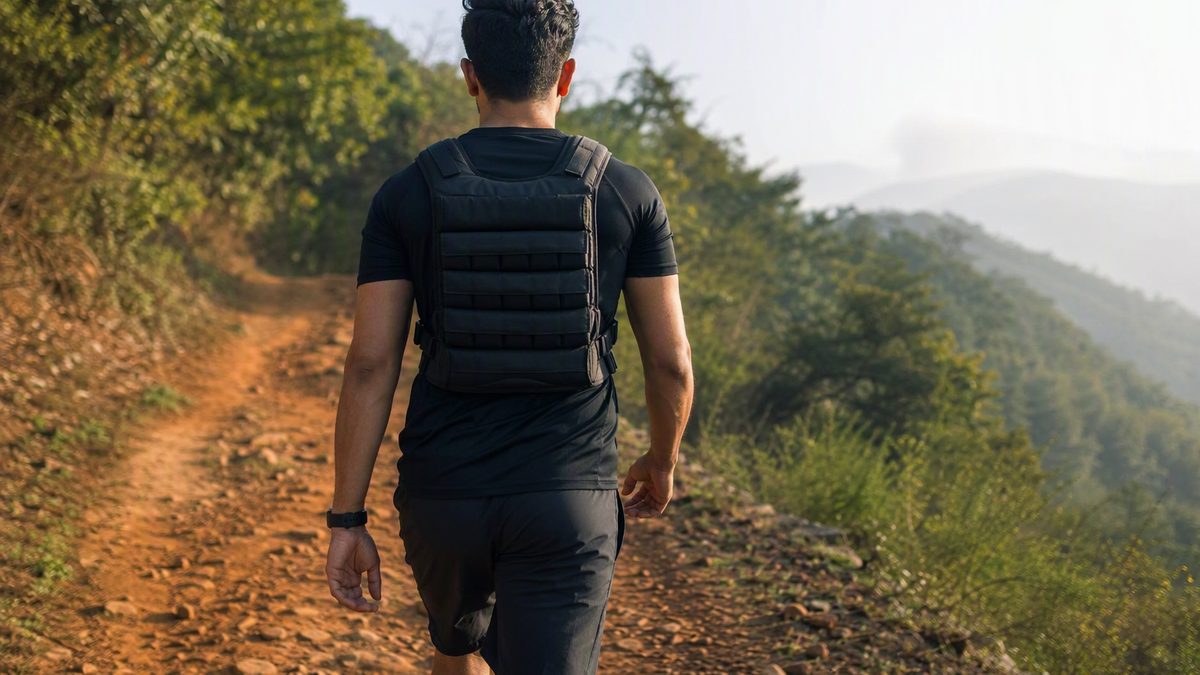
Rucking is walking with a weighted pack at a conversational pace, and it fills exactly that gap. It sits in the same easy aerobic window your base rides target — about 60-70% of max heart rate, RPE 3 to 5, able to talk in sentences — so the base-building stimulus is the same kind your bike delivers. But because you are upright and carrying load through your legs, hips and spine, you add a weight-bearing and posterior-chain demand the bike never imposes.
So it is not a weaker version of riding; it is a complementary channel. On a rest day, a rained-out trail, or a recovery slot, a ruck banks easy aerobic volume while loading the structures cycling unweights — which is precisely why it carries over rather than competing with your saddle time.
2. Load and Pace Targets for Riders
Keep it simple and start light: about 10% of bodyweight, which for most riders is a 15-to-20-lb plate riding high and flat in the pack. Build duration on easy ground first, then add gentle pace, then mild hills. Change only one variable per step — distance, pace, weight or terrain — never several at once.
| Goal | Pack load | Duration | Pace and terrain |
|---|---|---|---|
| First 2-3 weeks (build tolerance) | ~10% bodyweight (15-20 lb) | 30-40 min | Flat, conversational, 60-70% max HR |
| Off-bike aerobic base day | 10-15% bodyweight | 40-60 min | Flat to gently rolling, RPE 3-4 |
| Climbing posterior-chain stimulus | 10-15% bodyweight | 30-45 min | Mild trail inclines, RPE 4-5, tall posture |
| General-fitness ceiling | ~20-25% bodyweight | 40-60 min | Flat, only after lighter loads feel easy |
| Off-season strength carry-over | 15-20% bodyweight | 30-45 min | Varied terrain, slow, after base is built |
Add weight in roughly 5-lb jumps every couple of weeks at most, and only once the current load feels easy and pain-free for the full distance. The general-fitness ceiling is about a quarter to a third of bodyweight — you do not need military loads. Soft tissue and bone adapt slower than your already-fit aerobic system feels ready for, so let progression feel almost too slow.
3. Building the Standing-Climb Posterior Chain and Bone
Carrying load while walking puts a sustained, low-intensity demand on exactly the muscles a steep standing climb hammers. The legs carry the weight, the glutes, hamstrings and spinal erectors keep you upright and drive each step, and the trunk braces against the pack pulling you back. That is high time-under-load for the posterior chain — work capacity and muscular endurance the seated pedal stroke does not fully develop, and the same chain you fire when you stand and grind up a pitch.
The metabolic side is real too. Walking economy is set by speed, grade and gravitational load, so adding weight raises oxygen cost and calories per minute predictably (PMID 28729390) — roughly two to three times a plain walk, landing near a light jog while staying low-impact. Add trail inclines and the cost climbs faster, and grade meaningfully changes joint loading (PMID 24472218), so treat hilly rucking as a clear step up. The accumulated easy aerobic volume drives the base machinery you live on — mitochondrial density, capillarization, fat oxidation (PMID 17901124; PMID 28623613).
Then there is the structural bonus cycling famously lacks: bone. Riding is non-impact and does little for bone density, while rucking is weight-bearing and load-bearing — adding external load to walking increases mechanical stress through hips, spine and legs beyond a normal walk. The bone benefit here is a sound mechanism from the general loading literature rather than a rucking-specific trial, but for a cyclist whose main sport unloads the skeleton, it is a meaningful reason to walk under load.
4. Slotting Rucks Around Big Rides and Bad-Weather Weeks
Run rucking 1-2 times a week as easy aerobic volume, not a hard effort. The best slots are the ones the bike cannot fill: a recovery day when you want movement without saddle time, a trail too wet or icy to ride, or the off-season block where you are building strength and base before the season. On those days a flat 30-to-45-minute ruck banks easy aerobic minutes and loads the posterior chain without touching your interval reserves.
Keep heavier or hilly rucks off the day before a big weekend epic or bike-park day, since a loaded posterior chain can leave the glutes and low back fatigued for the descents that demand stability. Because rucking is low-intensity it recovers easily and interferes with riding far less than hard off-bike conditioning would, so on a recovery week it adds volume while your legs settle rather than digging the hole deeper.
Two practical cautions. Protect the low back: ride the pack high and tight, stand tall with a neutral spine, and never lean forward to counter the weight. And rucking is loaded walking, not a cardio engine — at this intensity hydration and fuel needs are modest, but multi-hour or hilly rucks deserve the same water and snacks you would pack for a remote ride. To make the off-bike walks a default habit through the off-season, our guide to building durable fitness habits helps them stick.
Trailhead Questions on Rucking
Why ruck when I could just ride for cardio?
Because the bike skips what rucking gives. Cycling is non-weight-bearing, so it leaves your skeleton unloaded and works your posterior chain through a narrow seated range. Rucking adds easy aerobic volume that loads bone, glutes, hamstrings and trunk while you walk upright. On rest days, rained-out trails, or off-season blocks, it banks base miles the bike's interval reserves do not have to pay for — complementing riding rather than replacing it.
Does rucking help arm pump or descending on long rides?
Not directly — arm pump and descent control are mostly grip, forearm endurance and core stability under vibration, which are best trained on the bike and with targeted forearm work. Rucking's carry-over is your engine and posterior chain for climbing, plus a weight-bearing bone stimulus. It supports the aerobic base and standing-climb muscles, but treat dedicated grip and descending work as a separate piece of your training, not something a ruck replaces.
How do I recover between weekend epics with rucking?
Use a light, flat ruck as easy aerobic movement, not a workout. About 10% of bodyweight for 30-45 minutes at a conversational pace keeps blood moving and banks base volume without adding fatigue, since it is low-impact and low-intensity. Keep it well away from the day before your next big ride, and skip it entirely if you are genuinely wiped. The goal between epics is easy volume and consistency, never another hard session in disguise.
Does anything change for rucking at altitude?
Altitude raises the effort of any aerobic work, so the same ruck feels harder and your heart rate runs higher at a given pace. Keep it conversational by slowing down and, if needed, dropping load — let perceived effort, not a fixed pace, set the dial. Hydration demand rises with altitude too, so carry water on longer rucks. None of this is unique to rucking, but its low-impact, self-paced nature makes it easy to scale to thinner air.
Disclaimer: This article is for educational purposes only and is not medical advice. Consult a qualified healthcare professional before starting any supplement, nutrition, or training protocol — especially if you are pregnant or breastfeeding, under 18, taking medication, or managing a health condition.
Scientific References & Clinical Sources
- Ludlow LW, Weyand PG. Walking economy is predictably determined by speed, grade, and gravitational load. J Appl Physiol (1985), 2017. PMID: 28729390
- Haggerty M, et al. The influence of incline walking on joint mechanics. Gait Posture, 2014. PMID: 24472218
- Joyner MJ, Coyle EF. Endurance exercise performance: the physiology of champions. J Physiol, 2008. PMID: 17901124
- San-Millán I, Brooks GA. Assessment of Metabolic Flexibility by Means of Measuring Blood Lactate, Fat, and Carbohydrate Oxidation Responses to Exercise in Professional Endurance Athletes and Less-Fit Individuals. Sports Med, 2018. PMID: 28623613
- Williams PT, Thompson PD. Relationship of walking and running LISS to cardiovascular risk factors. Arterioscler Thromb Vasc Biol, 2013. PMID: 23559628

