💡 Key Takeaways
- You don't need to relearn running — you need one default rule: nudge cadence up 5-10% to kill overstriding, applicable on any hotel treadmill without thinking.
- Skip the footstrike project; there's no 'correct' landing, and switching mid-travel-block risks a calf or Achilles injury you can't afford on the road.
- Buy shoes by comfort and fit, not an arch scan — pack two comfortable pairs and rotate them to spread load across erratic weeks.
- Your biggest risk is a weekend-warrior mileage spike after a sedentary travel stretch; cap weekly increases near 10% and let the trend, not heroics, build fitness.
It's 6:10am in a hotel gym, you have a 7:30 call, and the treadmill in front of you is the only training you'll get today. You don't have the bandwidth to think about footstrike mechanics, arm angles, or which 'pronation type' shoe you packed. You need running to fit your week, not the other way around — a default you can run on autopilot from any city.
Good news: that's exactly how the evidence says you should treat running form. Almost all of it is individual and low-yield, and the one adjustment that actually matters compresses into a single rule you set once and apply everywhere. The rest is load management — knowing when to push and when to keep it easy, which suits a chaotic schedule perfectly.
This guide lays out running biomechanics and footwork for busy executives: where running slots into a 60-hour week, the one cadence rule that travels, and how to pick shoes and pace miles so an unpredictable calendar doesn't injure you.
1. Where a Run Fits a 60-Hour Travel Week
Your schedule won't bend, so the running has to be portable and decision-light. Treat it as three fixed slots rather than a daily negotiation. First, the default session: 20-40 minutes easy on whatever treadmill or sidewalk you find, at a conversational pace where you could speak in full sentences. That easy volume is the single biggest driver of running economy and durability — far more than any form cue — and it's the part that survives airports.
Second, one quality touch when you have a clearer day: a handful of short, relaxed accelerations — say four to eight efforts of about 20 seconds — to practice fast, smooth mechanics without grinding yourself down. Third, two brief strength sessions a week, even 15 minutes of calf raises, single-leg work and hips in a hotel room, to build the tissue tolerance that keeps you running when your sleep and stress are a mess.
That's the whole footprint. The point is to remove the morning decision entirely: same easy default everywhere, one quality touch when the week allows, strength twice. You spend your scarce decisions on work, not on whether to run.
2. The One Rule That Travels: Cadence Over Everything
If you adopt a single form rule, make it cadence — your steps per minute. It's the most practical and best-supported lever because it directly fixes overstriding, the one mechanical fault actually worth correcting. Quicker, shorter steps at the same pace bring your foot down closer to under your body, cut the braking force, and lower the load spike at your knee. On a hotel treadmill, it's the easiest thing in the world to dial in: the belt even gives you a steady rhythm to match.
Ignore the '180 steps a minute' rule you may have heard — it came from watching elite racers and isn't a universal target. The honest move is to find your own habitual cadence on an easy run, then nudge it up roughly 5-10%. If you run at 158, aim for around 166-174. A bigger jump feels forced and tends to backfire.
Set a metronome app to your target and you have a rule that needs no thought and works identically in Singapore or Chicago. That's the design goal: a default that survives time zones, not a technique you have to coach yourself through at 6am while jet-lagged.
3. Shoes and Footstrike on the Road
Don't start a footstrike project while you're traveling — or really, at all, unless you have months to do it carefully. There's no single 'correct' way to land; most recreational runners heel-strike and do fine. Switching only moves the load, typically off the knee and onto the calf and Achilles, and an abrupt change is a reliable way to earn a calf strain right before a week of client meetings. As long as your foot lands under your hips (the cadence rule handles that), how it touches down is not your problem to solve.
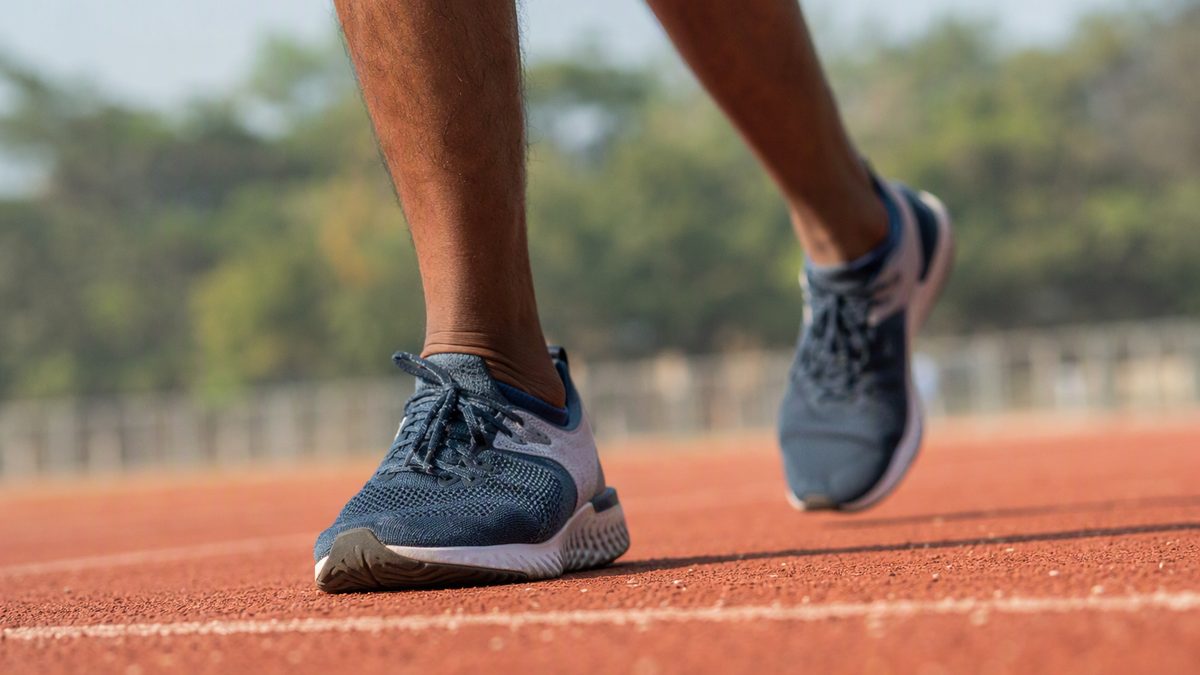
Shoes follow the same low-effort logic. The arch-scan, 'pronation-type' fitting model is weakly supported and hasn't reliably prevented injuries — treat it as marketing. The rule that holds up is the comfort filter: within the shoes you like, the pair that feels best underfoot comes with lower injury risk and better economy. Check for a thumb's width of toe room and no heel slip, keep them light, and you're done. Practically, pack two comfortable pairs and alternate them — rotating shoes is a simple, cheap way to vary the loading and lower injury risk across your erratic weeks. Replace a pair when the cushioning is clearly flat, roughly every 300-500 miles.
4. Your Travel-Proof Default Protocol
Here's the whole system as fixed rules you apply anywhere, no daily decisions. The numbers are starting points to tune to how you feel; and since chronic sleep restriction and stimulant stacking are your real risk factors, let your annual executive physical be the checkpoint where these habits meet real bloodwork.
| Cue | What to do | Why it works for you |
|---|---|---|
| Default run | 20-40 min easy, conversational pace, any treadmill or street | Easy volume drives most economy and durability; survives any schedule |
| Cadence rule | Find habitual spm, set metronome ~5-10% higher (e.g. 158 to ~166-174) | Fixes overstriding, lowers knee load; identical in every time zone |
| Weekly load cap | Increase total running by no more than ~10% week to week | Prevents the post-travel weekend-warrior spike that causes injury |
| Strides | 4-8 x ~20 s relaxed accelerations on a clearer day | Grooves fast, smooth mechanics with minimal recovery cost |
| Strength | 2 x 15 min/week: calf raises, single-leg, hips (hotel room works) | Builds tissue tolerance against stress, poor sleep, long sitting blocks |
| Shoes | Two comfortable pairs, rotate them; retire ~300-500 mi | Comfort beats pronation matching; rotation spreads the load |
The all-or-nothing trap — a perfect training week or none at all — is the executive's classic mistake. This protocol is built to defeat it: a 20-minute easy default with a metronome counts, and consistency at low doses outperforms occasional heroics every time.
5. The Mistakes That Sideline Busy Professionals
Two patterns injure executives more than bad form ever will. The first is the spike: a sedentary travel stretch followed by an aggressive 'catch-up' weekend of long, hard miles. Doing too much too soon is the dominant cause of running injury, and your stop-start calendar manufactures exactly that risk. The defense is the 10% cap and the willingness to keep a run easy or short when you're depleted — a 20-minute jog on three hours of sleep beats a missed week, and beats a hard session that breaks you.
The second is treating stimulants as a substitute for recovery. Stacking caffeine and pre-workout on top of chronic sleep debt to push through a run trades a recovery problem for a stress one, and your tissues adapt worse when you're under-slept and over-cortisoled. Run easy on bad-sleep days; save quality for when you're genuinely recovered. Watch wearable cadence and distance as loose trends, not gospel — consumer devices carry real error. And if a niggle starts altering your stride or lingers past a few days, that's a clinician's call, not something to caffeinate through. Get load and recovery right and running becomes the rare habit that actually survives your calendar. For tools that sync across time zones, our roundup of the best fitness apps is a useful starting point.
What Busy Executives Ask About Running Form
What's the minimum effective running routine when I travel?
A 20-40 minute easy run at conversational pace on whatever treadmill or street you find, with your cadence nudged 5-10% above habitual via a metronome app. Add four to eight short relaxed accelerations on a clearer day, plus two 15-minute strength sessions a week in your room. That's it. Easy volume drives most of the durability and economy benefit, and the cadence rule handles the only form fault worth correcting, with zero daily decisions required.
Can I keep this consistent across time zones?
Yes, because the whole system is built on default rules rather than judgment calls. A metronome cadence target works identically in any city, the easy default run needs only a treadmill, and shoes chosen by comfort travel fine. Jet lag and poor sleep will leave you depleted some mornings — on those, run easy or short rather than skipping, and save quality sessions for recovered days. Consistency at low doses beats occasional heroics, which suits an unpredictable calendar perfectly.
Should I fix my footstrike or buy pronation-control shoes?
Neither is worth your time. There's no single correct footstrike, and switching only shifts load onto your calf and Achilles, risking injury you can't afford on the road. The pronation-matching shoe model is weakly supported and hasn't reduced injuries. Instead, choose shoes by comfort and fit, pack two pairs and rotate them, and let the cadence rule keep your foot landing under your hips. That covers everything footstrike and stability fitting claim to, with far less risk.
What single metric should I watch?
Cadence, as a trend. It's the one form metric tied to a real, fixable fault — overstriding — and it's easy to track on any device. Find your habitual steps per minute, aim about 5-10% higher, and let that be your only number. Watch it loosely; consumer trackers carry meaningful error, so chase the trend, not a precise value. Beyond cadence, your weekly mileage increase is the figure to keep near 10% to avoid the travel-spike injuries that actually sideline busy professionals.
Disclaimer: This article is for educational purposes only and is not medical advice. Consult a qualified healthcare professional before starting any supplement, nutrition, or training protocol — especially if you are pregnant or breastfeeding, under 18, taking medication, or managing a health condition.
Scientific References & Clinical Sources
- Joyner MJ, Coyle EF. Endurance exercise performance: the physiology of champions. J Physiol, 2008. PMID: 17901124
- Ludlow LW, Weyand PG. Walking economy is predictably determined by speed, grade, and gravitational load. J Appl Physiol (1985), 2017. PMID: 28729390
- Lee DC, et al. Leisure-time running reduces all-cause and cardiovascular mortality risk. J Am Coll Cardiol, 2014. PMID: 25082581
- Düking P, et al. Criterion-Validity of Commercially Available Physical Activity Tracker to Estimate Step Count, Covered Distance and Energy Expenditure during Sports Conditions. Front Physiol, 2017. PMID: 29018355
- Williams PT, Thompson PD. Relationship of walking and running LISS to cardiovascular risk factors. Arterioscler Thromb Vasc Biol, 2013. PMID: 23559628

