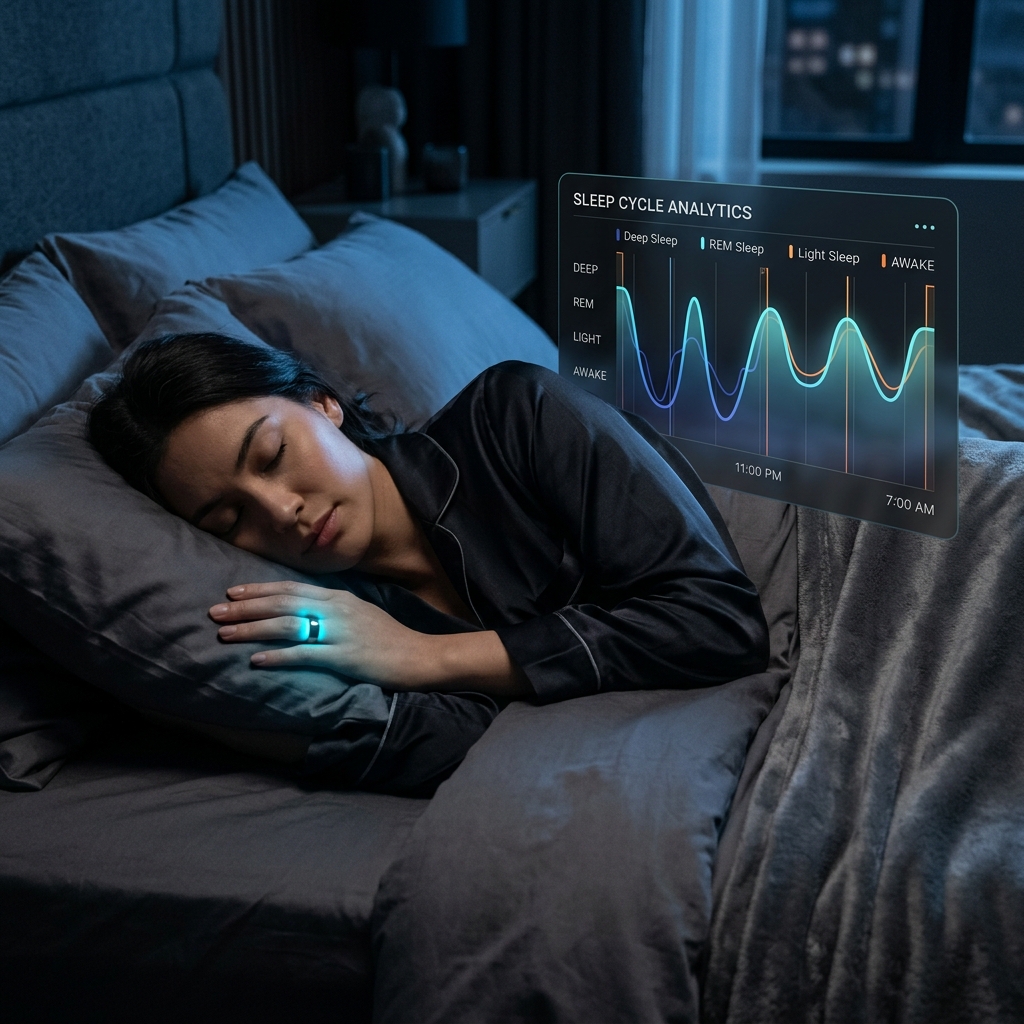
Sleep is when your body builds muscle, clears metabolic waste, consolidates memories, and repairs nervous system damage from training. Yet most athletes wing it — sleeping whenever they get the chance. This guide teaches you the neuroscience of sleep, how to track sleep quality with wearables, and the specific protocols to optimize recovery. The athletes sleeping 7-9 hours of high-quality sleep outpace everyone else by an embarrassing margin.
Sleep Architecture: The 90-Minute Cycles That Drive Recovery
Your sleep isn't uniform. It consists of repeating 90-minute cycles, each containing distinct stages:
The Sleep Cycle (90 minutes)
Stage 1: Light Sleep (N1) — 0-5 minutes
- Transition from wake to sleep
- Brain waves slow; heart rate decreases
- Easy to wake (slight noise disrupts)
- Recovery value: Minimal
Stage 2: Light Sleep (N2) — 5-45 minutes
- Deepest light sleep stage; harder to wake than N1
- Body temperature drops; heart rate continues slowing
- Brain consolidates memories and motor learning
- Recovery value: Moderate (important for skill consolidation in sports)
Stage 3: Deep Sleep (N3, "Slow-Wave Sleep") — 45-70 minutes
- Hardest to wake from (almost impossible with loud noise alone)
- Maximum release of growth hormone (drives muscle repair)
- Parasympathetic nervous system activation (rest and digest mode)
- Glymphatic system activation (brain clears metabolic waste)
- Maximum muscle protein synthesis occurring
- Recovery value: MAXIMUM (this is where the magic happens)
Stage 4: REM Sleep (Rapid Eye Movement) — 70-90 minutes
- Eyes move rapidly under closed eyelids (hence the name)
- Dreams occur (vivid, emotionally intense)
- Mood regulation and emotional processing
- Memory consolidation (learning and cognitive function)
- Hormone production (cortisol begins rising toward wake time)
- Recovery value: High (critical for mood, learning, cognition)
You cycle through this 4-stage sequence 4-6 times per night (hence 7-9 hours of sleep). Each cycle is ~90 minutes.
Sleep Duration: How Much Do You Actually Need?
General recommendations:
- Adults (non-athletes): 7-9 hours nightly
- Athletes in heavy training: 8-10 hours nightly (increased recovery demands)
- Young athletes (under 25): 8-10 hours (still developing nervous systems)
Individual variation is significant. Some people naturally need 8 hours; others thrive on 7. Find your minimum by sleeping naturally (no alarm) for 1 week on vacation. Whatever you average is your baseline need.
The sleep debt concept: If you sleep 6 hours on weekdays (4 hours short of 10-hour need), you accumulate a 20-hour sleep debt by Friday. Sleeping 10 hours over the weekend doesn't fully repay this. Chronic sleep debt (weeks/months of insufficient sleep) impairs recovery, immunity, and performance.
Sleep Quality: Beyond Hours — Tracking What Actually Matters
7 hours of poor sleep isn't equivalent to 7 hours of high-quality sleep. Quality depends on:
1. Sleep Efficiency (% of time asleep in bed)
If you're in bed for 9 hours but only sleep 7.5 hours, your sleep efficiency is 83%. Elite athletes aim for 90%+ efficiency.
Why this matters: Lying awake in bed creates cognitive associations ("bed = wakefulness," which is bad). If you're not falling asleep within 10-15 minutes or waking and not falling back asleep within 20 minutes, get up and do quiet activity in another room until sleepy.
2. Deep Sleep Percentage
Target: 15-20% of total sleep should be deep (N3).
Example: 8 hours total sleep = 120 minutes deep sleep = 2 hours of maximum recovery
If your deep sleep percentage drops below 10%, you're not recovering optimally. Track this with wearables (Oura, Whoop) for 2-4 weeks to establish baseline.
What increases deep sleep:
- Hard physical training (increases deep sleep demand)
- Cool room temperature (60-67°F; anything warmer reduces deep sleep)
- Consistent sleep schedule (same bedtime/wake time trains deeper sleep)
- Magnesium supplementation (200-400 mg before bed)
- Heat exposure 2-4 hours before bed (sauna, hot bath — paradoxically improves sleep via temperature drop afterward)
3. REM Sleep Percentage
Target: 20-25% of total sleep should be REM.
REM sleep is critical for mood, learning (motor skills from training), and hormonal balance. Insufficient REM (below 15%) manifests as:
- Irritability and mood swings
- Poor decision-making
- Difficulty learning new movements (poor skill acquisition)
- Increased appetite (REM deprivation increases hunger hormones)
What increases REM sleep:
- Consistent sleep schedule (REM naturally increases if you sleep longer)
- Adequate total sleep (REM increases in later cycles; 5-hour sleepers miss most REM)
- Avoiding alcohol (alcohol suppresses REM by 20-30%)
The Sleep Tracking Protocol
Wearable Options (Ranked by Accuracy)
1. Oura Ring Gen 3 (Best for sleep data)
- Measures: Deep %, REM %, light %, total duration
- Algorithm validated in clinical studies
- HRV and body temperature tracking adds context
- Cost: $299 + $5.99/month
2. Whoop Band
- Measures: Sleep duration, HRV, recovery score
- Less detailed sleep staging than Oura
- Good for tracking trends over time
- Cost: $239 + $30/month (expensive subscription)
3. Apple Watch with Sleep Focus
- Measures: Duration only (no sleep staging)
- Free (included with watch)
- Better than nothing, but limited data
4. Sleep Lab (Gold Standard but Impractical)
- Polysomnography (gold standard accuracy)
- Measures all stages precisely
- Cost: $3,000-5,000 per night, not practical for regular tracking
Monthly Sleep Analysis Protocol
Week 1: Track every night (establish baseline patterns)
Week 2-4: Implement one sleep optimization protocol (see below), track results
Monthly analysis:
- Average total sleep duration
- Average deep sleep %
- Average REM %
- Sleep efficiency %
- Correlation between sleep and next-day performance (strength, mood, training quality)
Sleep Optimization Protocols: Evidence-Based Interventions
Protocol #1: Temperature Optimization
The science: Core body temperature needs to drop 1-2°F to initiate deep sleep. A cool room facilitates this. A warm room prevents deep sleep.
Implementation:
- Bedroom temperature: 60-67°F (15-19°C, ideally 65°F)
- If you can't control home temperature: use a cooling mattress pad (OOLER, BedJet) or sleep naked with fewer blankets
- Hot bath or sauna 2-4 hours before bed: causes temporary temperature elevation, followed by a drop when you cool off (signals deep sleep time)
Expected improvement: +15-20% increase in deep sleep percentage within 1 week
Protocol #2: Consistent Sleep Schedule
The science: Your circadian rhythm governs sleep-wake cycles. Inconsistent sleep times confuse this rhythm, reducing sleep quality. Consistent timing trains deeper sleep.
Implementation:
- Sleep/wake times within 30-min window daily (even weekends)
- Example: Sleep 10 PM - 6 AM every day (including weekends)
- Takes 5-7 days to adjust; benefits increase after 2 weeks
Expected improvement: +10-15% increase in deep sleep percentage, +20% improvement in falling asleep speed
Protocol #3: Light Exposure Timing
The science: Light exposure tells your brain what time it is. Morning light advances your clock (earlier sleep); evening light delays it (later sleep).
Implementation:
- Morning (7-9 AM): 10-30 min bright sunlight or 10,000 lux light therapy lamp
- Evening (after 8 PM): Blue light blocking glasses or reduce screen brightness
- Night (bedroom): Complete darkness (blackout curtains, eye mask)
Expected improvement: Easier sleep onset, more consolidated sleep (fewer micro-awakenings)
Protocol #4: Magnesium Supplementation
The science: Magnesium activates the parasympathetic nervous system (rest mode) and is required for melatonin synthesis.
Implementation:
- Magnesium Glycinate: 200-400 mg, 30-60 min before bed
- Best form for sleep (glycinate is gentlest on digestion)
- Avoid magnesium oxide (causes laxative effect)
Expected improvement: +10-15% increase in deep sleep, faster sleep onset
Protocol #5: Avoid Alcohol 3-4 Hours Before Sleep
The science: Alcohol suppresses REM sleep by 20-30% and reduces deep sleep.
Implementation: If drinking, finish 3-4 hours before bed. One drink = mild REM suppression; 3+ drinks = severe disruption.
Expected improvement: +20-30% increase in REM sleep percentage, better mood next day
The Sleep Debt Calculation
If you need 9 hours but sleep 6 hours:
- Daily sleep debt: 3 hours
- Weekly sleep debt (5 weekdays): 15 hours
- Monthly sleep debt: 60 hours
This translates to 20-24 missed deep sleep cycles per month. At 2 hours deep sleep per full night, you're missing 40-48 hours of deep sleep monthly. This explains why people who "sleep on weekends" still feel fatigued — weekend catch-up doesn't fully compensate for chronic weekday debt.
Sleep Performance Correlation: Measuring the Impact
Track the relationship between sleep and training performance:
- After 9+ hours of sleep: Record your max strength that day (how much weight you lifted for 1 rep)
- After 6-7 hours of sleep: Record your max strength that day
- After 4 weeks of data, calculate the average strength difference
Most athletes find: 9 hours sleep = 5-10% stronger than 6 hours sleep. This is enormous difference from just one night of good sleep. Multiply this across 52 weeks: sleep optimization alone adds 260-520 extra "strong reps" per year (equivalent to 5-10 additional weeks of training).
Common Sleep Mistakes
Mistake #1: Sleeping Too Much on Weekends
Sleeping 12 hours Saturday to "make up for" 6-hour weekday sleep doesn't work. The sleep debt is partially repaid, but your circadian rhythm gets confused (making Monday sleep harder).
Mistake #2: Napping in the Afternoon
Long afternoon naps (30+ minutes) reduce that night's deep sleep. If you must nap, keep it to 15-20 minutes.
Mistake #3: Training Hard Within 3 Hours of Sleep
Training stimulates the nervous system, making sleep harder. Train 6+ hours before bed when possible.
Mistake #4: Caffeine After 2 PM
Caffeine's half-life is 5 hours. 2 PM caffeine = 50% still active at 7 PM = degraded sleep quality.
Advanced Sleep Optimization: Personalized Sleep Genetics
Individual variation in sleep needs is GENETIC. Some people naturally need 8 hours; others genuinely thrive on 7. This is measurable:
Finding your genetic sleep need (n=1 experiment):
- Go on vacation (1 week minimum) with no obligations
- Sleep with NO alarm until you naturally wake
- Track hours for 6 nights (first night often has catch-up sleep, so ignore day 1)
- Your average of nights 2-6 = your genetic sleep need
Research shows this number doesn't change much year-to-year. It's your baseline need. If you're a 7-hour natural sleeper, forcing 9 hours actually degrades performance (oversleep causes grogginess and afternoon fatigue).
However: If you're in heavy training, add 1-2 hours to your baseline need. A 7-hour sleeper in light training might need 8-9 hours during intense strength phases.
Sleep Architecture Troubleshooting: When Something's Wrong
You're getting 8 hours but deep sleep is only 12% (low):
- Check room temperature first: Even 68°F is too warm for some people. Aim for 62-65°F
- Check caffeine timing: If you drank coffee at 1 PM, you have caffeine at 9 PM. Shift caffeine to 9 AM only
- Check sleep consistency: Going to bed 9 PM Mon-Fri but 11 PM weekends disrupts your rhythm. Fix schedule first
- Check alcohol:** Even 2 drinks reduce deep sleep 20-30%. Alcohol appears to help you fall asleep but degrades architecture
You're getting 8 hours and deep sleep looks good (18%), but you still feel tired:
- Check REM sleep percentage: If REM is below 15%, you're not cognitively recovering. Fix: More total sleep duration naturally increases REM in later cycles
- Check for sleep fragmentation: You might be getting 8 hours but with 15+ micro-awakenings. Wearables show this. Fix: Improve sleep efficiency (see protocols above)
- Check stress hormones: High cortisol at bedtime (due to work stress, anxiety) degrades sleep quality even if duration is fine. Fix: Evening breathwork (4-7-8 breathing) or meditation
Research-Backed Sleep Optimization
Key studies on sleep and athletic performance:
- Mah et al. (2011): Stanford study on basketball players — extending sleep from 8 to 10 hours improved shooting accuracy by 9% and sprint speed by 4-5%. Shows direct performance benefit of sleep extension in athletes
- Walker & Stickgold (2006): Nature Reviews Neuroscience — demonstrates deep sleep is required for motor skill consolidation. Athletes learning new movements need deep sleep for gains to "stick"
- Bonnar et al. (2018): Sports Medicine meta-analysis of 154 studies showing sleep deprivation (even 1-2 nights) reduces athletic performance 10-20% across strength, endurance, and skill tasks
Translation: Every night of poor sleep compounds. 1 night of 5-hour sleep = 10% performance drop. Do this 3 nights in a row = cumulative 30% drop by day 3 (not 10%).
Sleep Debt Repayment: Can You "Catch Up"?
Can you sleep 12 hours Saturday to repay weekday debt? Partially, but not completely.
Research shows about 30-40% of sleep debt can be repaid with catch-up sleep. A 20-hour debt accumulated over the week can be reduced to ~12-14 hours with weekend sleep, but you still carry ~6-8 hours of debt into the next week.
Why this matters: The chronic sleep debt athletes carry (sleeping 6-7 hours weekdays, 10 hours weekends) still results in continuous low-level recovery deficit. This explains why weekend sleep feels good but you're still tired Monday morning — you're not fully recovered.
The solution: Better to get 7-8 hours nightly, consistently, than to oscillate between 6-hour weekdays and 10-hour weekends.