💡 Key Takeaways
- A ring infers sleep stages from heart rate, HRV, movement and temperature on your finger - it never reads brain waves, so daytime stage breakdowns are estimates, not lab measurements.
- Across rotating shifts, judge a 7-day rolling average of total sleep and timing, not any single post-night reading; one ugly score after a 12-hour night is noise.
- Treat a rising resting heart rate, a depressed HRV, or a temperature bump as a soft cue to ease training or check for illness - not as a verdict on your worth.
- The ring cannot pay back sleep debt. If your weekly total keeps landing under 7 hours despite effort, that is the signal to act on, not the deep-sleep pie chart.
Here is the question that brings most shift workers to a search bar: 'When do I even read my sleep ring if I sleep at 9am after a night shift?' The honest answer in three sentences: read trends, not single days, because rotating sleep makes every single night noisy. The ring measures your sleep timing and total fairly well whenever you sleep, but its light-deep-REM split is an estimate that wobbles night to night. So the number worth your attention is a rolling weekly average, judged against your own baseline, not against a day-shift colleague's perfect chart.
This matters because your schedule breaks the assumptions these devices ship with. Most rings expect a clock-time night. Yours moves. The good news is that the genuinely useful signals - total sleep, consistency relative to your wake time, resting heart rate and HRV trends - still work when your sleep lands at noon. This guide shows you what the ring actually senses, what to ignore after a brutal rotation, and how to turn the data into one or two real decisions per week.
1. Direct Answer: What the Ring Senses While You Sleep at Noon
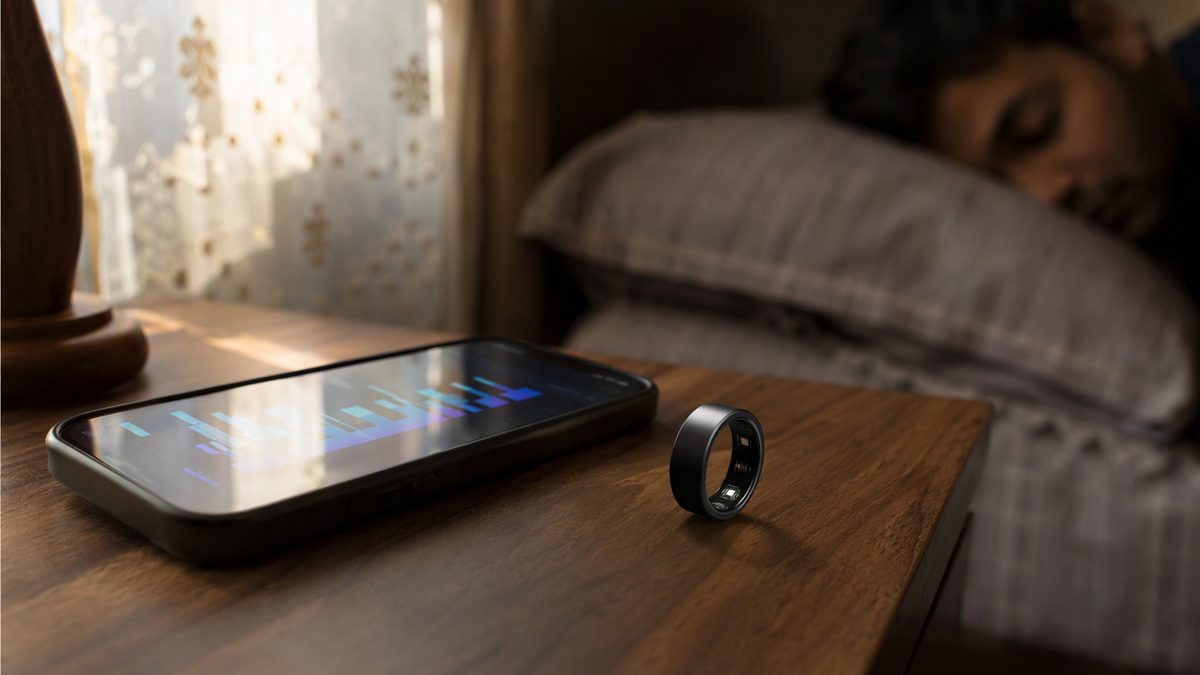
A smart ring does not see your brain. It reads peripheral signals from the dense arteries in your finger: an optical sensor (PPG) tracks heart rate and beat-to-beat variability, an accelerometer logs movement and restlessness, and a temperature sensor records how far your skin runs from your own baseline. An algorithm then guesses which 30-second chunks were wake, light, deep or REM. The lab gold standard, polysomnography, actually wires up brain waves, eye movement and muscle tone - your ring infers from the outside what the lab measures directly.
That distinction sets the ceiling on trust. Rings are generally good at the gross outputs: asleep versus awake, total sleep time, and when you fell asleep - often within roughly 10-20 minutes of a sleep lab on a clean night. They are much weaker at carving up exact stages, and your daytime sleep makes it harder, not easier: bright bedrooms, household noise and a body clock pushing you awake all fragment the architecture the algorithm is trying to score. So when the ring says you got 41 minutes of deep sleep after a night shift, read that as a rough estimate of one variable night, not a fact about your recovery.
2. Building a Baseline Across a Rotating Roster
The whole method depends on a personal baseline, and a rotating roster scrambles the easy version of one. Your resting heart rate, HRV and even your typical sleep duration shift depending on where you are in the cycle - a string of nights pushes resting HR up and HRV down compared with a run of days off. So do not anchor your baseline to a single good week. Let the ring gather two to three weeks across a full rotation, then treat the rolling average as 'normal for me,' knowing it has a wider spread than a 9-to-5 sleeper's would.
From there, anchor judgement to your wake time, not the clock. A ring's 'bedtime consistency' metric will look terrible on rotation; ignore the scolding and instead watch whether your total sleep across each 7-day window holds up. The decision-useful signals are total duration, day-to-day consistency relative to your own pattern, and the resting-HR and HRV trends. If you want the wider picture on choosing and living with these devices, the fitness apps guide is a sensible primer. The single-night stage chart is the part to glance at and move past.
3. The Post-Night Readiness Protocol
The point of the ring for you is not a prettier score; it is one or two honest decisions a week about training and recovery. Use the readiness-style signals as soft cues, cross-checked against how you actually feel. The table below gives concrete thresholds against your own baseline - substitute your measured resting HR and HRV once the ring has a few weeks of your data.
| Signal vs your baseline | What it suggests | Action that week |
|---|---|---|
| Resting HR up 5-10 bpm overnight | Fatigue, alcohol, illness or under-recovery | Swap hard training for easy aerobic; hydrate |
| Overnight HRV down ~15-20% for 2-3 days | Accumulated stress or sleep debt | Cut volume; protect your next sleep block |
| Skin temperature up ~0.3-0.5 C, sustained | Possible incoming illness | Back off training; watch for symptoms |
| 7-day total sleep under 7 hours | Genuine sleep debt building | Prioritise sleep over the next workout |
| All signals near baseline | Recovered enough to push | Proceed with planned harder session |
Read the table as a guide, not a gate. One elevated morning after a single rough night is noise. Two or three days of the same signal pointing the same way is the trend worth acting on. And no readiness number outranks the obvious: if you nodded off on the drive home, the answer is sleep, not a workout.
4. Why Chasing the Score Backfires on Nights
There is a documented trap called orthosomnia - the anxiety that grows from chasing 'perfect' tracker sleep, which then worsens the very sleep you are trying to fix. Shift workers are unusually exposed to it. Your sleep is already fragmented by biology, so the ring hands you imperfect numbers most mornings; if you treat each low score as a personal failure, you stack bedtime anxiety on top of circadian disruption. The irony writes itself: stressing about the data degrades sleep further.
The fix is behavioural. Stop checking the score first thing when you wake; the number sets your mood for no good reason. Look only at the weekly rolling view, where a string of nights and a string of days off average into something readable. If the ring is making your sleep worse rather than better, take it off for a week - the trend will still be there when you return. The device earns its place by nudging habits you control: a consistent wind-down, a darker room, caffeine kept well clear of your sleep window. It loses its place the moment it becomes one more thing stressing you out at 9am.
5. When the Ring Says See Someone
The ring is a screen-and-flag tool, not a diagnosis, and shift work raises the odds on a few things worth flagging. If it repeatedly shows loud snoring with dips in measured oxygen or breathing-disruption flags, paired with crushing daytime sleepiness even after a full off-day sleep, that pattern can point to obstructive sleep apnea - and a clinician, possibly a formal sleep study, is the next step. Rotating schedules also make chronic insufficient sleep common; if your weekly total stays low despite genuinely protecting your sleep block, that deserves a real conversation, not just a better night-time routine.
Escalate too if the ring shows a sustained, unexplained rise in resting heart rate, a lasting drop in HRV, or an irregular-rhythm flag, especially alongside how you feel - the device can raise suspicion of an arrhythmia but cannot confirm one. A fever-pattern temperature rise with other illness signs is another reason to rest and check in. None of this is the ring diagnosing you; it is the ring noticing something your busy schedule might otherwise let you ignore. The drowsy-driving risk after nights is the one that needs no device at all - if you are that tired, do not drive.
Night-Shift Questions About Smart Ring Sleep Data
When do I read my sleep ring if I sleep during the day on night shift?
Read it as a weekly trend, not a morning verdict. Whenever your main sleep happens - 9am, noon, whenever - the ring tracks your total and timing reasonably well, but any single day is noisy on rotation. Glance at the 7-day rolling average of total sleep and your resting-HR and HRV trends a couple of times a week, ideally not the second you wake. That smooths out the chaos of nights versus off-days into something you can actually use.
Do rotating shifts ruin the consistency the ring wants?
They wreck the clock-time consistency metric, yes, so expect that score to look bad and ignore it. The fix is to judge consistency relative to your own pattern and wake time, not a fixed bedtime, and to let the ring gather two to three weeks across a full rotation before you trust your baseline. The genuinely useful signals - total sleep, resting HR, HRV trends - survive a rotating roster fine. The stage pie chart and the bedtime nag do not.
How do I read the data after a 12-hour night shift?
Gently, and as one data point in a trend. After a long night your sleep is fragmented and your resting HR will likely run high, so a low readiness reading is expected, not alarming. Use it as a soft cue: if resting HR is up and HRV is down for two or three days running, ease your training and protect sleep. A single rough post-night score tells you only that you worked a night shift, which you already knew.
Can the ring offset my bad sleep?
No, and any device that implies otherwise is overselling. The ring can show you that bad sleep raised your resting heart rate and dropped your HRV, which genuinely helps you decide to train lighter and prioritise your next sleep block. But it cannot pay back the sleep debt itself - only sleep does that. Treat the data as a guide for adjusting load around your sleep, never as a substitute for the sleep your schedule is already stealing.
Disclaimer: This article is for educational purposes only and is not medical advice. Consult a qualified healthcare professional before starting any supplement, nutrition, or training protocol — especially if you are pregnant or breastfeeding, under 18, taking medication, or managing a health condition.
Scientific References & Clinical Sources
- Peake JM, et al. A Critical Review of Consumer Wearables, Mobile Applications, and Equipment for Providing Biofeedback, Monitoring Stress, and Sleep in Physically Active Populations. Front Physiol, 2018. PMID: 30002629
- Düking P, et al. Criterion-Validity of Commercially Available Physical Activity Tracker to Estimate Step Count, Covered Distance and Energy Expenditure during Sports Conditions. Front Physiol, 2017. PMID: 29018355
- Plews DJ, et al. Training adaptation and heart rate variability in elite endurance athletes: opening the door to effective monitoring. Sports Med, 2013. PMID: 23852425
- Thun E, et al. Sleep, circadian rhythms, and athletic performance. Sleep Med Rev, 2015. PMID: 25553531
- Mercer K, et al. Acceptability and Utility of Wearable Activity Trackers for Health Monitoring Among Older Adults With Chronic Illness: Qualitative Study. JMIR Mhealth Uhealth, 2016. PMID: 27113645

