💡 Key Takeaways
- Expect the ring to read total sleep and timing within roughly 10-20 minutes of a lab on a clean night, but treat its deep and REM minutes as rough estimates that swing nightly.
- Across 9-13 sessions a week, the decision-useful data is the trend: total sleep, overnight HRV and resting HR, not any single-night stage breakdown.
- A resting HR up 5-10 bpm or HRV down for 2-3 days is a soft cue to ease a session - HRV-guided autoregulation has support for push-vs-recover calls.
- The ring tracks recovery, not your swim-bike-run; with the highest training hours of any athlete, your real risk is under-recovery, and the ring is best at flagging it early.
Here is what a triathlete can actually expect to measure with a smart ring, and when. On a normal night, the ring will land your total sleep and bedtime within about 10 to 20 minutes of a sleep lab - reliable enough to trust. Within a week of wear it will establish your personal baselines for overnight resting heart rate and HRV. And across a training block, it will show those trends drift as fatigue accumulates from your 9-to-13 sessions, well before your splits fall apart. That early-warning trend is the real deliverable.
What it will not give you is a precise, trustworthy deep-sleep number each morning - that figure is an estimate built from your pulse and movement, and it swings night to night. You carry the highest weekly training load of any athlete across three sports on one recovery budget, so under-recovery and low-grade under-fueling are your genuine risks. The ring helps by surfacing them in the data early. This guide walks through what you can measure, when, how to act on it, and which numbers to ignore.
1. The Timeline: What You Can Measure and When
Set expectations by what the ring delivers and how fast. Night one, you get a usable total-sleep and sleep-timing figure - the high-signal outputs these devices handle well. Within three to seven nights, it has enough data to set your personal baselines for overnight resting heart rate and HRV, which are the numbers that actually track recovery. The recovery or readiness score appears immediately but only becomes meaningful once that baseline exists, because it is a deviation from your own normal, not an absolute.
Over a two-to-three week training block, the trends earn their keep. As you stack swim, bike and run volume on one recovery budget, you will typically see resting HR creep up and HRV drift down before your power, pace or perceived effort tell you the same thing - the data leads the symptoms. That is the early-warning value. By contrast, the deep and REM minute totals do not trend cleanly; they wobble night to night regardless of how you feel, because peripheral-signal staging is the hardest thing the device does. So front your attention on total sleep, resting HR and HRV, and let the stage chart be the thing you glance at last.
2. What the Sensors See on a Triathlete's Finger
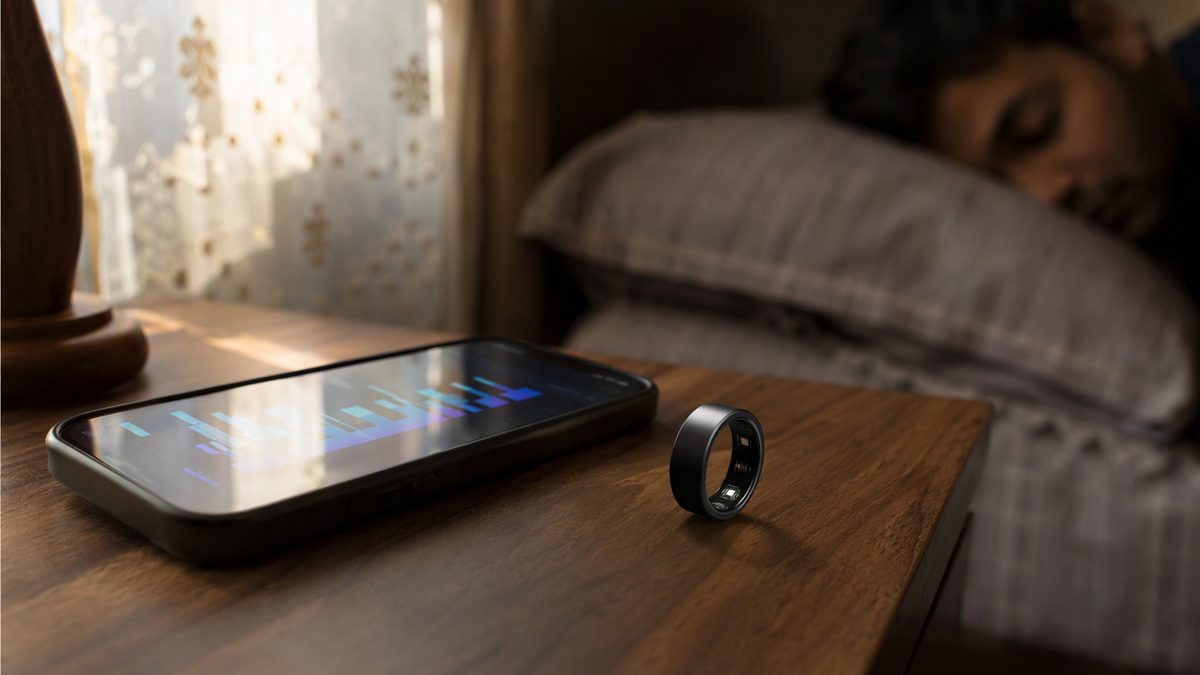
Understanding the inputs tells you which outputs to trust. A smart ring reads peripheral signals from the dense arteries in your finger: an optical PPG sensor for heart rate and beat-to-beat HRV, an accelerometer for movement and restlessness, and a temperature sensor reading deviation from your own baseline. From these it derives resting heart rate, overnight HRV, breathing rate, and - via algorithm - the estimated sleep stages and recovery score. It never records brain activity, which is what a sleep lab uses to score true stages, so the staging is inference, not measurement.
This is why some outputs deserve trust and others do not. Strong, decision-useful signals: total sleep duration, consistency, overnight resting HR, and HRV - the last is a well-supported personal recovery marker that drops with stress, illness, alcohol or training overload. Weak, noisy outputs: the exact light-deep-REM split, which can be off by tens of minutes and differs between brands, so never compare your stage percentages to a training partner on another ring. For a triathlete the implication is clean: build your training decisions on the HRV and resting-HR trends, treat the score as a deviation flag, and ignore the single-night stage breakdown. The wider context on choosing and trusting these devices sits in the fitness apps guide.
3. Acting on the Data Through Doubles and Bricks
The point of the ring is autoregulation - using the morning signals to decide whether today is a push or a recover, which has research support for endurance training. Anchor every threshold to your own baseline once the ring has captured a couple of weeks of your normal training. The table gives concrete cues; substitute your measured numbers.
| Morning signal vs baseline | What it suggests | Session adjustment |
|---|---|---|
| Resting HR up 5-10 bpm overnight | Fatigue, alcohol, illness or under-recovery | Swap quality work for easy aerobic volume |
| HRV down ~15-20% for 2-3 days | Accumulated training stress or sleep debt | Cut a double; protect tonight's sleep |
| After a long brick or big weekend | RHR up, HRV down for a day - expected | One easy day, then reassess the trend |
| 7-day total sleep under 7 hours | Sleep debt building on high volume | Prioritise sleep; shift an early session later |
| Temperature up ~0.3-0.5 C, sustained | Possible incoming illness | Back off hard work; watch for symptoms |
Read the table as a guide, not a gate. A single elevated morning after a big brick session is expected and means little. Two or three days of the same signal pointing the same way is the trend that justifies cutting a double or adding a recovery day. With your volume, the cost of ignoring a genuine downward trend is an injury or a stalled block - the ring's job is to catch it before that happens.
4. Energy Availability and the Numbers That Hide It
Your highest-volume blocks carry a quiet risk: chronic low-grade under-fueling across three sports, where you simply do not eat enough to cover the work. The ring will not measure energy availability directly, but the trends it tracks can hint at it. Persistently elevated resting heart rate, a flat or depressed HRV that will not recover despite easy days, and consistently poor sleep can all accompany under-recovery driven by under-eating, not just by training load. If the data stays gloomy while your fueling is thin, food is the first variable to fix - not more rest.
This matters because the obvious move when the numbers look bad is to train less, and sometimes the real problem is eating too little for the hours you are putting in. Use the ring as one input alongside body weight trend, hunger, mood, and how your sessions feel. If resting HR stays high and HRV stays suppressed across a fueling-up week, that is a sign your recovery problem is at the kitchen table, not in your training plan. The device closes the loop best when you let it test real changes - add carbohydrate and total calories, then watch whether the recovery signals lift over the following week.
5. When the Ring Flags Something Bigger
The ring screens and flags; it does not diagnose. A few patterns warrant a clinician. If it repeatedly shows loud snoring with measured oxygen dips or breathing-disruption flags, plus daytime sleepiness that survives a full night, that can point to obstructive sleep apnea, and a doctor - possibly a sleep study - is the next step. Chronic insufficient sleep despite genuinely good habits, or persistent excessive daytime sleepiness across a block, also deserves a real conversation rather than another taper tweak.
Flag a sustained, unexplained rise in resting heart rate, a lasting drop in HRV, or an irregular-rhythm alert too - endurance athletes are not immune to arrhythmias, and the ring can raise suspicion without confirming one. A fever-pattern temperature rise with other illness signs means rest, not a session. The line to hold is this: high-volume training produces a lot of normal fatigue that shows up in the data, and most rough mornings are just that. The skill is separating routine training stress from the rarer pattern where the numbers and how you feel both say something is wrong - and that pattern is the one worth taking to a professional, not pushing through.
Multisport Questions About Smart Ring Sleep Data
Which recovery signal should I actually watch across three sports?
Overnight HRV and resting heart rate trends, read against your own baseline, plus total sleep. Those are the well-supported, decision-useful numbers - HRV-guided autoregulation has research behind it for deciding push-versus-recover days. Watch them over rolling days, not single mornings. The deep and REM stage minutes are the least reliable output and swing night to night, so do not build training decisions on them. For a triathlete, the resting-HR and HRV trend is the early-warning system; the stage chart is noise.
How do I read the ring across doubles and brick days?
Expect a hit the morning after big sessions - resting HR up, HRV down - and treat one such day as normal, not alarming. The signal is the multi-day trend: if resting HR stays elevated and HRV stays suppressed for two or three days, ease a double or add a recovery day. A single rough reading after a long brick just confirms you did a hard session. Anchor everything to your baseline and let the rolling trend, not one morning, drive the call.
What's the race-week and Ironman protocol for reading the ring?
In race week you want to see resting HR settling and HRV rising toward baseline as the taper unloads you - that is the sign you are absorbing the work. Prioritise sleep and watch the trend climb. Do not chase a perfect score the night before a race; pre-race nerves often dent sleep and the readiness number, and that single night means little. Trust your training, sleep as much as you can, and read the week's trend rather than race-eve's chart.
Will the ring tell me if I'm under-fueling on big weeks?
Not directly, but it can hint. Chronic under-eating across high volume shows up as a resting HR that stays elevated and an HRV that will not recover despite easy days. If the data stays gloomy while your fueling is thin, food is the first thing to fix, not more rest. Test it: add carbohydrate and total calories for a week and watch whether the recovery signals lift. Use the ring alongside body-weight trend, hunger and session feel, not in isolation.
Disclaimer: This article is for educational purposes only and is not medical advice. Consult a qualified healthcare professional before starting any supplement, nutrition, or training protocol — especially if you are pregnant or breastfeeding, under 18, taking medication, or managing a health condition.
Scientific References & Clinical Sources
- Peake JM, et al. A Critical Review of Consumer Wearables, Mobile Applications, and Equipment for Providing Biofeedback, Monitoring Stress, and Sleep in Physically Active Populations. Front Physiol, 2018. PMID: 30002629
- Plews DJ, et al. Training adaptation and heart rate variability in elite endurance athletes: opening the door to effective monitoring. Sports Med, 2013. PMID: 23852425
- Kiviniemi AM, et al. Daily exercise prescription on the basis of HR variability among men and women. Int J Sports Med, 2007. PMID: 17345075
- Halson SL. Sleep in elite athletes and nutritional interventions to enhance sleep. Sports Med, 2014. PMID: 24791913
- Fullagar HH, et al. Sleep and athletic performance: the effects of sleep loss on exercise performance. Sports Med, 2015. PMID: 25315456

