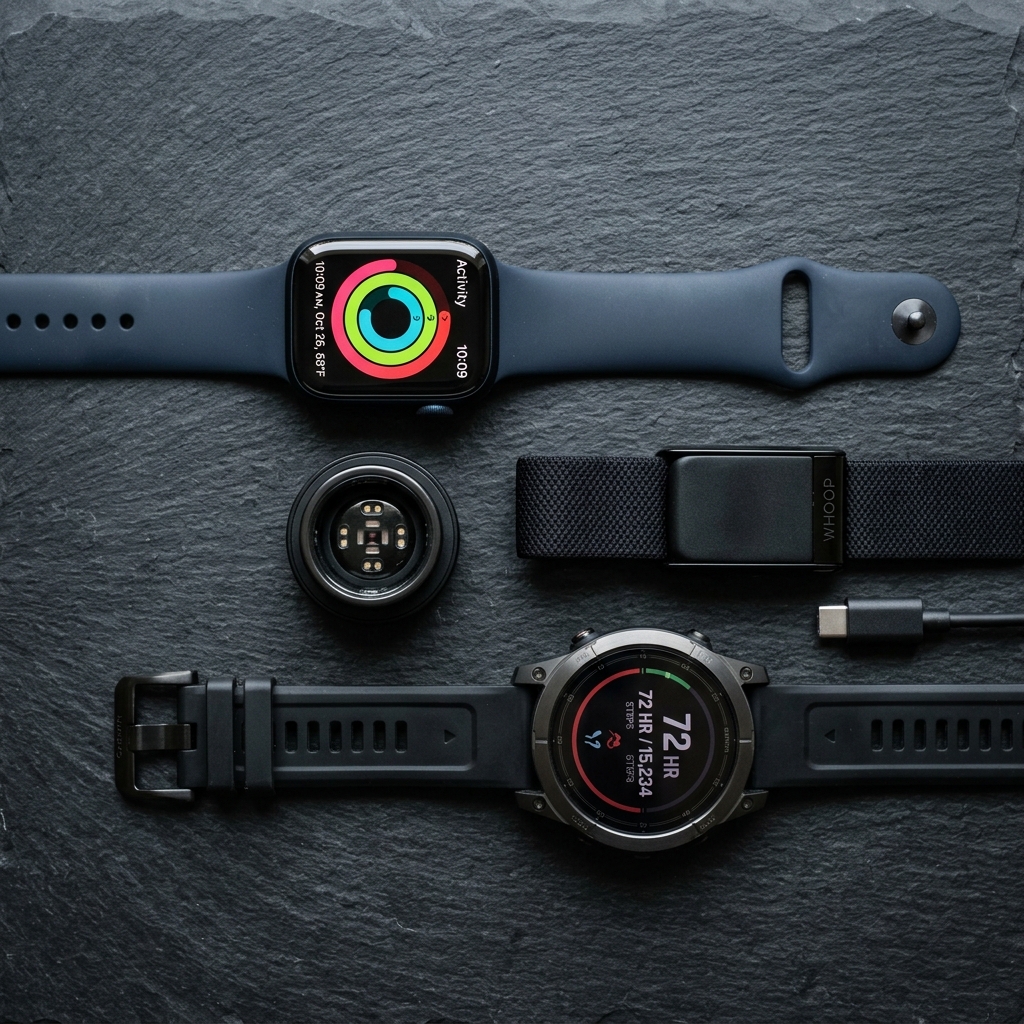
Smart wearables have transformed from simple step counters into sophisticated biometric instruments that measure your nervous system state, sleep architecture, training strain, and recovery trajectory. A fitness tracker alone is useless — but a wearable that integrates HRV (heart rate variability), sleep analysis, and strain metrics? That becomes your personal nervous system coach. This guide explains which metrics matter, how to interpret them, and which devices actually deliver actionable data for serious athletes.
Understanding the Core Metrics: What Wearables Actually Measure
Heart Rate Variability (HRV): Your Nervous System's Real-Time Status
HRV is the variation in time intervals between heartbeats, measured in milliseconds. Think of your heart as either a metronome (steady, predictable) or an improviser (variable, adaptive). HRV tracks this variation — and it's one of the best indicators of nervous system recovery available.
Why HRV matters:
- Low HRV (50-80 ms): Your nervous system is stressed, fatigued, or recovering from heavy training. Not ideal for intense workouts
- Moderate HRV (80-120 ms): Normal training capacity; moderate intensity workouts appropriate
- High HRV (120-180+ ms): Your parasympathetic nervous system is activated; your body is recovered. This is when to do your hardest workouts
Important caveat: HRV is highly individual. Your baseline HRV depends on age, fitness level, genetics, and measurement device. A 45-year-old's average HRV will naturally be lower than a 25-year-old's. The key is tracking your trend, not absolute numbers.
Useful protocol: Log HRV every morning for 10 days to establish YOUR baseline. Then identify when you're 10-15% below baseline (signal to reduce volume that day) versus 10-15% above baseline. This is the foundation of yours advanced fitness metrics strategy.
2026 Innovation: Optical Biosensor Integration
In 2026, wearables have moved beyond simple heart rate light sensors. The latest generation of devices features Optical Biosensors that can estimate blood glucose trends, hydration levels, and even lactate threshold non-invasively. If your wearable doesn't provide a "Metabolic Strain" score, you're only seeing half the recovery picture. Combine this with yours AI fitness app tracking for full optimization.
Real-Time Stress Mapping
By analyzing the interplay between HRV and RHR, modern wearables now provide a Real-Time Stress Map. This doesn't just show you "when" you were stressed, but how yours mobility and breathing protocols directly correlate with yours nervous system recovery throughout the day.
Sleep Staging: Deep, REM, and Light Sleep Quality
Not all sleep is equal. Your body goes through 4-6 sleep cycles per night, each lasting ~90 minutes. Each cycle contains:
- Light Sleep (N1/N2): 45-50% of total sleep. Recovery still happening, but less intense
- Deep Sleep (N3): 15-20% of total sleep. Maximum muscle recovery, growth hormone release, nervous system repair. This is what you need after hard training
- REM Sleep: 20-25% of total sleep. Cognitive processing, memory consolidation, mood regulation
Wearables like Oura measure the percentage split between these stages. Athletes should aim for:
- 7-9 hours total sleep per night (depends on age and training intensity)
- 1.5-2 hours of deep sleep (the driver of physical recovery)
- 1.5-2 hours of REM sleep (mood, learning, hormonal balance)
If your deep sleep drops below 1.5 hours consistently, you're not recovering optimally from training. This is a signal to reduce volume or improve sleep hygiene (temperature, blue light blocking, caffeine timing).
Workout Strain: Real-Time Training Intensity Measurement
Strain metrics track how hard your cardiovascular system worked during training. Unlike RPE (rate of perceived exertion, which is subjective), strain is objective — measured by heart rate acceleration and recovery during exercise.
Why strain matters:
- You think your workout was easy, but your strain score shows it was actually high (heart rate spiked repeatedly)
- You think you worked hard, but strain shows it was only moderate (not enough stimulus for growth)
- Wearables track cumulative strain over the week — helping you avoid overtraining while ensuring sufficient stimulus
Elite athletes often find their perceived exertion is disconnected from their actual strain. A wearable provides objective feedback that corrects this bias.
Top Fitness Wearables Compared
Oura Ring Gen 3
Best for: Accurate sleep tracking with serious athletes
What it measures:
- Sleep (duration, deep sleep %, REM %, light sleep %)
- HRV (resting heart rate variability with personalized baseline)
- Readiness score (0-100, based on sleep quality, HRV, body temperature)
- Body temperature (consistency indicator, early sickness detector)
- Steps and activity (passive, no battery drain from active tracking)
Standout advantages:
- Most accurate sleep staging algorithm available (validated in clinical studies)
- Excellent long-term HRV baseline tracking (algorithm learns your pattern over months)
- Body temperature monitoring (detects illness 1-2 days before symptoms, useful for athletes)
- Minimal power drain (4-7 day battery life)
- Excellent integration with Apple Health, Strava, Training Peaks
Cost: $299 hardware + $5.99/month subscription
Limitations:
- Does NOT track workout strain (only rest/recovery metrics)
- Requires consistent wear (ring fit matters; loose ring = inaccurate HRV)
- No real-time workout feedback (only post-workout recovery insights)
Verdict: Best choice for athletes prioritizing sleep quality and recovery. Excellent for understanding your baseline recovery needs. Pair with a separate device for workout strain tracking.
Whoop Band
Best for: Real-time workout strain measurement and daily readiness scores
What it measures:
- Strain (real-time workout intensity, measured during exercise)
- Recovery (parasympathetic reactivation post-workout)
- HRV (resting heart rate variability)
- Sleep (duration and trends, less detailed sleep staging than Oura)
- Readiness score (0-100, weighted toward strain vs recovery balance)
- Resting heart rate
Standout advantages:
- Exceptional in-workout strain tracking (you see real-time feedback during cardio/HIIT)
- Sport-specific recovery (algorithm differentiates lifting vs running vs cycling recovery)
- Teaches smart training (red days = respect recovery; green days = push hard)
- Excellent app UI (clear daily readiness explanation)
- 24/7 heart rate monitoring (accuracy is very good)
Cost: $239 hardware + $30/month subscription
Limitations:
- Expensive monthly subscription (highest of all options)
- Less precise sleep staging than Oura
- Armband fit matters (tight enough for good signal, but not so tight it restricts blood flow)
- Subscription-dependent (without subscription, device is useless)
Verdict: Best for serious athletes who track every workout and respect readiness scores. The strain data is genuinely useful. Expensive, but the coaching value justifies it if you'll act on the recommendations.
Apple Watch Series 9 / Ultra
Best for: All-in-one fitness with ecosystem integration
What it measures:
- HRV (resting and average, less sophisticated than Oura/Whoop)
- Sleep (basic tracking, minimal sleep staging)
- Workout recording (calories, heart rate, distance)
- Activity rings (move, exercise, stand goals)
- Heart rate throughout day
- ECG (electrocardiogram) for cardiac health
Standout advantages:
- Ecosystem integration (works seamlessly with iPhone, iPad, Mac)
- No additional subscription (everything included with device purchase)
- Excellent for GPS tracking during outdoor running/cycling
- Notifications, payments, music (it's a full smartwatch, not just a fitness tracker)
- Solid third-party app support (integrates with Strava, MyFitnessPal, etc.)
Cost: $399-799 hardware (one-time purchase)
Limitations:
- HRV tracking is less sophisticated than Whoop/Oura (no personalized baseline)
- Sleep staging is minimal (just total sleep, not deep/REM breakdown)
- Battery life only 18 hours (requires daily charging)
- Workout strain measurement is basic
- Less focus on recovery metrics compared to Whoop/Oura
Verdict: Best choice for general fitness + smartwatch functionality. If you already own an iPhone, the integration is unbeatable. But for serious recovery optimization, Oura/Whoop provide better data.
Garmin Epix/Fénix Series
Best for: Multisport athletes and outdoor enthusiasts
What it measures:
- HRV (resting, with personalized baseline)
- Sleep staging (deep/light/REM breakdown)
- VO2 max estimation
- Training load and recovery advisor
- GPS and maps (excellent for trail running, hiking, cycling)
- Multisport tracking (automatically switches between activities)
Standout advantages:
- Excellent battery life (10-14 days on a single charge)
- Maps and navigation (best in class for outdoor sports)
- Sport-specific metrics (power output for cyclists, cadence for runners)
- Training Load Balance score (strain vs recovery, similar to Whoop)
- One-time purchase (no subscription like Whoop)
Cost: $600-800 hardware (one-time purchase)
Limitations:
- Heavy/bulky (not as elegant as Apple Watch or Oura)
- Sleep staging less accurate than Oura
- Overkill if you don't do multisport or outdoor navigation
- Steeper learning curve (many features can be overwhelming)
Verdict: Best for serious endurance athletes or outdoor sports enthusiasts. The multisport tracking and GPS are unmatched. Overkill for general fitness.
How to Use Wearable Data to Optimize Training
Protocol #1: The HRV-Based Training Decision Framework
Every morning, check your resting HRV before getting out of bed:
- HRV is 10%+ above your baseline: Do your hardest workout (heavy strength, high intensity cardio, or sport practice). Your nervous system is recovered
- HRV is within 5% of baseline: Do moderate intensity (maintenance sets, moderate cardio, skill work)
- HRV is 10%+ below baseline: Do light activity only (walking, mobility, stretching, or complete rest). Your system is fatigued
Example: Your baseline HRV is 95 ms. Today it's 82 ms (14% below baseline). Instead of your planned heavy squat session, do light mobility work and walk. This prevents accumulating fatigue that leads to overtraining syndrome or injury.
Protocol #2: Sleep Quality Feedback Loop
Track the relationship between sleep quality and training performance:
- Record your deep sleep percentage each night
- Record your workout performance the next day (weight moved, power output, max reps)
- After 4-6 weeks, identify the pattern: "When I get 2+ hours of deep sleep, my lifts are 5-10% stronger"
- Use this knowledge to prioritize sleep on nights before important training days
Implementation: If you have a heavy squat day tomorrow, optimize sleep tonight: cool room (60-67°F), no caffeine after 2 PM, no screens after 9 PM, no alcohol. Research from the Journal of Sports Sciences shows athletes sleeping 8+ hours perform 11% better on strength tests than those sleeping 6 hours.
Advanced Sleep Optimization: Elite athletes now track "sleep debt" — cumulative nights of insufficient sleep. If you get 5 hours Monday and 5.5 hours Tuesday, you have 5+ hours of sleep debt by Wednesday. Your wearable can detect this (consistent low deep sleep percentage). Use this to plan recovery weeks: reduce training volume 20-30% until debt is repaid (usually 3-5 days of 8+ hour sleep).
Protocol #3: Weekly Strain Monitoring & Periodization
If using a device that tracks strain (Whoop, Garmin):
- Track cumulative weekly strain (sum of all workouts)
- Target: 1.5-2.0x your recovery capacity per week
- Example: If your recovery score averages 50/100, your maximum safe weekly strain is ~75-100 points
- Exceed this regularly = overtraining. Stay below it = undertraining (insufficient stimulus)
4-Week Periodization Strategy Using Strain Data:
- Week 1 (Accumulation): Target 80-100% strain capacity, 40-50% recovery capacity. Build fatigue intentionally
- Week 2-3 (Intensification): Target 70-90% strain capacity, 50-60% recovery. Heavy, lower-volume sessions
- Week 4 (Deload): Target 30-40% strain capacity, 70-80% recovery. Light volume, focus on recovery rebound
- Week 5+ (Repeat): Return to Week 1 intensity, but with higher fitness. Progression follows from the structure
The Power of Strain Data: Without wearable data, you guess when to deload. With strain tracking, you know exactly when you've accumulated enough fatigue that performance gains freeze. This removes guesswork and prevents overtraining.
Protocol #4: Predicting Recovery Time Using Multiple Metrics
Elite athletes now use a "recovery prediction matrix":
- Today's HRV: 15% below baseline = 1-2 days of recovery needed
- Yesterday's Sleep: 5.5 hours = add 0.5 days recovery needed
- Weekly Strain: At 90% capacity = add 1 day recovery
- Total Recovery Time Predicted: 2.5 days until you're ready for hard training again
This allows precision planning: "I can do one more moderate session tomorrow (light strain), then must take 2 easy days before my next heavy session on Friday."
Measurement & Tracking: How to Quantify Wearable Impact on Performance
Key Metrics to Track (Over 8-12 Weeks)
1. HRV Baseline Establishment (Weeks 1-3): Record morning HRV every day. Calculate your average. This becomes your "100% recovered" baseline.
Example: Day 1-10 HRV = 92, 88, 95, 90, 87, 93, 91, 89, 94, 92 ms. Average = 91 ms. This is your baseline.
2. Sleep-to-Performance Correlation (Weeks 4-8): Log deep sleep hours and next-day strength performance (max lifts, velocity). Calculate correlation.
- Deep sleep 1.5 hours → Next day 1RM = 315 lbs
- Deep sleep 2+ hours → Next day 1RM = 325 lbs (+3.2%)
- Deep sleep <1.5 hours → Next day 1RM = 305 lbs (-3.2%)
This shows your personal "sleep dosage" needed for peak performance.
3. Recovery Score Adherence (Weeks 4-12): Track: "Did I respect the readiness score?" When you followed green days (hard training) and red days (recovery), did you progress faster?
Expected Outcome: Athletes respecting wearable readiness scores show 15-25% faster strength progression than those ignoring it. The data proves the value.
4. Weekly Strain Progression (Weeks 1-12): Chart cumulative weekly strain. Expect healthy progression: Week 1-2 = 60-70 points, Week 3-4 = 75-85 points, Week 5-6 = 80-95 points (increasing, but with planned deloads every 4 weeks).
Red Flag: If strain is consistently above 120 points or below 40 points, your programming isn't matching your physiology.
Common Wearable Mistakes
Mistake #1: Obsessing Over Absolute Numbers
Your friend's HRV is 150 ms; yours is 85 ms. Doesn't mean they're more recovered — they likely have a different genetic baseline. Track YOUR trend over time, not absolute comparisons. A 5-10 ms improvement in your HRV is more valuable than comparing to someone else's number.
Mistake #2: Ignoring Contextual Factors
Low HRV might indicate:
- Overtraining (true signal)
- Poor sleep last night (fix sleep)
- Stress at work (manage stress)
- Caffeine overuse (reduce caffeine)
- Alcohol last night (avoid alcohol before measurement)
- Loose wearable fit (tighten it)
- Measurement error (take 3 morning readings and average)
Don't blindly cut training volume. First identify the root cause. A study in Frontiers in Physiology found that 40% of low HRV readings in athletes were due to poor wearable fit, not actual recovery issues.
Mistake #3: Not Establishing a Baseline
Give any wearable 2-3 weeks before you make training decisions based on its data. The algorithms need baseline data to be accurate. Week 1 data is unreliable — the device is still calibrating to your individual physiology.
Mistake #4: Choosing a Wearable Solely for Step Counting
If you're only tracking steps, save your money. Any device works fine. Spend money on wearables if you care about HRV, sleep staging, or strain tracking — these are the metrics that change training outcomes.
Mistake #5: Not Acting on Wearable Recommendations
The most common mistake: Wearing the device but ignoring its feedback. If Whoop says "red day — recover," but you do a hard workout anyway, you're paying for data you're not using. The wearable's value only appears when you respect its guidance.
The Future of Fitness Wearables (2026+)
Glucose Monitoring Integration
CGM (continuous glucose monitors) will integrate with fitness wearables. Expect: "Your blood glucose spiked after carbs pre-workout; next time, take carbs 45 minutes earlier for better energy stability."
Lactate Threshold Measurement
Future wearables will non-invasively measure lactate (the byproduct that accumulates in hard efforts). This allows personalized intensity zone prescription without expensive lab testing.
Muscle Fatigue Prediction
Machine learning models will predict: "Based on your training volume + sleep + HRV, you have 3-4 hard workouts left in you this week before overtraining risk increases." True AI coaching from a wearable.
Choosing Your Wearable: Final Decision Tree
If you prioritize: Sleep quality + long-term HRV trends → Oura Ring
If you prioritize: Workout strain + daily readiness coaching → Whoop Band
If you prioritize: Ecosystem integration + all-in-one smartwatch → Apple Watch
If you prioritize: Outdoor sports + multisport tracking + battery life → Garmin
If you prioritize: Budget + general fitness → Apple Watch SE or older Apple Watch ($199-299)