💡 Key Takeaways
- Run one default rule, same dose, same slot, anywhere, so the stepmill survives airports and 6 a.m. calls without a daily decision.
- Intervals buy time: 20 minutes of hard-easy climbing delivers fat loss comparable to a longer steady session when effort matches, ideal for a packed calendar.
- Fat loss is a diet-led deficit; the machine widens it but cannot out-run client dinners and alcohol, and the console's calorie count over-states your burn.
- Protect muscle with 1.6 to 2.2 g/kg protein and two lifts a week, and treat sleep, not a bigger climb, as the metric your wearable should flag.
It is 6:10 a.m. in a hotel you will forget by Thursday. You have 25 minutes before the first call, a body fighting timezone lag, and last night's client dinner still on board. The question is not which elaborate program is optimal; it is what you can do, right now, in this gym, that actually moves fat loss without another decision to make. That is the only useful frame for an executive, and the stair climber answers it well.
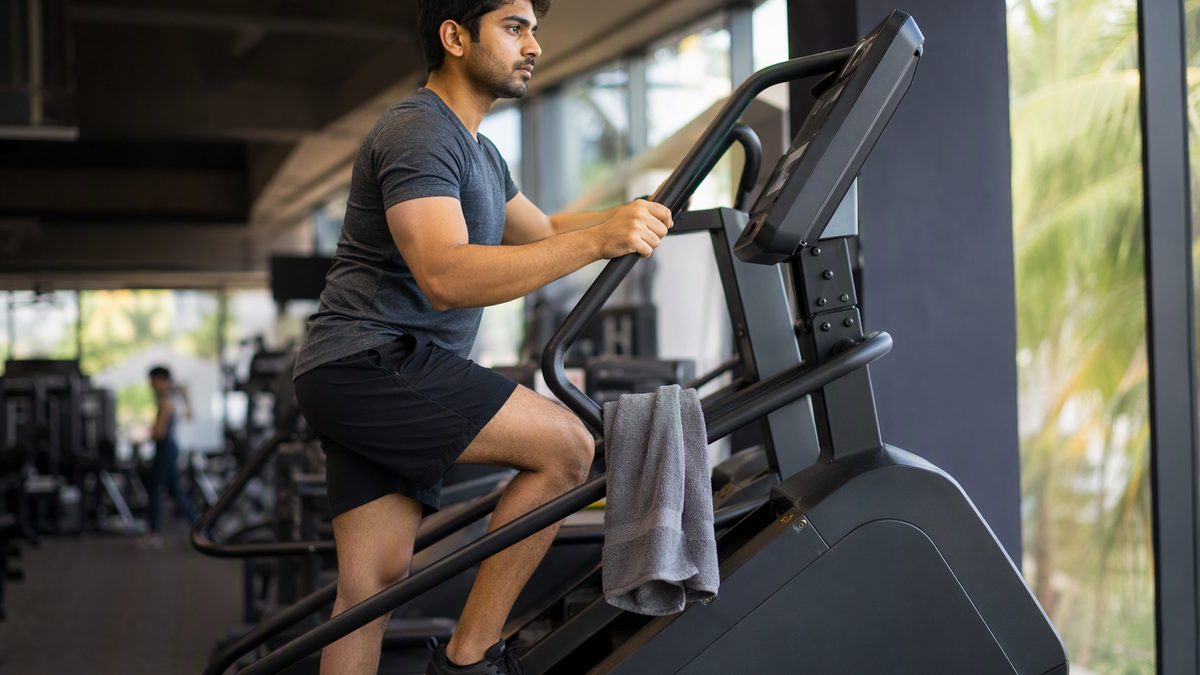
The stepmill is in nearly every hotel gym, it needs no skill, and it delivers a strong metabolic hit per minute because you are lifting your bodyweight uphill against gravity. Set up as a single default rule, it survives the chaos of your week far better than a plan that assumes you control your schedule.
Below: where a 20 to 30 minute climb slots into a travel day, the exact protocol, the honest math on why diet still drives the result, and how to keep this from costing you muscle or sleep.
1. Slotting the Climb Into a Travel Day
Your schedule is unpredictable, so the protocol cannot be. The fix is a default: same dose, same slot, anywhere. For most executives the morning, before email and meetings claim the day, is the only slot the calendar cannot steal, so anchor the climb there. Twenty to thirty minutes on the stepmill in the hotel gym, done before the first call, beats a perfect 60-minute session you will skip when the day runs long.
Build the rule so it survives the failure modes of your week. Landed late and exhausted? The default downgrades to an easy 20-minute zone-2 climb, no intervals, just movement and a clear head. Fresh and on home turf? The same slot holds an interval session. The point is that you never negotiate with yourself at 6 a.m.; the decision was made once. All-or-nothing thinking, the perfect week or nothing, is the executive's classic failure, so design the default to bend rather than break. A 20-minute climb on a brutal travel day keeps the streak alive, and the streak is what produces results over a quarter.
2. The Minimum-Effective Stepmill Protocol
Because your time is the scarce resource, lean on intervals when you are fresh: hard-then-easy climbing raises fitness and burns calories in less time, and for fat loss it produces results broadly comparable to longer steady sessions when total effort matches. On depleted travel days, default to easy zone 2, which is gentler to recover from when sleep is already short. Anchor effort with the talk test rather than the machine's level number: zone 2 lets you speak in sentences, hard intervals leave you only a few words.
| Day type | Protocol | Intensity and time |
|---|---|---|
| Fresh, on schedule | Intervals: 1 min hard / 2 min easy x 6 | Hard at 80-90% max HR (RPE 8), 18-20 min total |
| Time-crunched | Intervals: 30 s hard / 60 s easy x 10 | RPE 8-9 on work, ~15 min, finish on a brutal day |
| Travel-lagged / poor sleep | Steady zone-2 climb | 60-70% max HR, conversational, 20-30 min |
| Recovery / between hard days | Easy steady climb | RPE 3-4, 20 min, active recovery |
Keep the hard sessions on non-consecutive days, two a week is plenty, with the rest of your climbing easy. That mostly-easy, occasionally-hard split is what the endurance literature recommends and what your recovery budget can actually afford given the cortisol load of your travel and decision fatigue. One default rule, four simple variants, no daily deliberation.
3. The Honest Math on Diet, Alcohol and the Deficit
Here is the part that protects you from wasted effort. Fat loss is driven by a sustained calorie deficit, and you create most of that deficit through what you eat, not through the climber. The machine widens the deficit and builds fitness, but it cannot out-run a client dinner and a few glasses of wine, which can erase a morning's work in an hour. Two realities sharpen this. The stepmill's calorie counter is a generic estimate that over-states your burn, and your body partly compensates for exercise with a bigger appetite, so an aggressive climb can quietly drive you to eat more later.
The executive-grade move is to win the deficit at the table. Hold the line at business dinners, skipping meals all day then over-eating late is a trap, manage alcohol deliberately, and let the climb add to a deficit the diet already created. Keep the rate of loss moderate, roughly half to one percent of bodyweight weekly, so you protect muscle and strength while traveling. And track trends, waist and bodyweight over weeks, not the calorie figure flashing on the console after each session.
4. Protecting Muscle and Sleep Under Pressure
Two things quietly sabotage an executive cut: lost muscle and lost sleep. Cardio in a deficit, with nothing else, sheds muscle alongside fat, which is the opposite of the lean, capable physique you want. The defense is simple and portable. Keep protein near 1.6 to 2.2 grams per kilogram of bodyweight daily, even on the road, and add two short resistance sessions a week using the hotel gym's dumbbells or your home rack. Lifting through the deficit is the main lever that tells your body to keep muscle while the climbing and diet strip fat. Keep your hardest climbing on different days from priority lifting so the two do not blunt each other.
Sleep is the other one. Stacking stimulants over chronic sleep debt to power through a 6 a.m. climb is a losing trade; under-slept, your appetite, recovery and decision-making all degrade. Let your wearable's sleep and recovery score, not a bigger climb, be the single metric you watch, and on genuinely wrecked nights take the easy zone-2 default instead of intervals. Your annual executive physical is a natural checkpoint to confirm the cardiovascular gains are showing up where they count. If you want the default rules to run themselves across timezones, pairing the climb with one of the better fitness apps keeps the plan on autopilot.
Stair Climber FAQs for Time-Pressed Executives
What is the minimum effective stair climber routine when I travel?
Twenty to thirty minutes on the stepmill, done before your first call. When you are fresh, use intervals such as 1 minute hard and 2 minutes easy for six rounds, roughly 18 minutes, which for fat loss is broadly comparable to a longer steady session when effort matches. On travel-lagged days, default to an easy 20-minute zone-2 climb. The point is a single rule, same dose, same slot, anywhere, so you never have to decide in the moment.
Does alcohol at client dinners ruin this?
It can undo the deficit, which is what actually drives fat loss. The climber widens the deficit, but it cannot out-run a few drinks and a heavy meal, and the machine's calorie count over-states what you burned anyway. So win the deficit at the table: manage portions and alcohol deliberately, and avoid skipping meals all day then over-eating late at night. The morning climb adds to a deficit your diet creates; it cannot rescue one the dinner erased.
Can I keep this up across time zones?
Yes, because the protocol is built as a default, not a fixed clock time. Anchor the climb to the first quiet slot of your day, usually morning, and let the dose flex: intervals when you are fresh, an easy zone-2 climb when you are lagged or under-slept. That bend-don't-break design is exactly what survives jet lag and 60-hour weeks. Keep hard sessions on non-consecutive days and treat genuinely wrecked nights as a reason to go easy, not skip.
What single metric should I watch?
Sleep and recovery, not the machine's calorie number. Your wearable's sleep and recovery score tells you whether to run intervals or default to an easy climb, and chronic sleep debt undermines fat loss, appetite control and judgment more than any single workout helps. For the fat-loss result itself, track waist and bodyweight trends over weeks. Your annual executive physical is a useful checkpoint to confirm the cardiovascular gains are landing.
Disclaimer: This article is for educational purposes only and is not medical advice. Consult a qualified healthcare professional before starting any supplement, nutrition, or training protocol — especially if you are pregnant or breastfeeding, under 18, taking medication, or managing a health condition.
Scientific References & Clinical Sources
- Keating SE, et al. A systematic review and meta-analysis of HIIT versus continuous training for fat loss. Obes Rev, 2017. PMID: 28401638
- Melanson EL, et al. Exercise, appetite and weight management: understanding the compensatory responses in eating behaviour and how they contribute to variability in exercise-induced weight loss. Br J Sports Med, 2012. PMID: 21596715
- Tabata I, et al. Effects of moderate-intensity endurance and high-intensity intermittent training on anaerobic capacity and VO2max. Med Sci Sports Exerc, 1996. PMID: 8897392
- Garthe I, et al. Effect of two different rates of weight loss on body composition and strength and power-related performance in elite athletes. Int J Sport Nutr Exerc Metab, 2011. PMID: 21558571
- Morton RW, et al. A systematic review, meta-analysis and meta-regression of the effect of protein supplementation on resistance training-induced gains in muscle mass and strength in healthy adults. Br J Sports Med, 2018. PMID: 28698222

