💡 Key Takeaways
- The stepmill builds your aerobic engine through your legs and glutes, adding fat-loss cardio without piling more stroke volume onto already-loaded shoulders.
- Keep most climbs easy zone 2 (60-70% max HR, 30-45 min) around your pool week; cap hard intervals at 1-2 sessions, away from your hardest swim sets.
- You sweat on the stepmill the way you can't feel in the pool - rehydrate after climbs like you should after a hard morning set.
- Fat loss is a sustained calorie deficit plus protein at 1.6-2.2 g/kg/day, not the machine's calorie readout, which over-counts especially if you lean on the rails.
The shoulder is the swimmer's weak link, and most attempts to add fat-loss cardio quietly make it worse. You already grind out thousands of strokes a week, so the obvious ways to burn more calories - extra pool yardage, pull sets, lat-heavy dryland - all funnel load straight back into the joint that's already taking the most punishment. You want a bigger deficit and a leaner build for the water, but the tissue most fatigued is the one you keep asking to do the work.
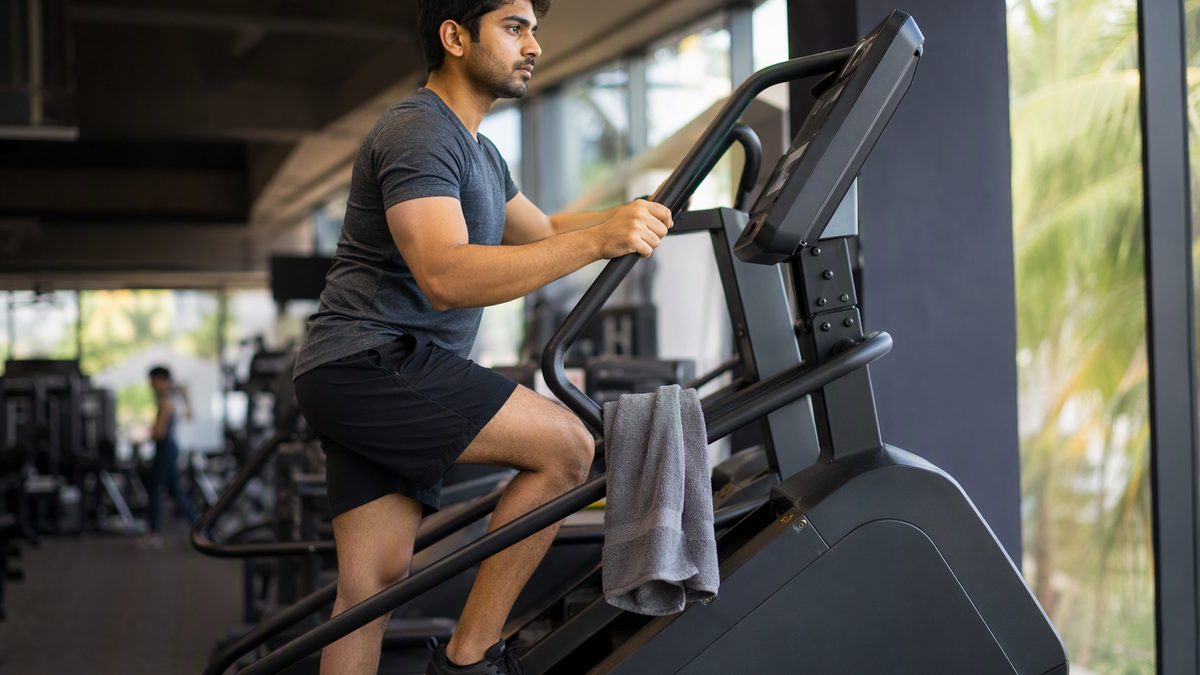
The stair climber breaks that bind. It's a leg- and glute-dominant cardio movement: every step is a loaded step-up driven by hip and knee extension under your bodyweight, so your heart rate climbs and the calories burn while your shoulders do essentially nothing. It's weight-bearing yet lower-impact than running, with no hard heel-strike to beat up legs you need fresh for kick sets. Used well, the stepmill lets you widen a fat-loss deficit, keep your aerobic base honest, and move on days a cranky shoulder needs the water but not another pull.
1. The Shoulder Problem the Stepmill Solves
Start with where swimming load actually lands. Propulsion in the water comes from the upper body, and the rotator cuff and surrounding tissue absorb the volume of every stroke. That's why "swimmer's shoulder" is so common, and why adding upper-body cardio to chase fat loss is a trap - you're stacking more reps onto the exact structures that are already near their limit. The stepmill moves the engine load off the shoulder entirely and onto the big lower-body muscles, which have plenty of capacity to spare.
The second gift is impact. Running would also spare the shoulder, but it pounds your legs at two to three times bodyweight per stride - not ideal when you need springy legs for kick and starts. The stepmill is weight-bearing without that flight-phase landing: you push up and step down rather than crashing onto the ground. So you get a strong cardiorespiratory stimulus and a real leg and glute load with far less repetitive pounding. The one caveat is that "low-impact" isn't "no-impact" - climbing still loads the knees through bending under bodyweight, which matters if you carry any patellofemoral grumpiness. But for the shoulder, the stepmill is close to free training.
2. Stand Tall: The Form That Makes It Worth Doing
The single biggest stepmill mistake is the one that quietly cancels your workout: leaning or hanging on the handrails. Grip and brace on the rails and your arms and the machine carry part of your bodyweight, so your legs lift less - which directly cuts the actual work, the muscular load and the true calorie burn, even though the displayed calories don't budge. You end up fooling yourself into an easy session that reads as hard.
Correct form is simple and worth drilling. Stand tall with a neutral spine, weight through your legs, chest up, core lightly braced. Use only a fingertip touch on the rails for balance if you genuinely need it - never a grip that bears weight. Take full, deliberate steps, placing the whole foot rather than tip-toeing or shuffling. The fastest way to make the same machine far more effective is to let go of the rails. And there's a built-in cue: if you can't stay upright without hanging on, the speed is simply too high - slow it down until you can climb tall. As a swimmer used to long technical sets, you already know that small mechanical errors compound; this is the same principle on dry land.
3. Slotting Stepmill Cardio Around the Pool Week
Treat the stepmill as easy aerobic infrastructure and shoulder-rest insurance, not another quality session fighting your pool work. Most of it should be steady zone 2 - long, continuous, conversational climbing - which is cheap to recover from and won't compromise your next swim. Anchor effort with heart-rate zones and the talk test, estimating max HR as roughly 220 minus age, and keep hard intervals to a small dose well away from your toughest sets.
| Stepmill session | Format | Effort target | Weekly dose for a swimmer |
|---|---|---|---|
| Zone-2 steady | 30-45 min continuous | 60-70% max HR, RPE 3-5, conversational | 2-3, including shoulder-rest days |
| Aerobic intervals | 1 min hard / 2 min easy x 6-8 | 80-90% max HR on work, RPE 8 | 1, on a non-pool-quality day |
| Short sharp climbs | 30s hard / 90s easy x 8 | Near-max steps, RPE 8-9 | Optional, 1 every other week |
| Recovery climb | 20 min easy | ~60% max HR, RPE 3 | On heavy-yardage or sore-shoulder days |
Two scheduling rules keep this from backfiring. First, don't bolt a hard stepmill session onto a hard swim day; place your two or three weekly hard efforts - pool and stepmill combined - on separate days, 48 hours apart, so the same systems get to recover. Second, use the stepmill as your default on shoulder-management days: when a coach pulls you from a heavy pull set, a 30-minute easy climb keeps your aerobic volume and your deficit up without touching the joint. During a taper, drop stepmill volume the same way you drop pool volume.
4. Sweat, Protein and Honest Fat-Loss Math
The stepmill fixes one of swimming's sneakiest problems: you can finally see your sweat. In the pool your losses are invisible but real, and plenty of swimmers finish a hard morning meaningfully dehydrated without a single visible drop. On the stepmill the puddle makes it obvious - keep a bottle on the rail and rehydrate after climbs exactly as you should after a tough set, especially before a later double. Get some carbohydrate in before any early-AM climb too; empty-stomach hard work before practice degrades both quality and recovery, the same trap as under-fueling a morning swim.
On the fat-loss goal, stay honest. The stepmill helps because a lot of muscle working at low impact lets you sustain real total work and widen your deficit - but the monitor's calorie number is just an estimate from a generic formula and it over-counts, more so if you ever lean on the rails. Body composition is driven by a sustained calorie deficit, mostly from diet, and hard intervals and easy steady climbing come out broadly comparable for fat loss when effort is matched. Keep the deficit moderate - around half a percent to one percent of bodyweight per week - to preserve the lean mass that makes you fast, and hold protein near 1.6 to 2.2 grams per kilogram per day to retain muscle. One real stop signal: if a session reproduces shoulder pain that alters your stroke, stop and get it assessed rather than pushing through. You can build the habit alongside the right tools using a good fitness-tracking app.
Pool-Deck Questions About the Stair Climber
Do I really sweat on the stair climber, and does it matter?
Yes, and unlike the pool you'll see it. A steady or interval climb raises sweat losses just like any land cardio, and the puddle under the machine makes obvious what the water hides. Finishing a hard session dehydrated is common and degrades both performance and recovery. Keep a bottle on the rail, sip during long climbs, and rehydrate afterward - especially before a later pool double the same day, when stacked dehydration sneaks up fast.
Will the stepmill help my swimming or just burn calories?
Mostly it builds your general aerobic engine and helps fat loss without loading the shoulder - that's its main value. Easy zone-2 climbing improves the base that restores you between hard pool efforts, so you hold quality longer in a set. It won't replace in-water speed work or directly improve your stroke, but as cross-training it raises your fitness and widens your deficit using your legs, which more pulling or yardage can't do without taxing the joint that's already overloaded.
How do I fit the stair climber around 5am practice?
Treat most climbs as easy zone-2 volume that doesn't compete with the pool, and lean on it during shoulder-rest days when you'd otherwise skip pulling. Keep hard intervals to one or two a week, scheduled away from your hardest swim sets, with 48 hours between any two hard efforts. Fuel it like a morning double - some carbohydrate before, food soon after. Its job is added aerobic base and a shoulder break, not another quality session to recover from.
Will leaning out change my feel in the water?
Modest fat loss done right helps more than it hurts, as long as you protect muscle. Keep the deficit moderate - about half a percent to one percent of bodyweight a week - and protein near 1.6-2.2 g/kg/day, so you strip fat without losing the lean mass that powers your stroke. The thing that actually wrecks your feel is fatigue degrading technique, and the stepmill helps there by building fitness while sparing the shoulder you'd otherwise overload.
Disclaimer: This article is for educational purposes only and is not medical advice. Consult a qualified healthcare professional before starting any supplement, nutrition, or training protocol — especially if you are pregnant or breastfeeding, under 18, taking medication, or managing a health condition.
Scientific References & Clinical Sources
- Joyner MJ, Coyle EF. Endurance exercise performance: the physiology of champions. J Physiol, 2008. PMID: 17901124
- Melanson EL, et al. Exercise, appetite and weight management: understanding the compensatory responses in eating behaviour and how they contribute to variability in exercise-induced weight loss. Br J Sports Med, 2012. PMID: 21596715
- Keating SE, et al. A systematic review and meta-analysis of HIIT versus continuous training for fat loss. Obes Rev, 2017. PMID: 28401638
- Morton RW, et al. A systematic review, meta-analysis and meta-regression of the effect of protein supplementation on resistance training-induced gains in muscle mass and strength in healthy adults. Br J Sports Med, 2018. PMID: 28698222
- Haggerty M, et al. The influence of incline walking on joint mechanics. Gait Posture, 2014. PMID: 24472218

