💡 Key Takeaways
- The stepmill widens your fat-loss deficit with low-impact, leg-driven cardio - but the muscle you protect during the cut depends on your plant-protein quality, not the machine.
- Aim for ~1.6-2.2 g/kg/day protein in a deficit, and because plant proteins are lower in leucine and digest slower, lean on soy, distribute protein across meals, and eat a bit toward the top of that range.
- Keep most climbs easy zone 2 (60-70% max HR, 30-45 min); add 1-2 short interval sessions weekly and pair the cardio with lifting to retain muscle.
- Keep the deficit moderate (~0.5-1% bodyweight/week), and check ferritin and B12 yearly - iron is non-heme and B12 needs supplementation on a meat-free diet.
The hard part of a fat-loss phase for a vegetarian athlete isn't burning calories - it's holding onto muscle while you do it. A deficit always threatens lean mass, and your diet stacks an extra challenge on top: plant proteins carry less leucine per serving and digest more slowly than animal sources, so the muscle-protein-synthesis signal you're relying on to defend your hard-won muscle is naturally a little weaker per gram. Add a calorie cut, and the margin for error narrows. The cardio is the easy part; the protein math is where vegetarians win or lose the cut.
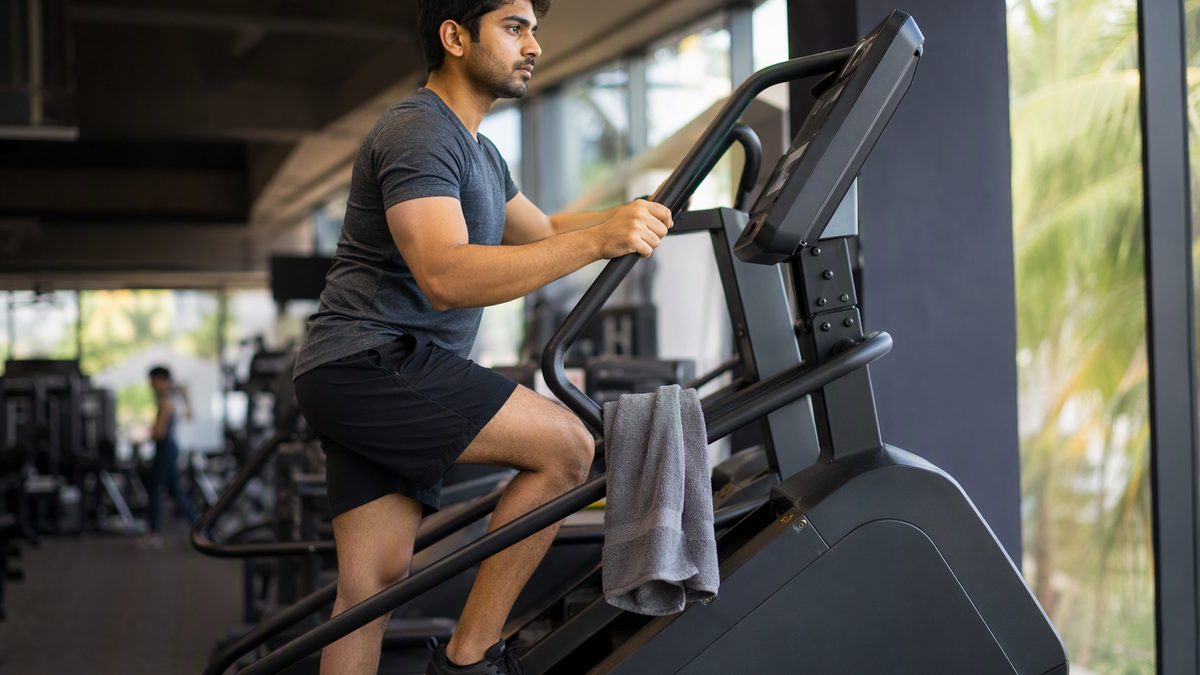
The stair climber fits this picture well precisely because it's a clean, low-impact way to widen the deficit without demanding much from your recovery. Every step lifts your bodyweight up real stairs, driving heart rate up fast while loading glutes, quads and calves - a strong cardiorespiratory stimulus with far less pounding than running. That means you can add fat-loss volume without beating up your joints or stealing recovery from your lifting, which is the work that actually preserves muscle. Used as one lever among several, the stepmill lets you lean out while your plant-based plate does the muscle-protecting job.
1. The Real Problem: Protecting Plant-Built Muscle in a Deficit
Be clear about the mechanism. In any calorie deficit, your body will look to break down muscle alongside fat unless you give it strong reasons not to - and the two strongest reasons are resistance training and adequate, high-quality protein. For a vegetarian, the protein side needs more deliberate planning, because plant sources deliver less leucine (the amino acid that triggers muscle-protein synthesis) per serving and are digested more slowly. The practical consequence isn't "you can't build muscle" - that myth is tired and wrong - it's that you should aim toward the upper end of the protein range and choose your sources well.
Concretely: target roughly 1.6 to 2.2 grams of protein per kilogram of bodyweight per day during the cut, lean a bit higher within that band, and prioritize higher-leucine plant proteins like soy (tofu, tempeh, soy milk, soy protein) alongside legumes and, if you eat them, dairy and eggs. Spread protein across three to five feedings rather than loading it into one meal, so you hit the leucine threshold more often through the day. This is the work that decides whether the weight you lose on the stepmill is fat or muscle - the machine just creates the deficit; your plate determines what gets spent.
2. Stepmill Form and the Honest Fat-Loss Picture
Before programming, fix the form, because bad form quietly erases the calorie cost you're counting on. The cardinal error is leaning or hanging on the handrails: when your arms and the machine carry part of your bodyweight, your legs lift less, which cuts the real work and the true burn even though the displayed calories don't drop. Stand tall, neutral spine, weight through the legs, only a light fingertip touch on the rails for balance, and take full deliberate steps. If you can't stay upright without leaning, slow down.
Now the honesty. Fat loss is driven by a sustained energy deficit, not by the stepmill specifically - the machine is a tool to widen the gap, not a fat-burning trick. Two things make its number softer than it looks. The on-board calorie counter is a generic estimate and tends to over-count, especially with rail-leaning. And your body partly compensates for exercise: appetite rises and incidental movement falls, so exercise-only weight loss runs smaller and more variable than the math suggests. For a vegetarian who's already managing protein carefully, the takeaway is simple - build most of the deficit through diet, use the stepmill to extend it, and don't let the machine's screen convince you you've "earned" a calorie surplus that erases your hard-won deficit. Track waist and bodyweight trends over weeks instead.
3. A Stepmill-Plus-Lifting Week for Vegetarian Fat Loss
Cardio alone is the wrong plan for a cut - pair the stepmill with resistance training, which is the main lever for keeping muscle while diet and cardio strip fat. Anchor climbing effort with heart-rate zones and the talk test, estimating max HR as roughly 220 minus age, and keep most of the volume easy. The lifting days are non-negotiable; the climbing supports them.
| Day | Session | Effort / detail | Protein focus |
|---|---|---|---|
| Mon | Lower-body lift | Priority strength, no hard climb same day | ~2.0 g/kg, soy + legumes across meals |
| Tue | Zone-2 climb 35-45 min | 60-70% max HR, RPE 3-5 | Protein feeding within ~2h post |
| Wed | Upper-body lift | Priority strength | Spread across 4-5 feedings |
| Thu | Intervals: 1 min hard / 2 min easy x 6 | 80-90% max HR on work, RPE 8 | Higher-leucine source post-session |
| Fri | Full-body lift | Priority strength | ~2.0-2.2 g/kg on training days |
| Sat | Zone-2 climb 30 min | 65% max HR, RPE 4, active recovery | Maintain target even on lighter day |
| Sun | Rest or easy walk | Recovery | Don't drop protein on rest days |
Notice the sequencing: hard climbing intervals sit on a different day from priority lower-body lifting, because stacking hard endurance directly onto strength work can blunt the strength and hypertrophy gains you're trying to protect. Easy zone-2 climbing interferes far less and even doubles as active recovery around lifting. Keep the deficit moderate - around half a percent to one percent of bodyweight per week - so you preserve lean mass; aggressive cutting sacrifices the muscle your plant-based diet worked hard to build.
4. Labs, B12 and Iron: The Vegetarian Checkpoints
A cut on a meat-free diet is exactly when nutrient gaps bite, so keep an eye on the markers that matter for athletes who don't eat meat. Iron from plants is non-heme and absorbed less efficiently than the heme iron in meat, which makes low ferritin more common - and low iron quietly tanks endurance and recovery, the opposite of what you want on the stepmill. Pair iron-rich plant foods with vitamin C to boost absorption, and check ferritin yearly (more often if you feel unusually flat). B12 isn't reliably available from plants at all, so a vegetarian generally needs to supplement or rely on fortified foods, and it's worth confirming on labs.
None of this is the stepmill's domain - it's the dietary infrastructure that lets the training work. A couple of practical notes: choose protein powders and supplements that are certified vegetarian or vegan and third-party tested, so you know what you're getting and avoid surprises. And don't over-rely on processed meat substitutes to hit protein - they vary widely in quality and can crowd out whole-food sources. If labs come back low or you're persistently fatigued, that's a conversation with a clinician or sports dietitian, not something to train through. With iron, B12 and leucine handled, the stepmill becomes what it should be: a clean, low-impact way to widen the deficit while your plate keeps the muscle on.
Plant-Based Questions About the Stair Climber
How do I keep muscle on the stepmill without meat protein?
Lift hard and eat enough high-quality plant protein. Target 1.6-2.2 g/kg/day, leaning toward the top in a deficit, and prioritize higher-leucine sources like soy (tofu, tempeh, soy protein) alongside legumes, plus dairy or eggs if you eat them. Spread protein across four to five feedings so you hit the leucine threshold more often, since plant proteins are lower in leucine per serving. Pair that with resistance training and a moderate deficit, and the weight you lose stays fat, not muscle.
Can I really lose fat on the stepmill while eating plant-based?
Absolutely - fat loss is about an energy deficit, and a plant-based diet creates one just as well as any other. The stepmill widens that deficit with low-impact cardio while your diet does the main work. The vegetarian-specific task isn't burning calories; it's protecting muscle, which means hitting your protein and leucine targets and lifting. Keep the deficit moderate, don't trust the machine's calorie display, and track waist and bodyweight trends over weeks instead.
Which labs should I check during a cut as a vegetarian?
Ferritin and B12 are the big two. Plant iron is non-heme and absorbed less efficiently, so low ferritin is common and it drags down endurance and recovery - check it yearly, or sooner if you feel flat. B12 isn't reliably available from plants, so you generally need to supplement or use fortified foods and confirm it on labs. If anything comes back low or fatigue persists during the deficit, see a clinician or sports dietitian rather than pushing through it.
Is the stepmill enough on its own for fat loss?
No machine is - and cardio alone is a poor cut strategy. The stepmill widens your deficit, but the deficit itself comes mostly from diet, and muscle retention comes from resistance training plus protein. Use the stepmill as one lever: mostly easy zone-2 volume with one or two interval sessions, paired with lifting and a moderate deficit. For a vegetarian athlete, the protein and leucine planning matters more to your result than which cardio machine you pick.
Disclaimer: This article is for educational purposes only and is not medical advice. Consult a qualified healthcare professional before starting any supplement, nutrition, or training protocol — especially if you are pregnant or breastfeeding, under 18, taking medication, or managing a health condition.
Scientific References & Clinical Sources
- Melanson EL, et al. Exercise, appetite and weight management: understanding the compensatory responses in eating behaviour and how they contribute to variability in exercise-induced weight loss. Br J Sports Med, 2012. PMID: 21596715
- Morton RW, et al. A systematic review, meta-analysis and meta-regression of the effect of protein supplementation on resistance training-induced gains in muscle mass and strength in healthy adults. Br J Sports Med, 2018. PMID: 28698222
- Phillips SM, Van Loon LJ. Dietary protein for athletes: from requirements to optimum adaptation. J Sports Sci, 2011. PMID: 22150425
- Garthe I, et al. Effect of two different rates of weight loss on body composition and strength and power-related performance in elite athletes. Int J Sport Nutr Exerc Metab, 2011. PMID: 21558571
- Joyner MJ, Coyle EF. Endurance exercise performance: the physiology of champions. J Physiol, 2008. PMID: 17901124

