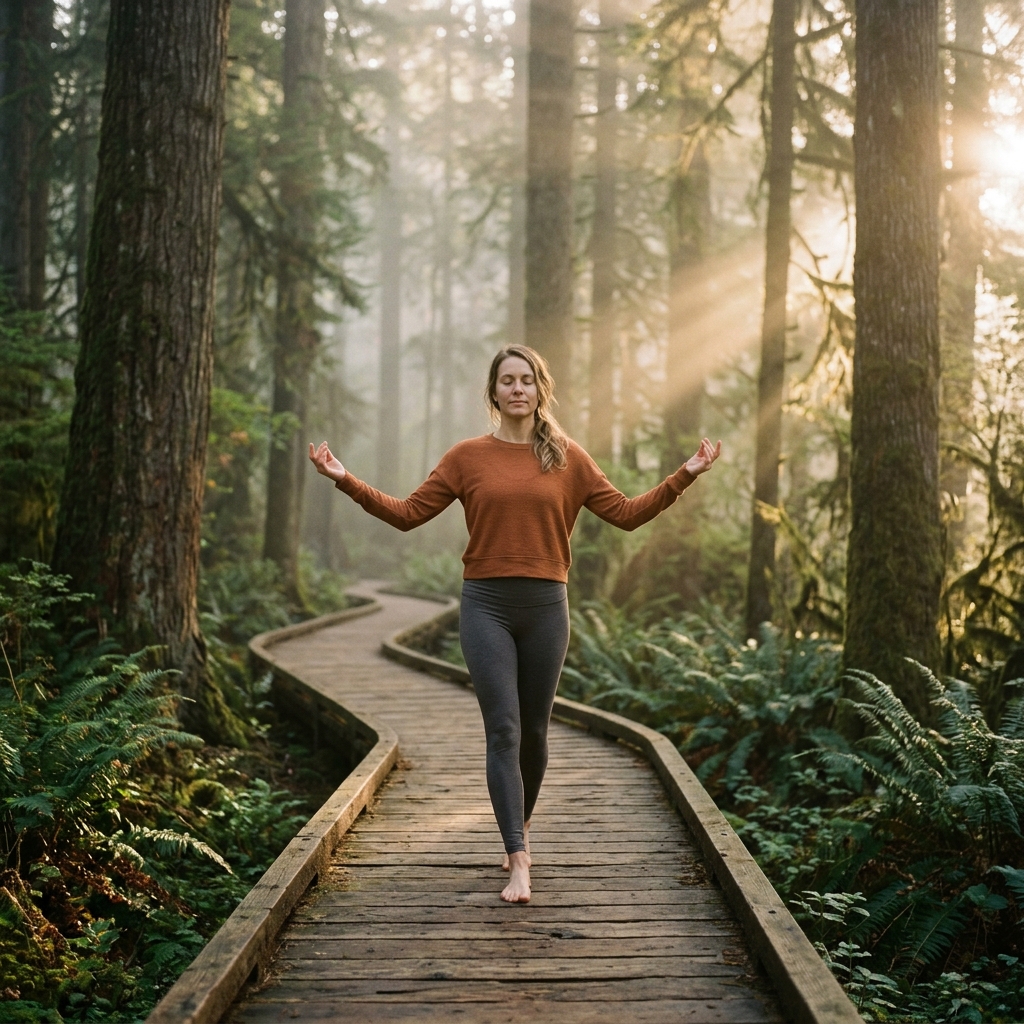
Something quietly powerful is happening on morning trails, city sidewalks, and neighborhood parks in 2026: people are walking differently. They move with intention — pausing to breathe, flowing through gentle arm sweeps, synchronizing each step with an exhale. Walking yoga, the practice of weaving yoga's breath awareness and movement principles into everyday walking, has become one of the fastest-growing low-impact fitness trends of the year. It is not a gimmick or a simplified yoga class. It is a genuinely distinct practice that delivers a combination of benefits that neither walking alone nor a mat-based yoga session fully provides on their own.
What Walking Yoga Actually Is
Walking yoga is not yoga poses performed while moving. It is the integration of yogic principles — conscious breathing, present-moment awareness, intentional movement, and body alignment — into the act of walking. The result is a practice that feels meditative without requiring stillness, and active without requiring intensity.
At its core, walking yoga involves three interwoven elements:
- Breath synchronization: Coordinating your inhale and exhale with your steps, so movement and breath become one continuous rhythm rather than two separate things happening at the same time.
- Mindful body awareness: Bringing attention to posture, hip opening, arm swing, and foot placement — the same precision you'd bring to a yoga pose, applied to each stride.
- Transitional micro-movements: Brief pauses woven into the walk where you perform standing yoga postures — a warrior variation, a forward fold, a gentle twist — before continuing forward.
This combination turns an ordinary walk into a moving meditation that engages the whole person: body, breath, and mind.
Why This Trend Is Surging Right Now
Several cultural and practical factors have converged to make walking yoga feel newly relevant in 2026. First, there is growing awareness of the mental health toll of high-intensity training culture. More people are actively seeking forms of movement that restore rather than deplete. Second, remote and hybrid work has reshaped how people structure their days — a 30-minute outdoor walking yoga session fits naturally into a lunch break or early morning in a way that a gym visit often does not.
There is also a demographic shift happening. Older adults who have always walked for health are discovering that adding yoga elements dramatically improves what they get from those walks. Yoga practitioners returning from injury are finding that walking yoga keeps them moving while protecting vulnerable joints. And complete beginners who feel intimidated by mat classes are finding that the open-air, low-stakes format of walking yoga lowers the barrier to entry considerably.
Perhaps most importantly, walking yoga is genuinely accessible. You do not need a mat, a studio, special clothing, or any equipment. You need your body and somewhere to walk.
The Combined Benefits: More Than the Sum of Its Parts
Regular walking is already well-established as one of the most beneficial forms of exercise a person can do — it supports cardiovascular health, improves mood, aids digestion, and is sustainable over a lifetime. Yoga, similarly, has a deep evidence base supporting its effects on flexibility, stress reduction, balance, and joint health. But walking yoga creates a specific combination of benefits that neither practice delivers as completely on its own.
- Cardiovascular conditioning with a low heart-rate ceiling: The sustained walking keeps your heart rate elevated enough to deliver genuine aerobic benefit, while the breathing and movement elements keep intensity moderate — ideal for people who need to avoid high-impact exercise or who are building a base of fitness.
- Dynamic mobility: Unlike seated stretching or static yoga holds, walking yoga builds mobility through movement rather than stillness. Hip flexors, thoracic spine, hamstrings, and ankles get worked through their range of motion in a functional, weight-bearing context.
- Mental clarity and stress reduction: The breath-step synchronization creates a natural focus anchor, pulling attention out of a racing mind and into present-moment sensation. Many practitioners describe finishing a walking yoga session feeling as mentally clear as after a meditation session.
- Improved posture and body awareness: Bringing yogic alignment awareness to your gait reveals and gradually corrects patterns like forward head position, collapsed arches, or tight hip rotators that most people carry unconsciously through every step of their day.
- Consistency: Because it is low-impact, adaptable to any fitness level, and requires no special setup, walking yoga is a practice people actually maintain over time — which is ultimately the most important fitness variable of all.
Who Walking Yoga Suits Best
The honest answer is that walking yoga suits a remarkably wide range of people, which is part of why it has spread so quickly. That said, certain groups tend to find it especially well-matched to their needs.
Active recovery days: If you train hard several days a week, walking yoga is a near-perfect active recovery tool. It keeps blood moving to support muscle repair, maintains mobility, and keeps the nervous system in a parasympathetic (rest-and-digest) state rather than piling on more stress.
Beginners to exercise: The format is completely non-intimidating. There is no performance pressure, no complex equipment, no class dynamic to navigate. You can start very simply — just walking with deeper breaths and more upright posture — and add more elements as you build comfort.
People managing chronic pain or injury: Low-impact movement that improves circulation and range of motion without loading joints is often exactly what rehabilitation requires. Anyone with a specific injury should always get medical clearance before beginning, but walking yoga is frequently compatible with conditions that make higher-impact or more demanding exercise difficult.
High-stress lifestyles: If your days are mentally demanding and you leave work feeling wired and depleted simultaneously, walking yoga addresses both states at once. The movement burns off excess cortisol; the breath work activates the parasympathetic nervous system.
Yoga practitioners seeking more variety: Mat practice develops certain qualities well but neglects others. Walking yoga builds functional movement patterns, improves balance under real-world conditions, and takes your breath awareness into a different context — deepening the overall practice.
A Simple Starter Routine
This 25-minute routine requires only a safe place to walk. Move at your own pace. The goal is integration, not speed.
- Minutes 0–5 (Settling In): Walk at a comfortable pace. Begin counting your steps: inhale for four steps, exhale for four steps. If this feels too short or too long, adjust the count until the breath feels natural rather than forced. Let your arms swing freely and bring attention to your feet making contact with the ground.
- Minutes 5–8 (Spinal Awakening): On each exhale, gently roll your shoulders back and down. On every third or fourth breath, pause and sweep both arms overhead on your inhale, then lower them on your exhale. Feel the spine lengthen. Continue walking between pauses.
- Minutes 8–13 (Hip Opening Walk): Widen your stride slightly and begin to consciously push through your back heel with each step, engaging the glute and opening the hip flexor. Every few minutes, pause at a fixed point — a bench, a tree — and move into a low lunge for three breaths, then switch sides. Return to walking.
- Minutes 13–18 (Core and Balance): As you walk, draw your lower belly in slightly on each exhale. Twice during this segment, stop and perform a standing balance: shift your weight onto one foot, lift the opposite knee to hip height, hold for five slow breaths, then switch. This activates the stabilizing muscles that protect your spine during walking and in daily life.
- Minutes 18–22 (Upper Body Integration): As you continue walking, on alternating exhales let one arm reach forward with your opposite leg — an exaggerated, slow version of your natural arm swing. This gently mobilizes the thoracic spine and reinforces the cross-body coordination pattern that efficient walking depends on.
- Minutes 22–25 (Cool Down): Gradually slow your pace. Shorten your steps. Let your breath return to a natural, uncouted rhythm. In the final minute, pause completely. Stand with feet hip-width, eyes soft or closed. Take three full breaths — a deep inhale through the nose, a long slow exhale through the mouth — before finishing.
Tips for Building the Practice Over Time
Walking yoga is one of those practices that rewards patience. The first few sessions may feel slightly awkward — coordinating breath with steps while also thinking about your posture and occasionally pausing for a lunge is genuinely a lot to hold at once. This is normal and it passes quickly.
- Start with just one element: If breath-step coordination is enough to focus on in week one, that is completely sufficient. Add the paused postures the following week.
- Choose consistent routes early on: Familiar terrain lets you put more attention on internal experience rather than navigation. Once the practice feels established, varying your route adds freshness.
- Early morning tends to work best: Fewer distractions, cooler temperatures in warmer months, and the mood-setting benefits of morning light make this an ideal time. But the best time is always the one you will actually use.
- Track your sessions: Duration, how the practice felt, what you focused on, and how you felt afterward. Over weeks, patterns emerge — you will notice which elements most reliably produce clarity or ease, and you can lean into them.
- Progress gradually: Once 25 minutes feels effortless, extend to 35 or 40. Add more complex standing postures at your pause points. Increase your breath count from four steps to six. The practice has significant room to grow with you.
Getting Started with UltraFit360
Walking yoga is most effective when it is consistent, and consistency is easiest when you have a clear picture of your own progress over time. Log your walking yoga sessions in UltraFit360 — duration, focus area, how you felt before and after — and let the app's AI coaching layer help you identify patterns, suggest progressions, and keep the practice woven sustainably into your broader fitness routine. A practice this accessible deserves to become a real, lasting part of your movement life.
Transform Your Fitness Journey
Log your workouts, track your diet, and get AI coaching insights — all with UltraFit360.