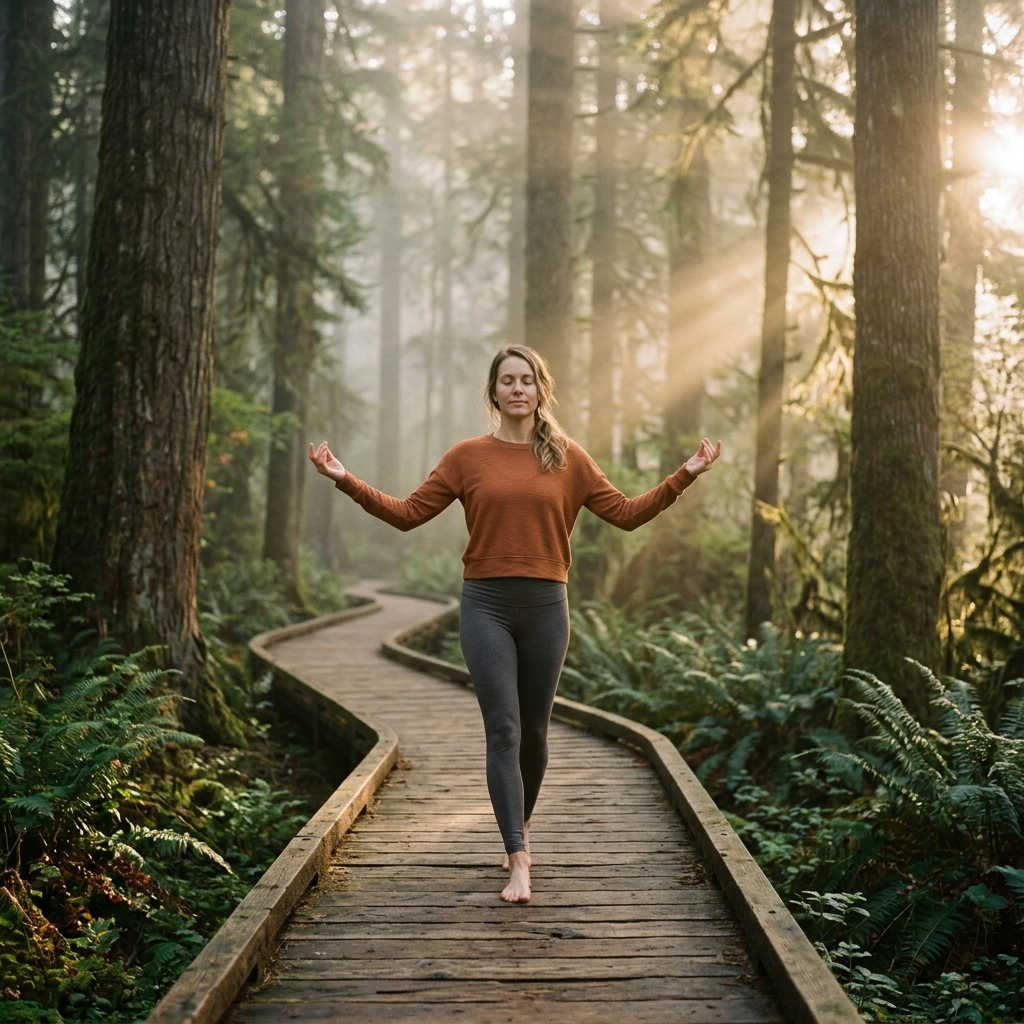
What if you could get the cardiovascular benefits of a 30-minute walk and the mental clarity of a meditation session — at the same time? That's the promise of walking yoga, a hybrid practice that's gaining serious traction among fitness enthusiasts who've grown tired of choosing between training their body and training their mind. In 2026, the boundaries between fitness categories are dissolving, and walking yoga sits right at the centre of that evolution.
What Is Walking Yoga?
Walking yoga is a structured practice that combines the physical act of walking with yogic principles: breath control (pranayama), body awareness, mindfulness, and intentional movement. It's not yoga poses performed while walking — it's the philosophy of yoga applied to the act of walking.
Think of it as a spectrum between two endpoints:
- On one end: Kinhin — the extremely slow walking meditation from Zen Buddhism, where a single step might take 10 seconds
- On the other: Brisk fitness walking — fast-paced, heart-rate-elevated cardio
Walking yoga lives in the middle — deliberate, moderately paced walking with synchronised breathing, environmental awareness, and specific mental focus techniques.
The Science Behind Mindful Movement
Neurological Benefits
Walking activates the brain's default mode network (DMN) — the neural circuitry responsible for creativity, self-reflection, and problem-solving. When you add mindfulness to walking, you create a state neuroscientists call "open monitoring" — a relaxed but alert awareness that's associated with breakthrough insights and reduced anxiety.
A 2024 study at the University of British Columbia found that participants who practiced mindful walking for 20 minutes showed a 23% reduction in amygdala reactivity (the brain's fear centre) compared to those who walked while listening to podcasts.
Cardiovascular Benefits
Walking yoga, when practiced at a moderate pace, places you squarely in Zone 2 heart rate territory — the optimal zone for building aerobic base, burning fat, and improving cardiovascular efficiency. The added breathing protocols enhance oxygen utilisation and vagal tone.
Stress Physiology
The rhythmic breathing patterns used in walking yoga activate the parasympathetic nervous system, shifting you from "fight or flight" to "rest and digest." This lowers cortisol, improves digestion, enhances sleep quality, and creates a sense of calm that persists long after the practice ends.
5 Core Principles of Walking Yoga
1. Breath Awareness (Pranayama in Motion)
Every step is paired with breath. Unlike casual walking where breathing is unconscious, walking yoga uses structured breathing patterns (detailed below) that regulate your nervous system and keep your mind anchored to the present moment.
2. Mindful Steps (Pada Sthiti)
Feel every part of your foot contact the ground — heel, arch, ball, toes. Walk as if you're leaving footprints in soft sand. This level of attention to your gait improves proprioception (body awareness) and naturally corrects posture issues.
3. Body Scan in Motion (Deha Bhavana)
As you walk, cycle your awareness through your body: feet, calves, knees, hips, abdomen, chest, shoulders, neck, head. Notice areas of tension and consciously release them. This is the yogic "body scan" adapted for movement.
4. Environmental Connection (Prakriti Samyoga)
Engage your senses with the environment: the temperature of the air on your skin, the sounds around you, the colours and textures you see, the scents you detect. This isn't distraction — it's active presence. It anchors you in the here and now.
5. Non-Judgmental Awareness (Sakshi Bhava)
When your mind wanders (and it will — constantly), notice the thought without judgment and gently return to your breath and steps.
2026 Evolution: Parasympathetic Priming
In 2026, we’ve moved beyond "stretching" for recovery. Walking yoga is the ultimate tool for Parasympathetic Priming—using rhythmic, cross-lateral movement to signal to yours nervous system that the "threat" of a heavy HIIT session is over. This rapid state-shifting is the secret to high-performance longevity. Combine this with yours Japanese walking cadence for peak results.
Joint Elasticity through Rhythmic Loading
Static poses can sometimes over-stress ligaments. Walking yoga promotes **Joint Elasticity** by providing constant, low-grade rhythmic loading to the fascia and joints. This "lubricates" the tissues, improving yours mobility and flexibility without the risk of over-stretching cold muscles.
Walking Yoga Breathing Techniques
The 4-4-4 Box Breath Walk
Inhale for 4 steps → Hold for 4 steps → Exhale for 4 steps → Hold for 4 steps. Repeat. This calming protocol is excellent for anxiety reduction and nervous system regulation. Used by Navy SEALs and now adapted for walking practice.
The 4-7-8 Relaxation Walk
Inhale for 4 steps → Hold for 7 steps → Exhale slowly for 8 steps. This is Dr. Andrew Weil's "relaxing breath" applied to walking. It's deeply calming and best used for evening walks or recovery days.
The Energising 2-2 Walk
Quick, rhythmic breathing: sharp inhale for 2 steps, sharp exhale for 2 steps. This is based on the yogic Kapalabhati breath, adapted for walking. Use it on morning walks when you need energy, not calm.
Natural Breath Observation
The simplest technique: don't control your breath at all. Simply observe it. Notice its rhythm, depth, and temperature. This is the most meditative approach and what most experienced practitioners eventually gravitate toward.
Your 30-Minute Walking Yoga Flow
Phase 1: Grounding (Minutes 1-5)
Stand still for 30 seconds. Close your eyes. Take 5 deep belly breaths. Open your eyes and begin walking at a slow, deliberate pace. Focus entirely on the sensation of your feet touching the ground. Use natural breath observation.
Phase 2: Body Awakening (Minutes 5-10)
Increase your pace to a moderate walk. Begin the 4-4-4 box breath. As you walk, perform a slow body scan from feet to head. Release any tension you find — drop your shoulders, unclench your jaw, soften your hands.
Phase 3: Active Meditation (Minutes 10-22)
Maintain a brisk, purposeful pace. This is your cardio zone. Switch to the 4-7-8 breath or the 2-2 energising breath depending on your intention today. Engage your senses — notice 5 things you can see, 4 you can hear, 3 you can feel. When your mind wanders, note "thinking" and return to breath.
Phase 4: Integration (Minutes 22-27)
Gradually slow your pace. Return to natural breath observation. Walk as if you have nowhere to go and all the time in the world. Let gratitude or a positive intention fill your awareness.
Phase 5: Stillness (Minutes 27-30)
Come to a standing stop. Plant both feet firmly. Close your eyes for 60-90 seconds. Take 3 deep, cleansing breaths. Notice how different your body and mind feel compared to 30 minutes ago. This is the integration — let it settle.
Walking Yoga for Different Goals
For Stress Relief
Use the 4-7-8 breathing protocol. Walk slowly. Practice in a quiet, natural setting. Focus on environmental sounds. Best done in the evening as a wind-down routine.
For Energy & Focus
Use the 2-2 energising breath. Walk briskly. Add arm movements — swing arms actively, or add shoulder rolls and wrist circles. Best done in the morning as a replacement for caffeine.
For Active Recovery
Use natural breath observation. Walk at an easy, effortless pace. Focus on the body scan technique to identify and release residual muscle tension from training. Perfect for rest days between heavy training sessions.
For Creativity & Problem-Solving
Use natural or 4-4-4 breathing. Walk at a moderate pace. Don't try to "think" about problems — just walk and let your mind wander freely. Carry a small notebook for when ideas arrive (they will).
Frequently Asked Questions
Can complete beginners do this?
Absolutely. Walking yoga has the lowest barrier to entry of any fitness or mindfulness practice. If you can walk and breathe, you can do walking yoga. Start with 10-15 minutes and work up to 30.
Is this the same as Japanese walking?
Similar, but different emphasis. Japanese walking focuses more on posture, cadence, and the 6-6-6 challenge structure. Walking yoga places greater emphasis on yogic breathing techniques, body scanning, and the meditative/spiritual dimension. They complement each other beautifully.
Do I need yoga experience?
Not at all. Walking yoga borrows the philosophy of yoga (breath, awareness, presence) but requires zero flexibility, no poses, and no mat. It's yoga's teachings applied to the most natural human movement.
What should I wear?
Comfortable walking shoes and weather-appropriate clothing. Nothing special. Leave the yoga pants and mat at home — this is an outdoor moving practice.
Conclusion: Movement as Meditation
In a world that's overwhelmed, overstimulated, and under-recovered, walking yoga offers something surprisingly countercultural: doing less, with more intention. It's not about burning calories or hitting step goals. It's about reconnecting your mind and body through the most fundamental human movement — walking — and emerging calmer, clearer, and more present than when you started.
Try the 30-minute flow above, just once, without headphones. You'll understand why this practice is catching on.
Track Your Mindful Movement
Sync walk data from Apple Health or Health Connect, monitor HRV trends, and see how mindful practices improve your recovery scores — all free with UltraFit360.