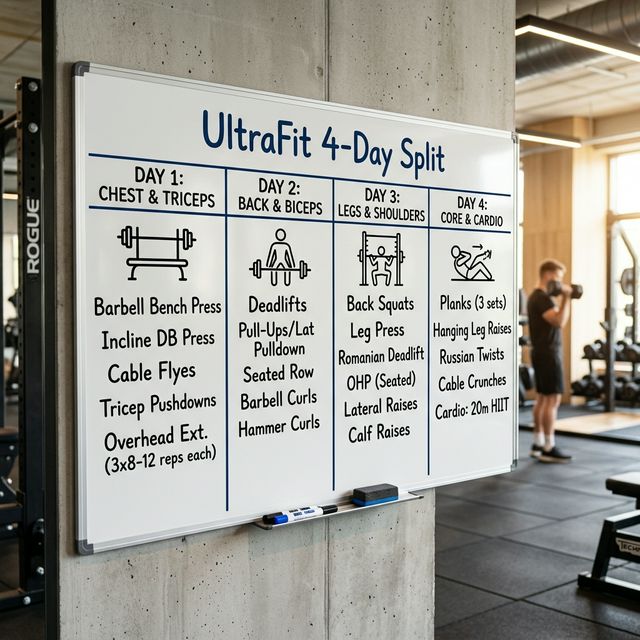
Your workout split determines how you distribute training volume across the week. The right split increases muscle growth, prevents overtraining, and fits your schedule. The wrong split leaves you under-stimulated or burnt out. This guide compares every major split: full-body, upper/lower, push/pull/legs, and specialized variants — helping you choose based on your goal, experience level, and training frequency.
What Makes a Good Workout Split?
- Adequate training frequency: Each muscle group trained 2x weekly minimum (optimal for muscle growth)
- Balanced volume: Even distribution across muscle groups (prevents imbalances)
- Recovery time: Muscle groups get 48-72 hours between hard sessions
- Sustainability: You can stick to it without burning out
Full-Body Split (3x Weekly)
Structure
Day 1, 2, 3 (Mon/Wed/Fri): Hit all major muscles every session
Sample workout:
- Squat: 4x5-8
- Bench press: 4x5-8
- Barbell row: 4x5-8
- Accessory work (3x8-12 each): Leg press, incline dumbbell press, lat pulldowns
Pros
- Each muscle trained 3x weekly (very high frequency)
- Simple to program; minimal decision-making
- Great for beginners (learn compound movements thoroughly)
Cons
- Lower volume per muscle (hard to do many exercises if training full-body)
- Less specialization (can't focus on weak points)
- Recovery demanding (hard to recover between sessions)
Best for
- Beginners (first 6-12 months)
- People training 3x weekly only
- Strength focus (compound lifts 3x/week = frequent practice)
Upper/Lower Split (4x Weekly)
Structure
Mon/Thu (Upper), Tue/Fri (Lower)
Upper Day A: Bench focus
- Incline bench: 4x5-8
- Bent-over row: 4x6-8
- Accessory: Dips, lat pulldowns, face pulls (3x8-12 each)
Upper Day B: Overhead press focus
- Overhead press: 4x5-8
- Pull-ups: 4x6-10
- Accessory: Dumbbell work, chin-ups, barbell rows
Lower Day A: Squat focus
- Barbell squat: 4x5-8
- Romanian deadlift: 4x6-8
- Accessory: Leg press, leg curl, calf raises
Lower Day B: Deadlift focus
- Deadlift: 4x3-5
- Front squat or leg press: 4x6-10
- Accessory: Single-leg work, hamstring focus
Pros
- Each muscle trained 2x weekly (optimal frequency)
- Higher volume per muscle than full-body (better hypertrophy stimulus)
- Better recovery than full-body (3-4 days between upper sessions)
- Specialization possible (two upper days to focus on weak points)
Cons
- Requires 4x weekly commitment
- More complex programming than full-body
Best for
- Intermediate lifters (1-3 years training)
- Muscle building focus (hypertrophy-optimized frequency)
- Those training 4x weekly
Push/Pull/Legs Split (6x Weekly)
Structure
3-day cycle, done twice per week (Mon/Tue/Wed + Thu/Fri/Sat)
Push Day: Chest, shoulders, triceps
- Bench press: 4x6-8
- Incline dumbbell press: 4x8-10
- Overhead press: 3x8-10
- Dips + tricep extensions: 3x8-12 each
Pull Day: Back, biceps
- Deadlift or rows: 4x5-8
- Pull-ups: 4x6-10
- Barbell rows: 4x6-8
- Bicep curls + rear delt work: 3x8-12 each
Legs Day: Quads, hamstrings, glutes
- Squat or leg press: 4x6-10
- Romanian deadlift or leg curl: 4x8-10
- Bulgarian split squats: 3x8-10
- Calf raises: 3x12-15
Pros
- Each muscle trained 2x weekly (optimal frequency)
- Highest volume per muscle (max hypertrophy stimulus)
- Great for specialization (can do 3-4 exercises per muscle group)
- Compound focus (moves are demanding; recovering between allows heavy lifting)
Cons
- Requires 6x weekly commitment (demanding schedule)
- High volume can lead to burnout if nutrition/sleep is poor
Best for
- Advanced lifters (3+ years training)
- Maximum muscle building (hypertrophy specialists)
- Those with 6x weekly availability
Choosing Your Split: Decision Tree
How many days can you train per week?
- 3 days: Full-body 3x weekly
- 4 days: Upper/lower
- 5 days: Push/pull/legs (cycle 1-2x, plus one extra session)
- 6 days: Push/pull/legs (cycle twice)
What's your experience level?
- Beginner (0-1 year): Full-body 3x weekly
- Intermediate (1-3 years): Upper/lower 4x weekly
- Advanced (3+ years): Push/pull/legs 6x weekly OR upper/lower with specialization
What's your primary goal?
- Strength: Full-body or upper/lower (frequent compound lifts)
- Hypertrophy: Upper/lower or push/pull/legs (high volume)
- Fat loss: Any split works; nutrition/cardio matter more than split choice
Volume Expectations by Split
Full-body 3x/week: ~9 total sets per muscle group per week
Upper/lower 4x/week: ~12-16 total sets per muscle group per week
Push/pull/legs 6x/week: ~15-20 total sets per muscle group per week
Common Split Mistakes
Mistake #1: Choosing a split based on popularity
PPL is "trendy," but if you only train 3-4 days weekly, full-body or upper/lower is better. Choose based on your schedule.
Mistake #2: Increasing frequency too fast
Jump from full-body (3x) to PPL (6x) and you'll overtrain. Progress gradually: 3x → 4x → 5-6x over months.
Mistake #3: Not enough volume
Doing 1-2 exercises per muscle group isn't enough for growth. Aim for 2-3 compound + 3-4 accessory per muscle per split.
Mistake #4: Ignoring recovery
Training frequency is only as good as your recovery. Sleep, nutrition, stress matter. Train 4x with perfect recovery beats 6x with poor recovery.
Example 12-Week Transition: Full-Body → Upper/Lower
Weeks 1-4: Full-body 3x weekly (establish baseline, learn form)
Weeks 5-8: Upper/lower 4x weekly (add volume, higher frequency)
Weeks 9-12: Advanced upper/lower (specialize, increase intensity)
Result: Better recovery, higher volume, faster muscle growth
Research on Training Frequency & Muscle Growth
Schoenfeld et al. (2016): Meta-analysis in Sports Medicine found training each muscle group 2x weekly produces 10-20% more muscle growth than 1x weekly (same total volume). Frequency matters.
Implication: Full-body or upper/lower splits (2x/week frequency per muscle) beat low-frequency splits for hypertrophy, even with equal total volume.
Caveat: Only if recovery is adequate. If you train 2x/week with poor sleep/nutrition, growth suffers. 1x/week with perfect recovery beats 2x/week with poor recovery.
Advanced: Auto-Regulating Your Split Based on Recovery
Rather than fixed splits, adjust frequency based on wearable data:
- High HRV + good sleep + low cortisol: You can handle 5-6x training weekly. Run PPL or upper/lower twice.
- Moderate HRV + average sleep: Run upper/lower 4x or full-body 3.5x (one week 3x, next week 4x alternating)
- Low HRV + poor sleep + high cortisol: Drop to full-body 3x weekly. Recovery is limiting factor
This data-driven approach beats rigid adherence to one split year-round. Your capacity changes monthly.
Split Selection by Experience Level (Refined)
Complete Beginner (0-6 months): Full-body 3x weekly + mobility 3x weekly = 6 sessions total. High frequency teaches movement patterns quickly. Expected gain: 1-1.5 lbs muscle/month.
Early Intermediate (6-18 months): Upper/lower 4x weekly. Sufficient frequency for muscle growth with manageable recovery demands. Expected gain: 0.75-1 lb muscle/month.
Advanced (18+ months): Push/pull/legs 5-6x weekly OR custom splits matching your weak points. Prioritize lagging muscle groups with higher frequency. Expected gain: 0.25-0.5 lb muscle/month (slower, but still progressive).
Measurement Framework: Tracking Split Effectiveness
After 12 weeks on a split, measure:
- Muscle gain: Body composition change (circumference + photos). Target 3-6 lbs muscle gain minimum
- Strength: Compound lift progression (expect +5-10% if eating in surplus)
- Recovery: HRV trend, sleep quality, subjective energy. Should improve or stay stable
- Adherence: Did you complete 90%+ of planned sessions? If not, frequency is too high
If metrics stall, change splits (not immediately, but after 12 weeks). If thriving, maintain another 12 weeks before changing.