
For decades, the gold standard of fitness tracking has been the calorie. We count "calories in" and "calories out" as if our bodies were simple furnaces burning wood. While energy balance is undeniably a fundamental law of physics, it is only a small fraction of the total health equation. In 2026, focusing solely on calories is like trying to drive a modern electric vehicle using only a gas gauge. You’re missing 90% of the data needed to optimize performance and longevity.
As we move into the era of hyper-personalized health, we have access to metrics that provide a high-definition view of our physiological state. These "Advanced Metrics" tell us how well we are recovering, how much stress our nervous system is under, and even how hydrated our cells are. Today, we’re going beyond the calorie counter to explore the metrics that actually move the needle for your health and how you can track them in less than five minutes a day.
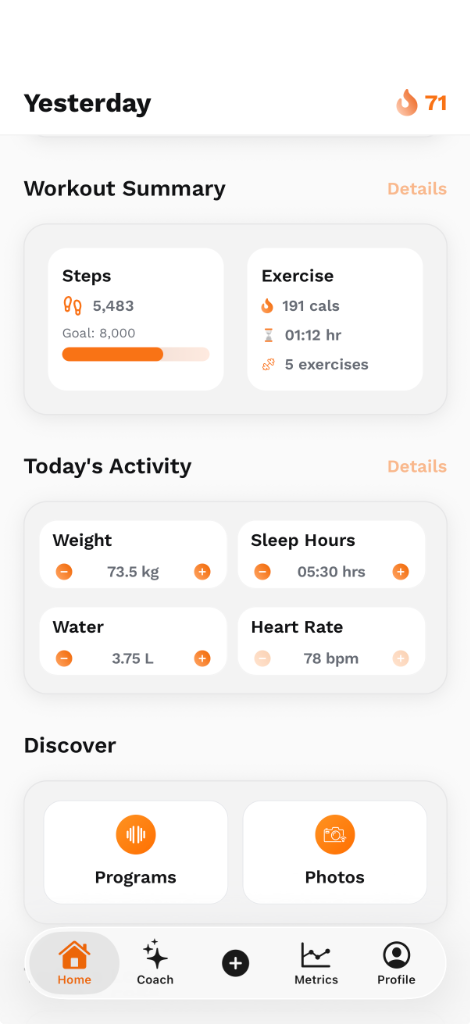
The UltraFit360 Dashboard: A holistic view of your daily activity beyond just calories.
HRV: Your Body’s Real-Time Readiness Score
If you could only track one metric besides weight, it should be Heart Rate Variability (HRV). HRV measures the variation in time between each heartbeat. Contrary to what you might think, a highly rhythmic "metronome" heartbeat is a sign of stress. A healthy, refreshed nervous system has a high variability, showing it is ready to react to the environment.
HRV is the ultimate proxy for your Autonomic Nervous System (ANS). When your HRV is high, your parasympathetic nervous system (rest and digest) is in the driver’s seat—you are ready to train hard. In 2026, we use **HRV-Guided Training** to peak for competitions. If yours HRV is 10% below your baseline, you pivot to a Zone 2 session instead of heavy lifting. This is the core of yours smart wearables strategy.
Metabolic Fingerprinting
In 2026, we’ve moved beyond generic BMR formulas. Metabolic Fingerprinting uses yours respiratory exchange ratio and heart rate data to identify yours exact "crossover point"—the intensity where yours body stops burning primarily fat and starts burning glucose. Knowing this allows you to optimize yours heart rate zones for muscle preservation while cutting.
Sleep Architecture: The Depth of Recovery
Most people track sleep duration, but duration is a vanity metric. What matters is Sleep Architecture—the distribution of Light, Deep, and REM sleep cycles.
- Deep Sleep (SWS): This is when your body repairs tissue, secretes growth hormone, and recovers physically. Low deep sleep leads to physical lethargy and poor muscle preservation.
- REM Sleep: This is for cognitive processing, emotional regulation, and memory. Low REM sleep results in brain fog and irritability.
Advanced apps like UltraFit360 don't just tell you that you slept 7 hours; they tell you that you lacked enough Deep sleep to recover from yesterday's heavy lifting, triggering a "Recovery Score" adjustment for the following day.
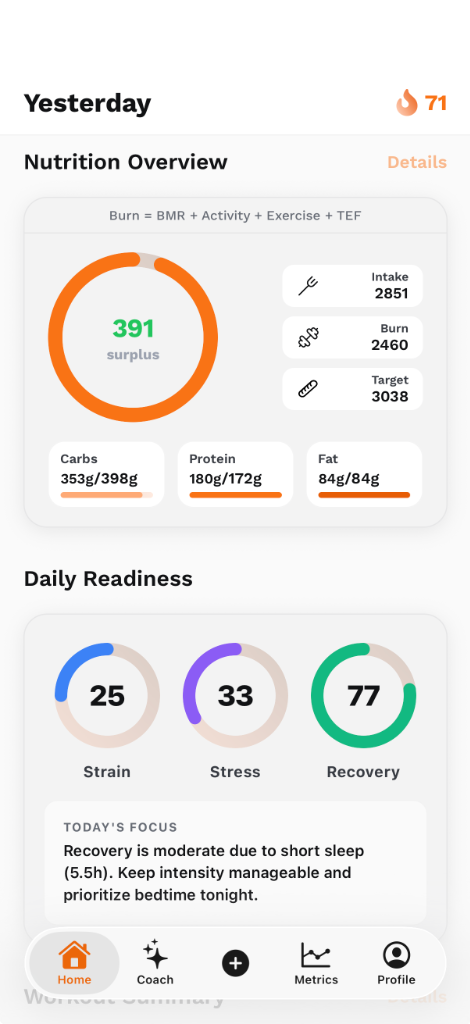
Readiness Scores (Strain, Stress, Recovery) integrate HRV and sleep data into actionable insights.
Hydration & Stress Dynamics: The Metabolic Spark Plugs
Water is the medium for every chemical reaction in your body, yet it’s often the most neglected metric. Chronic de-hydration causes a rise in resting heart rate and a drop in HRV, often mimicking overtraining. By tracking your daily water intake alongside your heart rate trends, you can identify whether a "bad day" in the gym was actually just a hydration failure.
Furthermore, monitoring your Biometric Trend Analysis—the long-term trends in yours RHR and HRV—allows you to see the true cost of your professional life on your physical recovery. If your stress score is 80 by 5:00 PM, your body is likely too depleted for a high-intensity session. Sync this data with yours body composition tracking to see how stress affects yours lean mass retention.
The Metrics That Matter: A Guide
| Metric | What it Measures | Optimal Goal |
|---|---|---|
| HRV | ANS Balance | A stable or rising trend line. |
| Deep Sleep % | Physical Repair | 15% to 25% of total sleep time. |
| RHR (Resting Heart Rate) | Cardiovascular Health | A declining trend or stable low. |
| Hydration (Liters) | Metabolic Medium | 3-4 Liters (adjusted for activity). |
| Active Volume | Cumulative Fatigue | Stay within your "MRV" (Max Recoverable Volume). |
Setting Up a Comprehensive Daily Tracking Routine
Tracking these advanced metrics sounds overwhelming, but with the tracking ecosystem of 2026, it takes less than five minutes a day:
- The Wake-Up Check (1 min): Check your UltraFit360 Readiness score first thing. See where your HRV and Sleep Architecture landed.
- Meal Snapping (30 sec per meal): Take photos of your meals for AI macro and fiber tracking.
- The Mid-Day Hydration Check (30 sec): Log your water intake at lunch to ensure you’re on track.
- The Post-Workout Review (1 min): Ensure your training volume (sets/reps) was logged to calculate cumulative strain.
Conclusion: Holistic Tracking is the Secret to Longevity
Calories tell you the quantity of your fuel; advanced metrics tell you the quality of your engine. By expanding your view to include HRV, sleep architecture, and stress recovery, you move from a state of mindless restriction to one of mindful optimization. You stop fighting your body and start collaborating with it. In 2026, the data is there—you just have to look beyond the calorie counter to see the full potential of your health.
Track More Than Just Calories
Connect your Apple Health or Health Connect to UltraFit360. Get instant insights into your HRV, sleep cycles, and daily readiness.