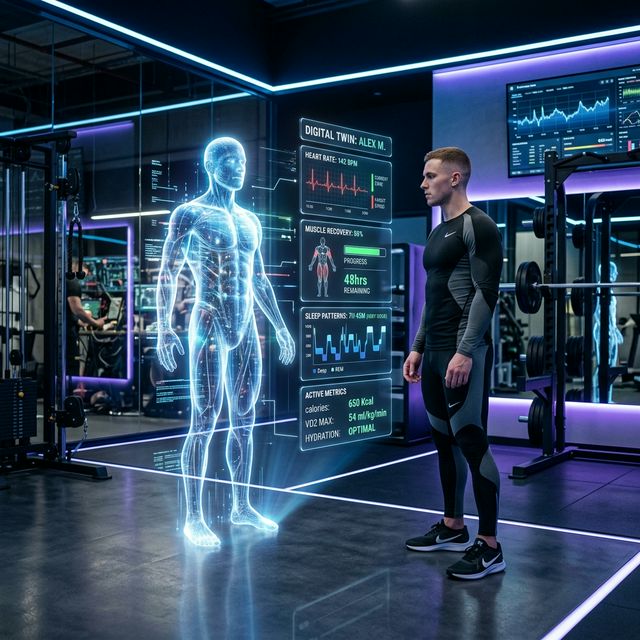
In the industrial world, engineers have long used "Digital Twins"—virtual replicas of complex machinery—to predict failures, optimize performance, and simulate real-world conditions without breaking the physical object. In 2026, this concept has finally made the leap from jet engines and smart cities to the most complex machine of all: the human body. We are no longer satisfied with apps that merely count steps or log calories. We are entering the era of the Biological Digital Twin.
A Digital Twin in health tech is a living, breathing virtual portrait of your physiological state. It is built from thousands of data points—from your heart rate variability (HRV) during sleep to the glycemic index of your breakfast. By centralizing this data, fitness apps like UltraFit360 provide a 360-degree view of your health, allowing you to predict burnout before it happens and optimize your training with surgical precision.
Beyond the Step Counter: The Evolution of Tracking
The first generation of fitness trackers were essentially digital pedometers. They rewarded you for volume—more steps, more miles, more minutes. But they were blind to the context of those actions. They didn't know if you were walking 10,000 steps on two hours of sleep or while fighting off a virus. They were reactive, not predictive.
The Digital Twin is the next evolution. It understands that your body is an interconnected web of systems. It knows that a high-stress day at work (Stress Score) combined with a poor night's sleep (Recovery Score) means that your planned "Heavy Leg Day" is likely to lead to injury or overtraining. It doesn't just track what you did; it analyzes what you can do.
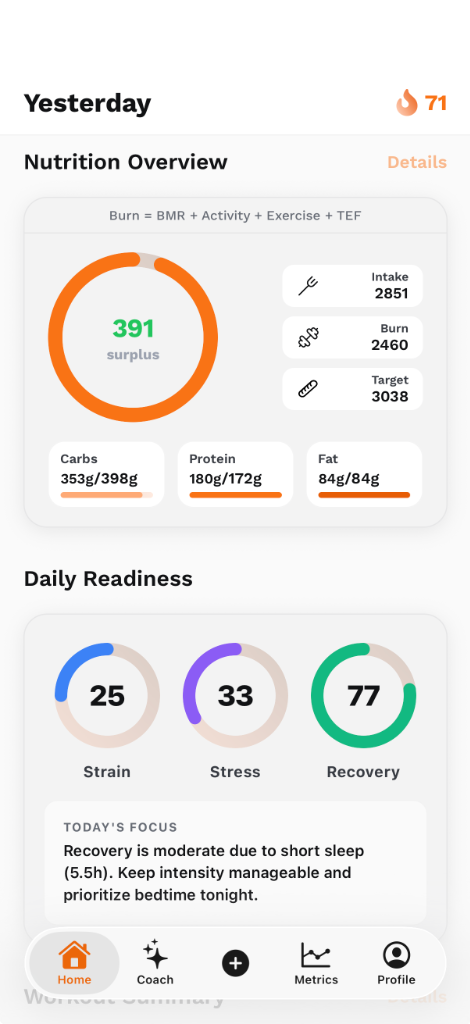
Your Digital Twin's Readiness Dashboard: Strain, Stress, and Recovery in one view.
The Three Pillars of Your Virtual Replica
To build an accurate Digital Twin, UltraFit360 synchronizes data from four primary streams, creating a unified physiological dashboard.
1. The Recovery Stream (Sleep & HRV)
Your "twin" monitors your sleep architecture—deep sleep, REM, and light sleep—alongside your Heart Rate Variability. HRV is the ultimate proxy for your Autonomic Nervous System. A high HRV indicates a body that is ready to adapt and perform; a low HRV signals a system that is under-recovered and fragile.
2. The Metabolic Stream (Nutrition & Glucose)
By logging your meals (using AI-vision) and potentially syncing with continuous glucose monitors (CGMs), your Digital Twin understands your specific insulin sensitivity and energy availability. It knows exactly how much "fuel" is in your system and how efficiently you are burning it.
3. The Strain Stream (Workouts & Daily Movement)
This is where your cardiovascular and resistance training data lives. Your Digital Twin tracks "Mechanical Load" (weight lifted) and "Cardiac Load" (heart rate zones) to determine the total stress placed on your tissues.
Predict vs. React: Avoiding the Overtraining Wall
The most significant game-changer of the Digital Twin concept is its ability to prevent burnout. Traditional fitness enthusiasts often "push through" fatigue, leading to a plateau or an injury that sets them back months. The Digital Twin provides an objective "Stop" or "Go" signal.
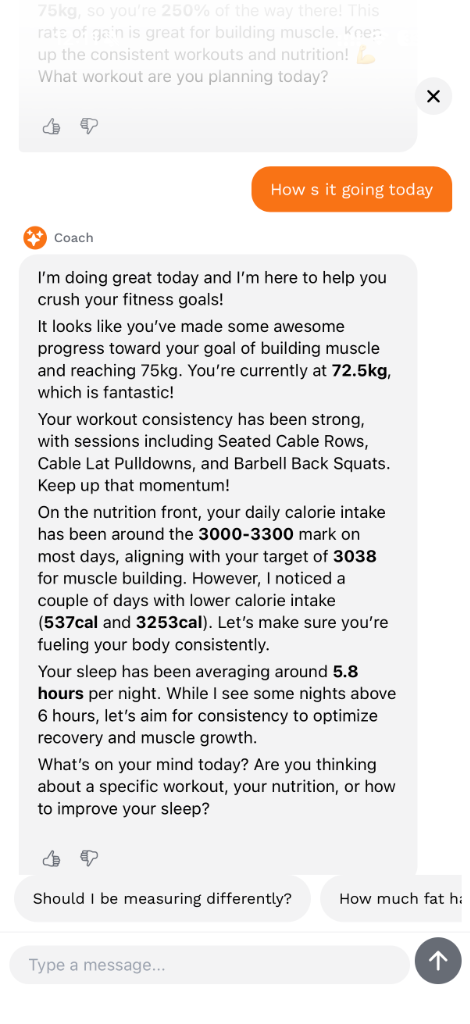
Your AI Coach uses your Digital Twin data to provide proactive course corrections.
If your readiness scores are in the red, your AI Coach might suggest swapping your HIIT session for a mobility flow or a long Zone 2 walk. This isn't about being lazy; it's about staying in the game. In 2026, the winner isn't the one who works the hardest—it's the one who recovers the smartest.
| Metric | The Old Way (Isolated Tracking) | The New Way (Digital Twin) |
|---|---|---|
| Steps | A daily number to hit regardless. | Contextualized by recovery and energy. |
| Workouts | Fixed schedule (Monday = Chest Day). | Dynamic based on physiological readiness. |
| Nutrition | Calculated once; static for weeks. | Adjusts daily based on activity and sleep. |
| Recovery | "I'll rest when I'm dead." | The primary driver of all training decisions. |
The Future of Holistic Health
As we look toward the later half of the decade, the Digital Twin will only become more sophisticated. We are moving toward real-time hormonal modeling and DNA-informed recommendations. Your UltraFit360 profile will eventually be a tool you can share with your doctor, providing years of continuous health data rather than a single "snapshot" from an annual blood test.
Conclusion: Take the Driver's Seat
Building your body's Digital Twin is about moving from guesswork to certainty. It's about respecting the complexity of your biology and using the incredible tech of 2026 to work with your body rather than against it. Sync your data, listen to your AI coach, and watch as your virtual twin guides you to a level of health and performance you never thought possible.
Start Building Your Twin Today
Connect your wearables and start generating your SSR scores. Your future self will thank you.