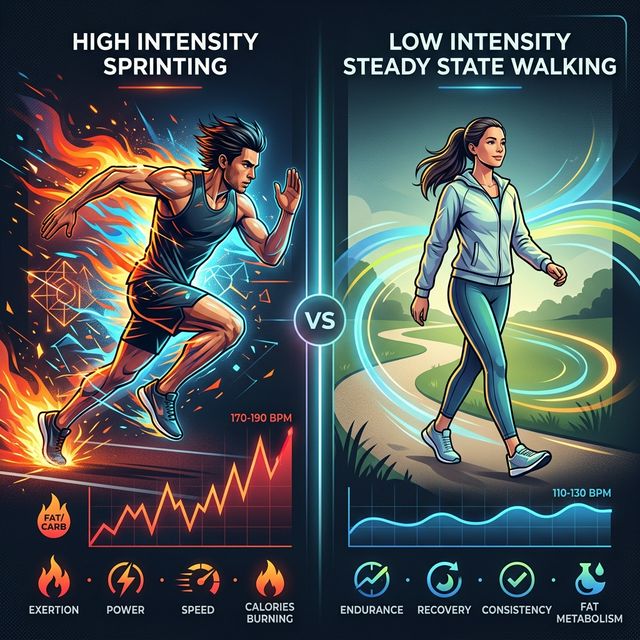
Cardio is a tool in your fat-loss toolbox. But like any tool, you need to know when to use a hammer (HIIT) and when to use a screwdriver (LISS). Both have distinct advantages, and the "best" one depends on your schedule and recovery capacity.
Defining the Terms
- HIIT: High-Intensity Interval Training. Think all-out sprints followed by short rest periods. Usually lasts 15-20 minutes.
- LISS: Low-Intensity Steady State. Think brisk walking, light cycling, or swimming. Usually lasts 45-60 minutes.
| Feature | HIIT | LISS |
|---|---|---|
| Time Commitment | Low (15-20 mins) | High (45-60 mins) |
| Burn Rate | High per minute | Low per minute |
| Recovery Needed | High (Systemic stress) | Very Low |
| Muscle Retention | Good | Very Good |
The Case for LISS
LISS is the most "sustainable" form of cardio. Because it puts very little stress on your central nervous system, you can do it every single day without affecting your heavy lifting sessions. For most people, **10,000 steps a day** is the ultimate LISS protocol.
The Case for HIIT
If you only have 20 minutes to work out, HIIT is the winner. It creates an "Afterburn Effect" (EPOC), where your metabolism stays elevated for hours after the session. However, it is very demanding on your joints and recovery.
Which Should You Choose?
If you are a beginner, start with **LISS**. It builds a cardiovascular base without risk of injury. If you are an intermediate athlete with a busy schedule, mix **1 HIIT session per week** with daily LISS.
Track Every Calorie with AI
Whether you're sprinting or walking, UltraFit360 calculates your exact calorie expenditure based on heart rate and movement data.
The Science and Strategy Behind HIIT vs LISS: Which Cardio is Best for Fat Loss? - UltraFit360 Blog
Understanding the deeper mechanics of this topic is essential for anyone looking to optimize their fitness journey in 2026. Recent advancements in exercise science and nutritional biology have shown that a holistic approach—balancing precise programming with adequate recovery—yields the most sustainable results. When we look closely at the physiological adaptations required for success, it becomes clear that consistency and data-driven adjustments are your best tools.
Furthermore, managing your metabolic health, sleep architecture, and daily stress levels plays a massive role in how your body responds to training. By treating your body as an integrated system, rather than isolated parts, you can unlock new levels of performance and longevity. This means paying attention to micronutrients, prioritizing joint mobility, and ensuring your nervous system has time to down-regulate after intense bouts of activity.
Common Myths and Misconceptions
The fitness industry is unfortunately filled with outdated advice. One of the biggest myths is that more is always better. In reality, the concept of Minimum Effective Dose (MED) is far more relevant. Training harder than your body can recover from leads to stagnation and injury. Another common misconception is the "one-size-fits-all" diet or workout plan. What works for a 20-year-old athlete will not work for a 50-year-old executive. Personalization, driven by tracking your unique data, is the only way forward.
Integrating These Concepts Daily
To make meaningful progress, you must seamlessly integrate these strategies into your daily routine. Start small. Focus on anchoring one new habit at a time, such as a 5-minute morning mobility flow or prioritizing protein at breakfast. Once that habit is automatic, layer the next one on top. Over months and years, these micro-habits compound into massive transformations. Remember, fitness is not a 12-week challenge; it is a lifelong pursuit of healthspan and vitality.
Frequently Asked Questions
How long does it take to see results?While neuro-muscular adaptations can happen within weeks, visible changes in body composition and significant improvements in cardiovascular capacity generally take 8 to 12 weeks of consistent effort.
Can I modify this for my fitness level?Absolutely. Every protocol should be scaled to match your current capabilities. The key is progressive overload—gradually increasing the challenge as your body adapts.
What is the most important factor for success?Consistency over perfection. Showing up and doing 80% of the work for a year will always beat doing 100% of the work for a month and then burning out. Focus on sustainability.