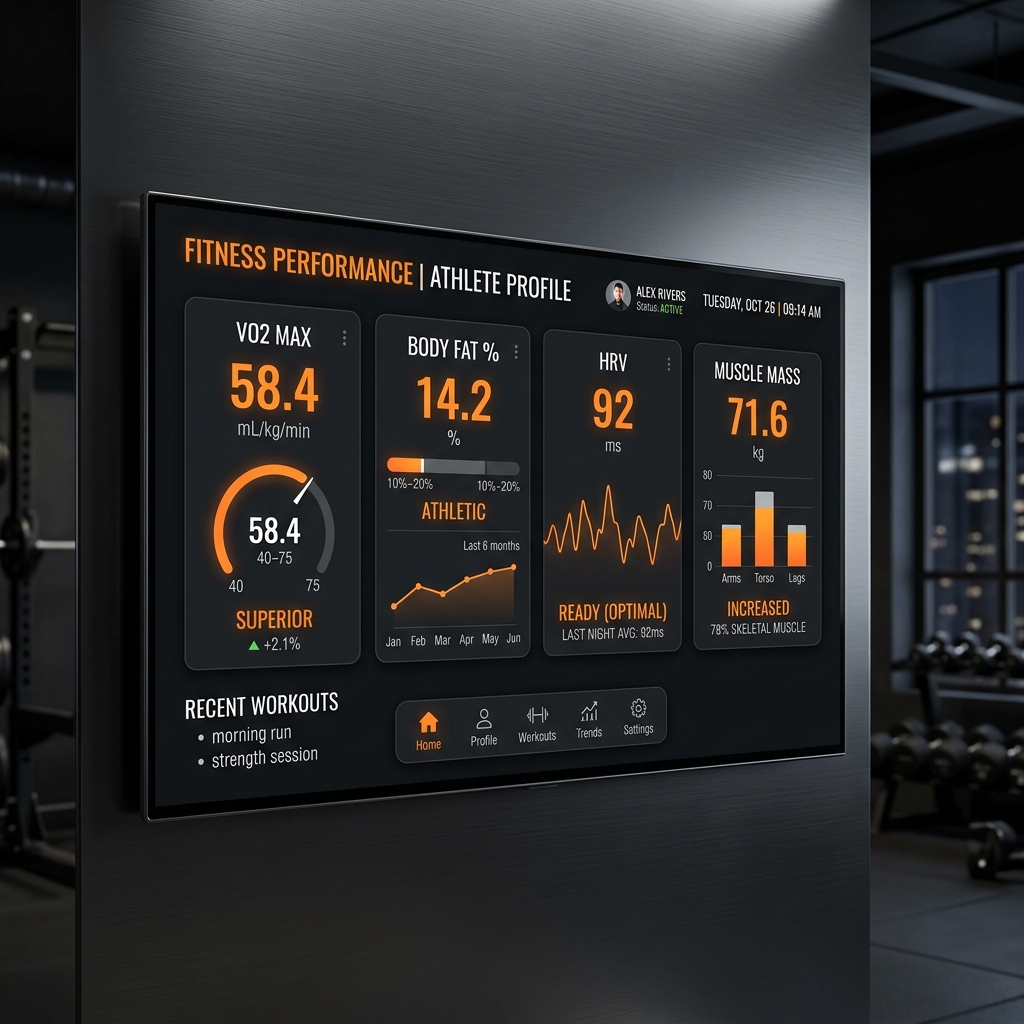
The scale is lying to you. You could gain 5 pounds of muscle and lose 5 pounds of fat — and the scale shows nothing. Or you could retain water for 3 days post-workout and think you're getting fatter. This guide reveals the metrics that actually matter: body composition (muscle vs fat), circumference measurements, and how to track progress when the scale is useless.
Why the Scale Is Misleading (And What Happens Instead)
Weight is the sum of everything: muscle, fat, water, organs, bones, food in your digestive tract. Here's what happens to your weight during a typical week:
- Monday morning: 185 lbs (after a weekend of normal eating)
- Monday evening: 187 lbs (you ate more food, drank more water)
- Tuesday morning: 184 lbs (you dehydrated overnight, digested the food)
- Wednesday post-workout: 186 lbs (muscle damage causes water retention; no fat was gained)
- Thursday after restaurant meal: 188 lbs (salt causes water retention)
- Friday morning: 185 lbs (you're back to "normal" weight)
Your weight fluctuates 3-5 lbs daily based on hydration, food volume, sodium intake, and training-induced inflammation. Weighing yourself daily creates false signals. You think you're "gaining fat" when you're actually just dehydrated or holding water post-workout.
Body Composition: The Metrics That Matter
1. Body Fat Percentage (via DEXA, BodPod, or Bioimpedance)
Body fat % is the ratio of fat mass to total body weight. Example: 185 lbs at 15% body fat = 28 lbs of fat, 157 lbs of lean mass (muscle + bone + organs).
Accuracy comparison:
- DEXA Scan (Gold Standard): ±1-2% accuracy. Uses dual X-ray absorptiometry to measure tissue density. Cost: $200-400 per scan
- BodPod (Air Displacement): ±2-3% accuracy. You sit in a pod; it measures your body volume. Cost: $150-300
- Bioimpedance (Inbody, TANITA): ±3-5% accuracy. Sends electrical current through you; measures resistance. Cost: $50-150 per scan, or free at many gyms
- Skinfold Calipers (Jackson Pollock): ±3-4% accuracy if done by trained technician. Cost: $20-50
- Visual Estimation: ±5-10% accuracy. You compare your physique to reference images. Cost: Free but unreliable
Recommendation: Start with a DEXA scan to establish a baseline. Then use Inbody or TANITA bioimpedance every 4-6 weeks (cheaper than DEXA, reasonable accuracy for tracking trends). Recheck with DEXA every 12 weeks to validate bioimpedance accuracy.
2. Lean Body Mass (LBM) Trend
Lean body mass = total weight minus fat weight. Tracking LBM is superior to tracking total weight because it shows whether you're gaining muscle or just gaining fat.
Example:
- Month 1: 185 lbs @ 15% BF = 28 lbs fat, 157 lbs LBM
- Month 2: 187 lbs @ 14% BF = 26 lbs fat, 161 lbs LBM
Your weight went up 2 lbs, but you lost 2 lbs of fat and gained 4 lbs of muscle. The scale said "you're gaining weight" but your body actually improved. Tracking LBM reveals this truth.
3. Circumference Measurements (Waist, Chest, Arms, Legs)
Measure with a soft tape measure. Record in cm or inches weekly. This is sensitive to fat loss without the noise of daily water fluctuations.
Key measurements:
- Waist (at navel): Tracks visceral fat (the dangerous kind). 1-cm decrease every 2 weeks = good fat loss progress
- Chest (around nipples): Tracks upper body muscle/fat changes
- Arms (flexed bicep): Tracks muscle gain during hypertrophy phases (1-2 cm gain over 12 weeks = solid muscle gain)
- Thighs (mid-thigh, not flexed): Tracks leg muscle/fat changes
Advantage over weight: Circumference measurements are stable week-to-week (not affected by water retention), making them better for identifying real progress. A 0.5 cm waist loss in one week = real fat loss, not water fluctuation.
The Complete Tracking Protocol for Body Composition Change
Tracking Schedule
Weekly (Every Sunday morning, consistent timing):
- Weight (naked, after bathroom, before breakfast)
- Circumference measurements (waist, chest, arms, legs)
- Compliance check (% of meals logged, % of workouts completed)
Monthly (1st of each month):
- Bioimpedance body composition scan (Inbody or TANITA)
- Photos (front, side, back, relaxed and flexed)
Quarterly (Every 12 weeks):
- DEXA or BodPod scan (validate bioimpedance accuracy)
- Full body measurements (above + hip, forearm, calf)
How to Interpret the Data
Scenario #1: You're Losing Fat + Gaining Muscle (Ideal Recomposition)
- Weight: Stable (no change) or slight increase
- Circumferences: Waist decreasing 0.5-1 cm/week, arms stable or increasing
- Body fat %: Decreasing 1% per month
- LBM: Increasing 1-2 lbs/month
- Conclusion: Perfect progress. Maintain current nutrition and training
Scenario #2: You're Losing Weight But No Body Composition Change
- Weight: Decreasing 1-2 lbs/week
- Body fat %: Not decreasing
- Circumferences: Stable (not decreasing)
- Conclusion: You're losing muscle, not fat. Increase protein, reduce calorie deficit intensity, prioritize strength training
Scenario #3: You're Gaining Weight But Can't See Progress
- Weight: Increasing 1-2 lbs/week
- Body fat %: Increasing 1%+ per month
- Circumferences: Waist increasing, arms increasing equally
- Conclusion: You're eating too much (calorie surplus too high). Reduce calories by 200-300/day, maintain training
Common Tracking Mistakes
Mistake #1: Weighing Yourself Daily and Reacting to Fluctuations
Weight fluctuates 3-5 lbs daily. Daily weigh-ins create emotional volatility ("I'm fat" on a day you retained water). Instead, weigh weekly at the same time, same conditions, and track the 4-week moving average.
Mistake #2: Trusting Bathroom Scales
Consumer bathroom scales have ±2-3 lb error. A $30 scale says you're 185 lbs; you're probably 183-187 lbs. Invest in a better scale ($100-200 digital scale) or use gym scales weekly for consistency.
Mistake #3: Ignoring Measurement Consistency
Waist measurement varies 1-2 cm depending on where you place the tape, how tight you pull, and whether you've eaten. Always measure the same location, same time of day, same procedure. Consistency matters more than absolute accuracy.
Mistake #4: Taking Photos Inconsistently
Take progress photos under identical conditions: same lighting, same pose (relaxed front/side/back), same time of day. Lighting and pose can make 10 lb differences look invisible or exaggerated.
Body Composition Goals by Level
Beginners (0-1 year training)
- Goal body fat %: 12-15% (men), 20-23% (women)
- Rate of change: 1% body fat decrease per month is aggressive but doable
- Track: Weekly weight, monthly body fat %, quarterly photos
Intermediate (1-3 years training)
- Goal body fat %: 10-12% (men), 18-20% (women)
- Rate of change: 0.5-1% body fat per month
- Track: Weekly weight + measurements, bi-weekly body fat %, monthly photos
Advanced (3+ years training)
- Goal body fat %: 8-10% (men), 16-18% (women)
- Rate of change: 0.25-0.5% body fat per month (very slow — harder to drop below 10%)
- Track: Weekly weight + measurements, weekly body fat %, weekly photos (micro-progress is important)
The Metric Dashboard: Tracking Everything
Spreadsheet format (Google Sheets or Excel):
- Column A: Date
- Column B: Weight (lbs)
- Column C: Waist (cm)
- Column D: Chest (cm)
- Column E: Arms (cm)
- Column F: Body Fat % (if measured)
- Column G: LBM (if measured)
- Column H: Notes (what changed, how you felt, food deviations, stress)
With 12 weeks of data, you'll see patterns: weeks where you lose fat, weeks where you plateau, correlations between your adherence and results. This data-driven approach removes guesswork.
Advanced Metric: Muscle-to-Fat Ratio & Recomposition Tracking
Beyond basic body fat %, elite athletes track the ratio of muscle gained to fat lost. This reveals recomposition quality.
Example of poor recomposition: You lose 10 lbs fat but also lose 5 lbs muscle (gaining nothing). This is a 2:1 ratio (2 lbs fat lost per 1 lb muscle lost). Not ideal.
Example of good recomposition: You lose 10 lbs fat while gaining 5 lbs muscle. This is 2:1 ratio in the opposite direction (fat loss with muscle retention). Ideal.
How to calculate: Month 1 body fat = 28 lbs fat + 157 lbs LBM. Month 2 body fat = 26 lbs fat + 161 lbs LBM. Fat loss = 2 lbs, muscle gain = 4 lbs. Ratio = 4 lbs muscle per 2 lbs fat loss = 2:1 muscle-favorable ratio.
Why this matters: Not all weight loss is equal. Losing 10 lbs while preserving/building muscle is vastly superior to losing 10 lbs of pure fat. The recomposition ratio shows this quality difference.
Measurement Protocol for Advanced Athletes
If you have access to multiple measurement methods, here's the protocol for maximum precision:
Monthly (Week 1):
- DEXA scan (gold standard body composition)
- Full circumference measurements (waist, chest, arms, legs, hips, forearm, calf)
- Progress photos (front/side/back, relaxed + flexed)
- Weight (morning, consistent protocol)
Weekly (Every Sunday):
- Weight (same scale, same time)
- Circumference measurements (waist, chest, arms)
- Bioimpedance or TANITA scan (if available)
After 12 weeks of data: You'll see clear patterns. Which metrics moved first? Which changed last? This reveals your body's response profile — where you lose fat first, where you gain muscle first. This becomes your personal recomposition blueprint.
Research on Body Composition Tracking
Key findings from sports science research:
- Helms et al. (2014): Study in Sports Medicine showed that athletes tracking body composition alongside strength metrics progressed 20-30% faster than those tracking strength alone
- Norton & Olds (2001): Validated circumference measurements as reliable proxy for body composition change (within ±2% of DEXA when done consistently)
- Kerksick et al. (2017): International Society of Sports Nutrition meta-analysis showing weekly tracking beats monthly for identifying trends (more data = better pattern detection)
Translation: You can track body composition effectively with just weekly weigh-ins + circumference measurements. DEXA is nice for validation, but not essential if you're consistent with measurements.
Why Metrics Matter: The Psychology of Progress
Progress fuels motivation. If you only weigh yourself and the scale doesn't budge, you feel defeated. But if you track circumference, body fat %, and photos, you see progress every week — even if weight is stable. This psychological boost keeps you consistent, and consistency compounds into massive results.
Expected timeline of visible progress:
- Week 1-2: No visible change (mostly water/glycogen changes)
- Week 3-4: Circumferences begin decreasing 0.5-1 cm (real fat loss begins showing)
- Week 5-8: Photos show visible definition changes (vasc ularity, muscle separation more obvious)
- Week 9-12: Dramatic before/after visible. Friends start noticing. Motivation is now self-reinforcing