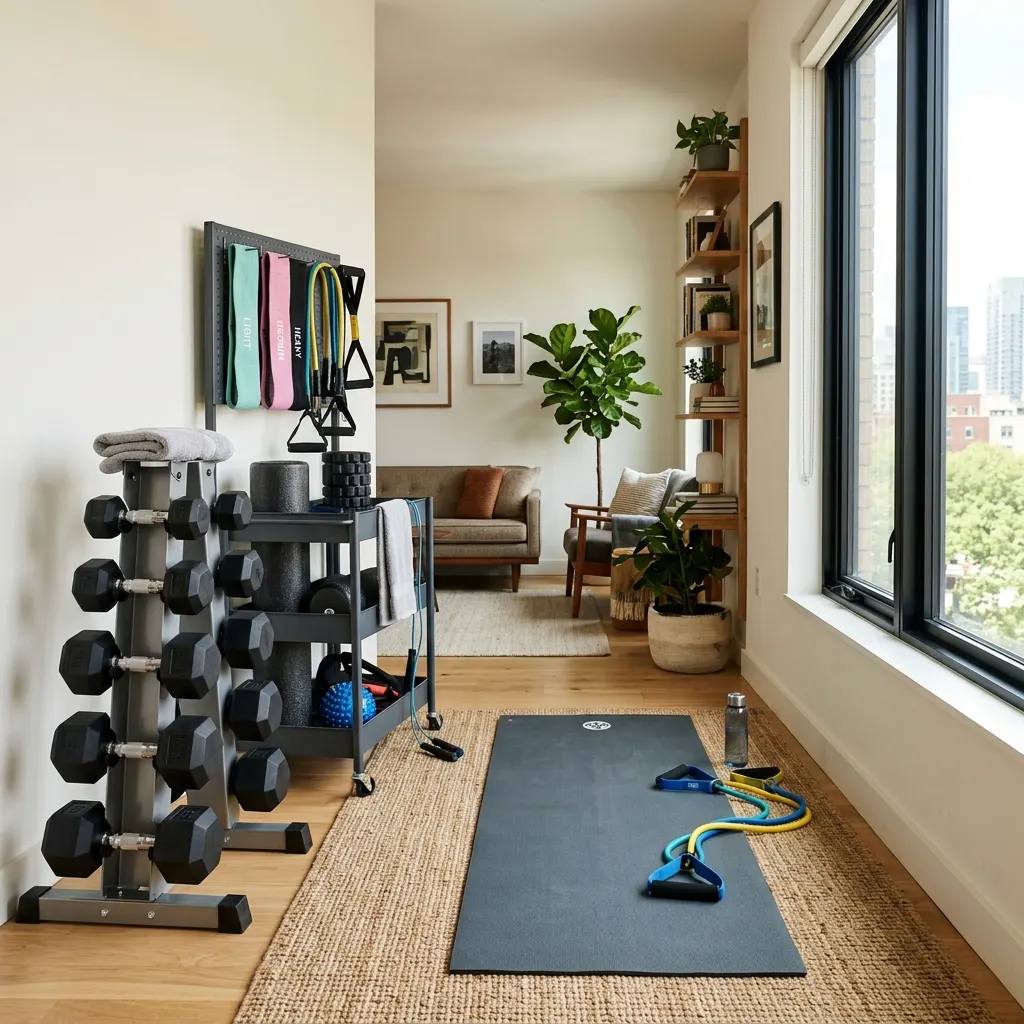
💡 Quick Answer
A dumbbell workout at home can build muscle with one adjustable pair. Beginners should train full body 3 days a week: goblet squat, Romanian deadlift, floor press, one-arm row, overhead press and hip thrust for 3 sets of 8–12 reps. Add weight once you hit 12 reps on every set.
- Buy adjustable dumbbells: 10–20 kg per hand for men, 7.5–12.5 kg for women covers most people.
- No bench needed: floor press and sofa-supported rows work well.
- Move to a 4-day upper/lower split after 3–6 months.
- Eat about 1.6 g protein per kg body weight to actually grow.
A dumbbell workout at home is the most space-efficient way to build real muscle without a gym. One pair of adjustable dumbbells covers every major muscle, fits under a bed and lets you keep adding weight for a year or more. This guide gives you the dumbbell exercises worth doing, two complete plans with sets and reps (3-day full body and 4-day upper/lower), what weights to buy, and how to progress.
Which Dumbbells to Buy for Home
| Type | Good for | Watch out for |
|---|---|---|
| Fixed rubber or cast-iron pairs (e.g. 5 kg and 7.5 kg) | Grab-and-go training, very durable | You outgrow them; buying many pairs takes space |
| Plate-loaded adjustable (rod + collars + plates) | Cheapest way to go from 2.5 kg to 15–20 kg per hand | Changing plates takes a minute; check collars lock tight |
| Dial/selector adjustable | Fast weight changes in a tiny footprint | Costs much more; check the weight range and warranty |
| PVC sand-filled | Very light toning work only | Bulky for the weight and you outgrow them quickly |
For most people in Indian flats, a plate-loaded adjustable set is the best value: one pair of handles plus plates replaces six or seven fixed pairs. Rubber-coated plates are quieter on tiles than bare iron. Keep them on a mat, not directly on marble or vitrified tiles, which chip easily. For a wider setup (bench, mat, bands, pull-up bar) with budget tiers, see our home gym setup guide.
What weight should you start with?
| You are… | Starting pair (per hand) | Range to aim for in 6–12 months |
|---|---|---|
| Beginner man | 5–7.5 kg | 10–20 kg (adjustable set) |
| Beginner woman | 2.5–5 kg | 7.5–12.5 kg (adjustable set) |
| Already lifting in a gym | Match your current working weights | Adjustable set up to 20–25 kg |
Leg and back exercises usually need heavier dumbbells than shoulder and arm exercises. That is the main argument for adjustable sets: your goblet squat may need 12.5 kg while your lateral raise needs 4 kg.
The Best Dumbbell Exercises, by Muscle Group
| Muscle group | Best dumbbell exercises | Typical sets × reps |
|---|---|---|
| Chest | Floor press, push-up (dumbbells as handles), floor fly | 3 × 8–12 |
| Back | One-arm row (hand on chair), bent-over row, pullover on floor | 3 × 10–12 |
| Shoulders | Seated or standing overhead press, lateral raise, rear-delt fly | 3 × 8–15 |
| Quads and glutes | Goblet squat, split squat, reverse lunge, step-up on a sturdy step | 3 × 8–12 |
| Hamstrings and glutes | Romanian deadlift, single-leg RDL, dumbbell hip thrust | 3 × 10–12 |
| Biceps | Alternating curl, hammer curl | 2–3 × 10–15 |
| Triceps | Overhead triceps extension, floor skull crusher | 2–3 × 10–15 |
| Core | Suitcase carry, weighted dead bug, renegade row | 2–3 × 30 s or 8–10 per side |
| Calves | Single-leg calf raise holding one dumbbell | 3 × 12–20 |
No bench? The floor press replaces the bench press: lie on a mat, elbows touch the floor at the bottom of each rep. It protects the shoulders and is still an excellent chest and triceps builder. A sturdy sofa edge or the side of your bed works for hip thrusts and one-arm rows.
Warm-Up (5 Minutes)
- 60 s marching or brisk walking in place
- 10 arm circles each way, 10 band or broomstick pull-aparts if you have them
- 10 bodyweight squats and 10 hip hinges
- One light set of your first exercise at about half your working weight
Plan 1: 3-Day Full-Body Dumbbell Workout (Beginners)
Train on non-consecutive days, for example Monday, Wednesday and Friday. Each session takes 40–50 minutes. Every set should end with 1–3 reps left in reserve.
| Exercise | Day 1 | Day 2 | Day 3 | Rest |
|---|---|---|---|---|
| Goblet squat | 3 × 10–12 | — | 3 × 10–12 | 90 s |
| Romanian deadlift | — | 3 × 10–12 | — | 90 s |
| Split squat | — | 3 × 8–10 per leg | — | 60 s |
| Floor press | 3 × 8–12 | — | 3 × 8–12 | 90 s |
| One-arm row | 3 × 10–12 per arm | — | 3 × 10–12 per arm | 60 s |
| Overhead press (seated) | — | 3 × 8–10 | — | 90 s |
| Bent-over row | — | 3 × 10–12 | — | 60 s |
| Hip thrust (back on sofa or bed edge) | 3 × 12 | — | 3 × 12 | 60 s |
| Lateral raise | 2 × 12–15 | — | 2 × 12–15 | 45 s |
| Curl + overhead triceps extension | — | 2 × 12 each | — | 45 s |
| Suitcase carry or dead bug | 2 × 30 s per side | 2 × 8 per side | 2 × 30 s per side | 45 s |
This plan suits your first 3–6 months. It works every muscle about three times a week with enough rest between sessions, which is how most beginners build muscle fastest.
Plan 2: 4-Day Upper/Lower Dumbbell Split (Intermediate)
Once you have trained consistently for a few months and sessions feel short, move to four days. Rest on Wednesday and the weekend, or walk.
| Day | Focus | Exercises (sets × reps) |
|---|---|---|
| Monday | Upper A | Floor press 4 × 8–10; one-arm row 4 × 10; overhead press 3 × 8–10; lateral raise 3 × 12–15; hammer curl 2 × 12; overhead extension 2 × 12 |
| Tuesday | Lower A | Goblet squat 4 × 10; Romanian deadlift 3 × 10; reverse lunge 3 × 10 per leg; calf raise 3 × 15; dead bug 3 × 8 per side |
| Thursday | Upper B | Push-up on dumbbells 3 × max (stop 2 short); bent-over row 4 × 10; Arnold press 3 × 10; floor fly 3 × 12; rear-delt fly 3 × 15; curl 3 × 10 |
| Friday | Lower B | Split squat 4 × 8 per leg; single-leg RDL 3 × 10 per leg; hip thrust 3 × 12; step-up 2 × 10 per leg; suitcase carry 3 × 30 s per side |
Curious how this compares with a bro split or push-pull-legs? Read bro split vs PPL. For home trainees with limited time, full body or upper/lower almost always beats a five-day bro split.
How to Progress: The Double-Progression Method
Pick a rep range (for example 8–12). Stay at one weight until you can do the top of the range on every set with good form, then increase the weight and drop back to the bottom of the range.
| Week | Target | Example: goblet squat with 10 kg |
|---|---|---|
| 1 | Bottom of the rep range on all sets | 3 × 10 |
| 2 | Add 1 rep on some sets | 11, 10, 10 |
| 3 | Add more reps | 12, 11, 11 |
| 4 | Top of range on all sets | 12, 12, 12 |
| 5 | Increase weight, drop back to the bottom of the range | 12.5 kg for 3 × 10 |
Jumps of 2.5 kg per dumbbell can be too big for small muscles like shoulders. When you can't add weight, add reps beyond the range, add a set, or slow the lowering to 3 seconds. Fractional plates of 1–1.25 kg are worth buying if your set allows it.
Dumbbell Workout for Weight Loss
Lifting builds and keeps muscle, which matters most when you are eating less. But the scale moves because of a calorie deficit, not because of the specific workout. Combine either plan with 7,000–10,000 daily steps and eat about 300–500 kcal below maintenance; the calorie calculator gives you a starting number. If you want extra conditioning, finish two sessions a week with a 10-minute circuit: goblet squat, push-up, bent-over row and reverse lunge, 40 s each, 20 s rest.
Eating to Build Muscle at Home
Training is half the job. Aim for roughly 1.6 g of protein per kg of body weight per day spread over 3–4 meals, and a small calorie surplus (about 250–300 kcal) if your goal is to gain size. On an Indian diet that means a protein source at every meal: curd or eggs at breakfast, dal plus paneer, soya or chicken at lunch and dinner, and milk or a whey shake when you fall short. See how much protein Indians need for muscle and the Indian gym diet plan for meal-by-meal examples.
Safety Tips for Small Indian Homes
- Clear a 2 m × 1.5 m zone with nothing breakable in arm's reach for overhead presses.
- Check plate collars before every set; a loose collar is the most common home-gym accident.
- Lower dumbbells to the floor with control. Dropping them cracks tiles and annoys neighbours.
- Store dumbbells flat on the floor, not on a shelf, especially with small children at home.
Not sure which plan fits your schedule? The AI workout planner can build a dumbbell-only programme around your available weights and days.
Frequently Asked Questions
Can I build muscle with only dumbbells at home?
Yes. Dumbbells let you train every major muscle with enough load to build size for a long time. The key is progressive overload: add reps, then weight, every week or two, and eat enough protein.
What weight dumbbells should a beginner buy?
Most beginner men start with 5–7.5 kg per hand and most beginner women with 2.5–5 kg. An adjustable set that goes to about 15–20 kg per hand avoids buying multiple pairs as you get stronger.
Are 5 kg dumbbells enough?
5 kg dumbbells are enough for shoulder raises, arm work and early beginner sessions, but most people outgrow them for squats, rows and Romanian deadlifts within a few weeks. Plan to go heavier.
How many days a week should I do a dumbbell workout?
Three full-body days a week is ideal for beginners. After a few months of consistent training, a 4-day upper/lower split lets you add more volume.
Is a dumbbell workout good for weight loss?
Yes, it helps you keep muscle while losing fat. Weight loss itself comes from a calorie deficit, so pair the workouts with daily walking and eating about 300–500 kcal below maintenance.
Do I need a bench for dumbbell exercises at home?
No. Floor press replaces bench press, rows can be done with one hand on a chair, and hip thrusts work with your back on a sofa or bed edge. A bench is a useful later upgrade.
Want a plan built around your training history? UltraFit360's free AI workout planner creates and adjusts programs for you.
Log Your Dumbbell Sessions
Track weights, reps and weekly progress, and let UltraFit360's AI coach tell you when to go heavier.