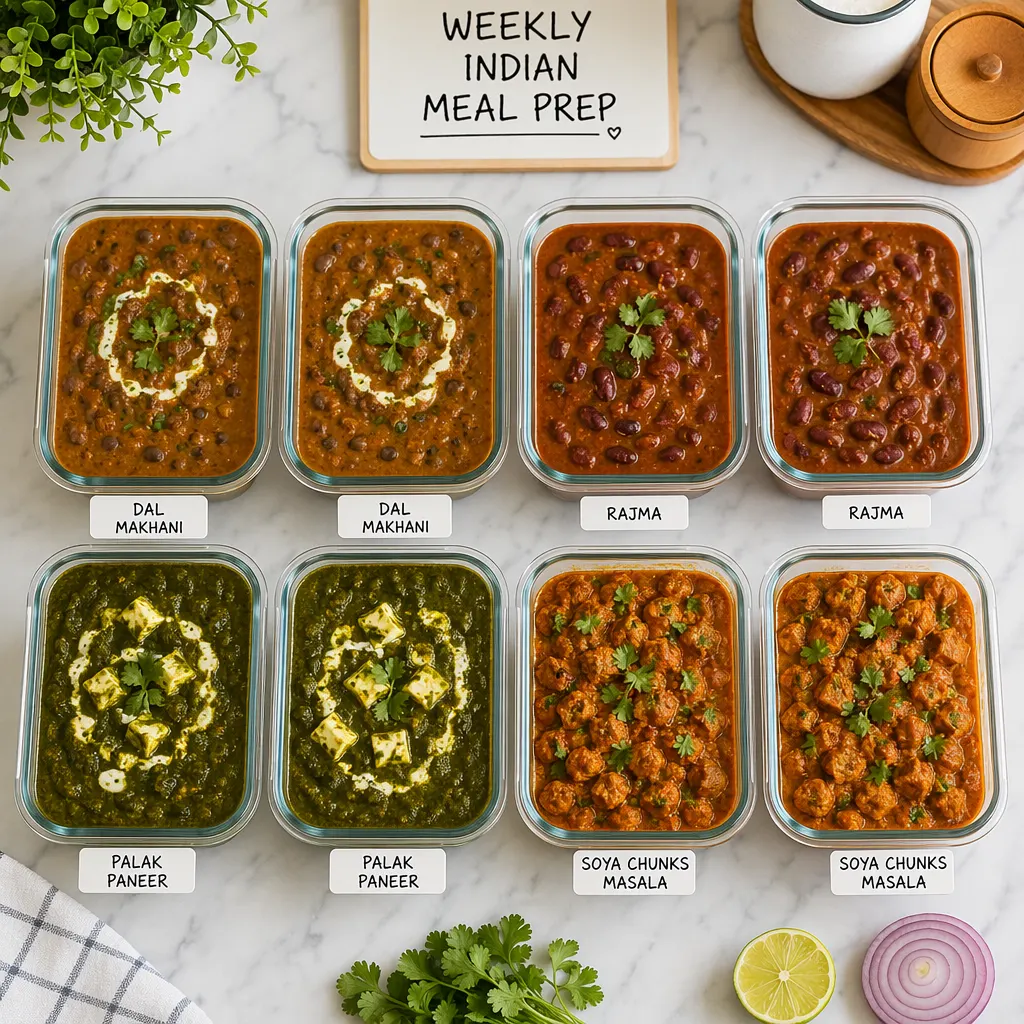
💡 Quick Answer
Indian meal prep for working professionals works best as component prep. In a 2–2.5 hour Sunday session, cook two proteins (a dal or legume plus paneer, soya or chicken), one grain, two sabzis and a chutney, then assemble different lunches daily. Cooked food keeps 3–4 days in the fridge, so add a 45-minute top-up on Wednesday.
- Prep components, not identical meals, to avoid food fatigue.
- Cook rice every 1–2 days and roti dough rather than rotis.
- Pack lunch cold with an ice pack; perishable food should not sit out over 2 hours.
- Same menu works for fat loss or muscle gain by changing rice, roti and oil portions.
Back-to-back meetings, a long commute and a 9 pm dinner make it easy to live on canteen food, biscuits and delivery apps. Meal prep fixes that, but the version you see on Instagram, with seven identical boxes of chicken and broccoli, rarely survives an Indian household. What works better is prepping components: dal, a protein, a grain and a couple of sabzis that you combine differently each day.
The Component System
Instead of cooking complete meals for the week, cook building blocks you can mix:
- 2 protein bases: one dal or legume (rajma, chole, moong) and one of paneer, soya chunks, eggs or chicken.
- 1–2 grains: a pot of rice or millet for two days, and roti dough or ready rotis.
- 2 vegetables: one dry sabzi (beans, cabbage, bhindi) and one gravy or a big box of chopped salad.
- 1 flavour booster: green chutney, onion-tomato masala or a curd dip.
Monday's lunch becomes rajma, rice and salad; Tuesday's is paneer, roti and beans; Wednesday's is a paneer-rice bowl with chutney. Same Sunday cooking, different meals.
Sunday Prep Plan (About 2–2.5 Hours)
| Time | Task |
|---|---|
| 0:00 | Put soaked rajma or chole in the pressure cooker. Start rice or millet on the second burner. |
| 0:15 | Make a large batch of onion-tomato masala; keep half aside for the week. |
| 0:40 | Finish the rajma or chole with half the masala. Pressure-cook moong or toor dal. |
| 1:00 | Cook the paneer bhurji, soya chunk masala or chicken with the remaining masala. |
| 1:20 | Cook one dry sabzi. Chop salad vegetables and store them dry in boxes lined with paper towel. |
| 1:45 | Knead roti dough, blend green chutney, boil eggs if you eat them. |
| 2:00 | Cool food quickly, portion into containers, label with the date and refrigerate. |
Add a 45-minute top-up on Wednesday evening: a fresh dal, a fresh sabzi and fresh rice. This keeps everything within safe fridge times and stops food fatigue.
A 5-Day Indian Meal Prep Plan
Protein figures are rough estimates for a vegetarian day of normal portions; adjust quantities to your calorie target with the calorie calculator.
| Day | Breakfast | Office lunch | Evening snack | Dinner | Protein (approx.) |
|---|---|---|---|---|---|
| Mon | Poha with peanuts + curd | Rajma, rice, kachumber salad | Roasted chana | Paneer bhurji, 2 rotis, beans sabzi | ~55–65 g |
| Tue | Besan chilla + curd | Paneer, 2 rotis, beans sabzi, salad | Buttermilk + peanuts | Moong dal, rice, cabbage sabzi | ~60–70 g |
| Wed | Overnight oats with milk and seeds | Paneer rice bowl with green chutney | Fruit + Greek yogurt | Fresh dal, fresh sabzi, 2 rotis | ~55–65 g |
| Thu | Moong chilla + curd | Soya chunk masala, rice, salad | Sprouts chaat | Chole, 2 rotis, salad | ~60–65 g |
| Fri | Paneer paratha + curd | Chole rice bowl, salad | Roasted chana + buttermilk | Moong dal khichdi + curd | ~60–65 g |
Non-vegetarians can swap paneer or soya for grilled chicken, egg bhurji or fish curry. These days land around 55–70 g of protein, which is more than most office-goers eat but below a lifter's target. To reach 1.6 g per kg, add a whey shake (about 22–25 g) or an extra 100 g of paneer or chicken (about 18–30 g) each day. See our guides to high-protein Indian meal prep recipes and healthy office tiffin ideas for more options.
Adjusting for Fat Loss or Muscle Gain
| Fat loss | Muscle gain | |
|---|---|---|
| Protein | Keep high: 1.6–2.0 g per kg body weight | 1.6–2.0 g per kg body weight |
| Rice / roti | 1 cup rice or 2 rotis per meal | 1.5–2 cups rice or 3–4 rotis per meal |
| Oil and ghee | Measure: 1–2 tsp per dish | Normal amounts |
| Vegetables | Fill half the box | Plenty, but leave room for carbs |
| Snacks | Buttermilk, roasted chana, fruit | Milk, peanuts, banana, whey shake |
The structure stays the same; only portions change. That is the main reason component prep is easier to stick to than a separate "diet" menu.
How Long Does Prepped Indian Food Last?
As a general food-safety rule (USDA), cooked leftovers keep 3–4 days in a fridge at 4°C or below. Rice needs extra care because it can carry bacterial spores that survive cooking, so cool it fast and use it within a day or two.
| Food | Fridge | Freezer | Tip |
|---|---|---|---|
| Dal, rajma, chole | 3–4 days | Up to about 3 months | Freeze half the batch on Sunday |
| Paneer or soya curry | 3 days | Paneer gravies freeze; texture may soften | Add fresh paneer cubes to frozen gravy |
| Dry sabzi | 2–3 days | Not ideal | Cook a second sabzi on Wednesday |
| Cooked rice | 1–2 days | Up to about a month | Spread out to cool, then refrigerate |
| Roti dough | 2–3 days | Freezes well in portions | Make rotis fresh each morning |
| Chopped salad vegetables | 2–3 days | No | Store dry with a paper towel; add lemon when eating |
Keeping Your Tiffin Safe at the Office
Perishable food should not sit at room temperature for more than 2 hours, or 1 hour when the air is above about 32°C, which is a normal summer day in much of India. If your office has a fridge, use it. If not:
- Pack lunch straight from the fridge into an insulated tiffin or lunch bag with an ice pack.
- Choose drier dishes (sabzi, paneer tikka, chole) over thin gravies and curd-based dishes on hot days; carry curd separately and cold.
- Reheat until steaming hot all the way through if there is a microwave.
- Throw away anything that has sat out warm all afternoon rather than eating it at 7 pm.
Weekly Shopping List
- Proteins: rajma or chole, moong and toor dal, besan, paneer (400–500 g), soya chunks, curd, milk, eggs or chicken if you eat them.
- Grains: rice or millets, atta, oats, poha.
- Vegetables: onions, tomatoes, ginger, garlic, green chillies, beans, cabbage, cucumber, carrots, spinach, coriander, mint, lemons.
- Snacks: roasted chana, peanuts, fruit, Greek yogurt.
Prefer not to plan it yourself? The meal plan generator builds a week from Indian recipes around your calorie and protein target.
Frequently Asked Questions
How long does cooked dal last in the fridge?
Cooked dal, rajma and chole keep for 3 to 4 days in a fridge at 4°C or below. Freeze extra portions on the day you cook them and they will keep for about 3 months.
Can I meal prep rotis?
Rotis go dry and hard after a day. Prep the dough instead: it keeps 2 to 3 days in the fridge or longer frozen, and fresh rotis take about 10 minutes each morning.
How do I keep my tiffin safe without an office fridge?
Pack food cold in an insulated tiffin with an ice pack, choose drier dishes on hot days, and do not leave perishable food out for more than 2 hours, or 1 hour above about 32°C.
How much time does Indian meal prep take?
About 2 to 2.5 hours on Sunday for 5 days of lunches and most dinners, plus a 45-minute top-up on Wednesday for fresh dal, sabzi and rice.
Is meal prep good for weight loss?
Yes. Pre-portioned meals make it easier to control rice, roti and oil, and stop last-minute delivery orders. Keep protein high and fill half the box with vegetables.
Set your targets with the free calorie and macro calculator, then build a day of meals with the meal plan generator.
Log Your Tiffin in Seconds
Photograph your lunch box and UltraFit360's AI identifies the Indian dishes and logs the macros.