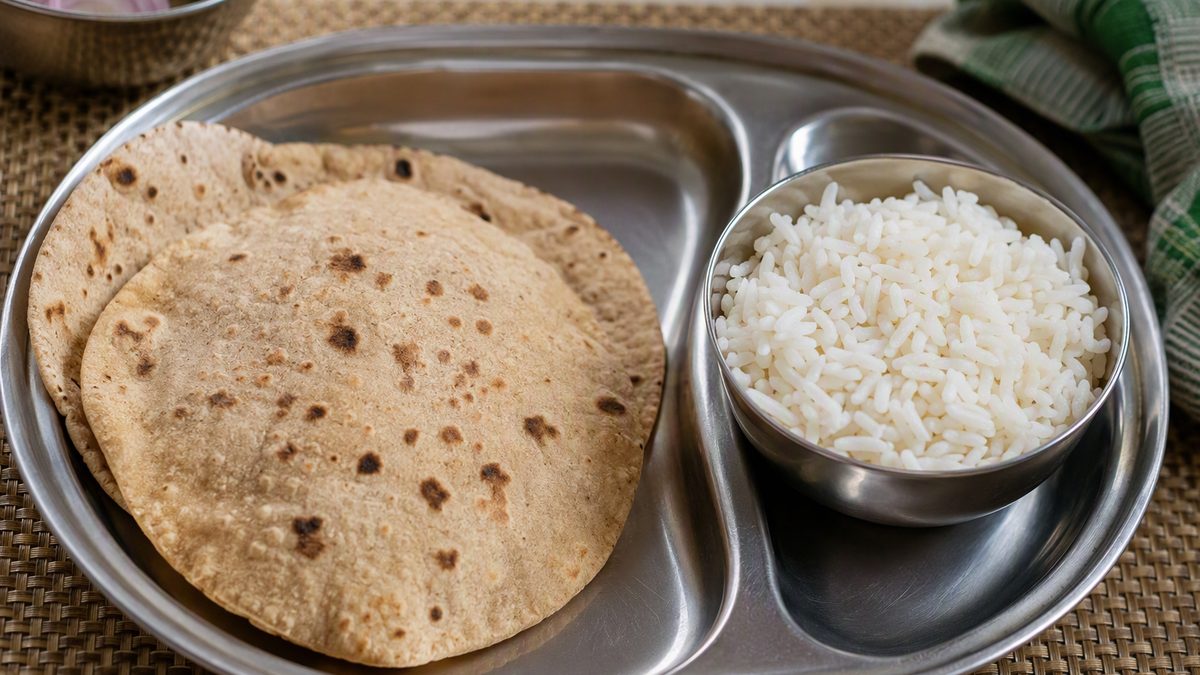
💡 Quick Answer
Calorie for calorie, roti and rice are almost the same: 2 medium rotis without ghee (~194 kcal) equal 1 katori (150 g) of cooked white rice (~195 kcal). Roti wins on protein (6.4 g vs 4 g) and clearly on fibre (about 6.8 g vs 0.6 g), which is why many people find it more filling. But you can lose weight with either; portion size and ghee matter more than the choice.
- 1 medium roti (~97 kcal) ≈ ½ katori of cooked rice.
- Gram for gram roti is denser, because cooked rice is mostly water.
- Whole wheat roti usually has a lower glycaemic index than white rice.
- Ghee on roti and large rice heaps are what break most diets, not the grain.
Portion calculator
2 × medium chapati, no ghee ≈ 6.4 g protein · 194 kcal
Scaled from the figures on this page. Brands and recipes vary.
Not sure how many rotis or how much rice fits your target? Snap a photo of your thali and the UltraFit360 app logs it against your daily calories. Get UltraFit360 on the App Store or Google Play.
"Roti or rice?" is one of the most common questions in any Indian diet group. Some people swear rice made them gain weight, others say they lost 10 kg eating dal-chawal every day. The honest answer is that the two are closer than most people think, and the differences that do exist are about fibre and fullness, not some special fattening property of rice. Here is the side-by-side, with numbers you can use.
Roti vs Rice: Calories, Protein and Fibre
The fairest comparison is at the same calories. Two medium chapatis (40 g each, made from about 30 g whole wheat atta, no ghee) land almost exactly on one standard katori of cooked white rice. Values match our calories in chapati and calories in rice guides.
| Portion | Calories | Protein | Carbs | Fibre | Fat |
|---|---|---|---|---|---|
| 2 medium chapatis, no ghee (80 g) | ~194 kcal | ~6.4 g | ~38 g | ~6.8 g | ~1 g |
| 2 medium chapatis + 1 tsp ghee each | ~280 kcal | ~6.4 g | ~38 g | ~6.8 g | ~11 g |
| 1 katori cooked white rice (150 g) | ~195 kcal | ~4 g | ~42 g | ~0.6 g | ~0.5 g |
| 1 katori cooked brown rice (150 g) | ~167 kcal | ~3.9 g | ~35 g | ~2.7 g | ~1.4 g |
| 1 katori jeera rice (1 tsp ghee) | ~240 kcal | ~4 g | ~42 g | ~0.6 g | ~5.5 g |
Basis: IFCT 2017 (ICMR-NIN) whole wheat atta at 320 kcal, 10.6 g protein and about 11 g fibre per 100 g, scaled to 30 g atta per chapati; USDA FoodData Central for cooked long-grain white rice (130 kcal, 2.7 g protein per 100 g) and brown rice (111 kcal, 2.6 g protein), and for ghee (about 44 kcal per teaspoon).
Three things stand out:
- Calories are a tie. At typical home portions, the difference is a handful of kcal.
- Roti has more protein, about 6.4 g vs 4 g. Useful, but neither is a real protein source; dal, paneer, curd, eggs or chicken have to do that job.
- Roti has far more fibre, roughly ten times as much as white rice. This is the main nutritional difference, and it is why roti often feels more filling.
Gram for Gram: Why Rice Looks Lighter
Per 100 g, a cooked chapati has about 240 kcal and cooked rice about 130 kcal. That is not because rice is "lighter" as a food; it is because cooked rice is about two-thirds water. When you compare by the amount of dry grain, they are nearly identical: wheat atta is about 320–340 kcal per 100 g and raw rice about 350–365 kcal per 100 g.
This matters for logging. Always log rice by cooked weight and rotis by count and size, and use one method consistently.
How Many Rotis Equal One Katori of Rice?
| Roti portion | Calories | Same calories in cooked white rice |
|---|---|---|
| 1 small phulka (~25 g) | ~60 kcal | ~45 g rice (about ⅓ katori) |
| 1 medium roti (~40 g), no ghee | ~97 kcal | ~75 g rice (½ katori) |
| 1 medium roti + 1 tsp ghee | ~140 kcal | ~108 g rice (¾ katori) |
| 2 medium rotis, no ghee | ~194 kcal | ~150 g rice (1 katori) |
| 3 medium rotis, no ghee | ~291 kcal | ~225 g rice (1½ katori) |
| 4 medium rotis, no ghee | ~388 kcal | ~300 g rice (2 katori) |
Calculated from the values above (rice at 1.3 kcal per gram cooked). A large chapati of about 60 g is roughly 145 kcal, or a heaped half katori of rice.
Glycaemic Index and Blood Sugar
The glycaemic index (GI) measures how quickly a food raises blood sugar compared with pure glucose. In the International Tables of Glycemic Index (Atkinson, Foster-Powell and Brand-Miller, 2008), chapatti averages about 52 and boiled white rice about 73, with brown rice around 68. Basmati and parboiled rice often test lower than other white rice, often in the 50s and 60s, but results vary a lot between varieties and studies.
Two practical points matter more than the GI of the grain alone:
- The meal changes the response. Dal, sabzi, curd, fat and protein all slow digestion, so dal-chawal with salad behaves very differently from a plate of plain rice.
- Portion size matters most. A large serving of a lower-GI food can raise blood sugar more than a small serving of a higher-GI one.
If you have diabetes, prediabetes or PCOS, roti, millet rotis and rice eaten with plenty of dal and vegetables are all usable; the plate balance is what counts. Our insulin resistance diet plan and low-glycaemic Indian breakfast guides go further, and your doctor or dietitian should guide medical diets.
Fullness: Which Keeps You Satisfied Longer?
For most people, two rotis are a little more filling than a katori of white rice because of the extra fibre and protein and because they take longer to eat. Roti has not been tested directly in the classic satiety index study (Holt and colleagues, 1995), but in that study wholemeal bread scored higher for fullness than white rice, which in turn scored well above white bread. The pattern fits: more fibre and more chewing tend to mean more fullness.
That said, fullness is personal. Many people from rice-eating regions feel more satisfied after rice and less so after rotis. The best choice for weight loss is the one that keeps you full on a controlled portion.
What Actually Breaks Most Diets
- Ghee on every roti. One teaspoon adds about 45 kcal. Four ghee-brushed rotis carry 180 kcal of ghee alone.
- The rice heap. A heaped plate of rice can be 300–400 g, or 390–520 kcal, before dal or sabzi.
- Doubling up. Three rotis plus a katori of rice plus papad and pickle easily makes a 600–700 kcal carb base.
- Parathas and fried rice. These are different foods; see calories in paratha and calories in biryani.
How It Fits Your Goal
Fat loss: choose one carb per meal: about 2 medium rotis for most women or 2–3 for most men, or 1 katori of rice. Fill the rest of the plate with protein (dal, paneer, curd, eggs, chicken or soya) and a large serving of vegetables. Two medium phulkas, a katori of dal tadka, a katori of sabzi and a katori of curd is about 510 kcal with 20 g protein.
Muscle gain: both are cheap, easy carbs. Rice is quicker to eat in large amounts, which helps when calories are high; rajma chawal or dal-chawal after training is a classic. Rotis add a little more protein. Many lifters simply have both.
The bottom line: pick the one you enjoy, measure it once, and keep the ghee in check. For every staple side by side, see the Indian food calories and protein chart, and set your daily target with the calorie calculator and protein calculator.
Sources: IFCT 2017 (ICMR-NIN) for whole wheat atta; USDA FoodData Central for cooked white and brown rice, raw rice and ghee; Atkinson FS, Foster-Powell K, Brand-Miller JC, International Tables of Glycemic Index and Glycemic Load Values (Diabetes Care, 2008); Holt SH et al., A satiety index of common foods (European Journal of Clinical Nutrition, 1995).
Frequently Asked Questions
Is roti or rice better for weight loss?
Both can work. Two medium rotis and one katori of cooked white rice have about the same calories (around 195 kcal), but roti has more protein and about ten times the fibre, so many people find it more filling. Your total daily calories decide weight loss, not which one you choose.
How many rotis equal one bowl of rice?
About 2 medium rotis (40 g each, no ghee) equal one 150 g katori of cooked white rice in calories. One medium roti is roughly half a katori of rice, and three rotis are about one and a half katoris.
Does rice make you fat?
No single food makes you fat. Weight gain comes from eating more calories than you burn over time. Rice is easy to overeat because a large heap can be 300 to 400 g, so measuring your portion is the practical fix.
Which has a lower glycaemic index, roti or rice?
Whole wheat roti usually has a lower glycaemic index than white rice. International GI tables list chapatti at about 52 and boiled white rice at about 73, though results vary with the type of rice and flour. Eating either with dal, vegetables and curd lowers the blood sugar response of the meal.
Can I eat rice at night and still lose weight?
Yes. The time of day does not decide fat loss; your total daily calories do. A controlled katori of rice at dinner with protein and vegetables fits a fat-loss diet.
Should I stop eating both roti and rice to lose weight?
No. Cutting out grains is not necessary and is hard to sustain. Keep the portion to about 2 rotis or 1 katori of rice per meal, fill the rest of the plate with protein and vegetables, and go easy on ghee.
Is brown rice better than roti?
They are close. A katori of cooked brown rice has about 167 kcal and 2.7 g fibre, which is better than white rice but still less fibre than two whole wheat rotis. Pick whichever you enjoy and can portion well.
Log Indian meals in seconds: snap a photo of your thali and UltraFit360 estimates calories and protein. Set your targets with the free calorie and macro calculator.
Let Your Thali Log Itself
Photograph your roti, rice, dal and sabzi and UltraFit360 estimates calories and protein, then tracks them against your goal.