💡 Quick Answer
A vegetarian Indian diet chart for weight loss should give 1,400–1,800 kcal and 80–110 g protein a day, depending on your size and activity. Build each meal around a protein (soya, paneer, hung curd, tofu, dal), add vegetables, and keep rotis or rice to 1–2 servings. Lose about 0.5 kg a week.
- Most women lose weight at about 1,300–1,600 kcal, most men at 1,700–2,100.
- Soya chunks, paneer, hung curd and tofu are the densest vegetarian proteins.
- Dal alone rarely gets vegetarians past 60 g protein a day.
- Weigh yourself weekly and adjust portions by one roti if progress stalls for 2–3 weeks.
Most vegetarian Indians trying to lose weight run into the same problem: meals are mostly carbs. Roti, rice, poha and a thin dal fill you up for an hour, protein stays low, and hunger wins by evening. A good Indian diet chart for weight loss keeps the food you know but changes the proportions: more protein, more vegetables, measured grains.
How Many Calories Do You Need?
Fat loss needs a deficit of about 300–500 kcal below your maintenance calories. As a rough guide:
- Women (50–70 kg, lightly active): 1,300–1,600 kcal
- Men (65–90 kg, lightly active): 1,700–2,100 kcal
- If you train hard 4+ days a week: add 150–300 kcal
Get a personal estimate from the calorie calculator. Going below about 1,200 kcal usually backfires with hunger, fatigue and muscle loss.
How Much Protein for Fat Loss?
Aim for 1.2–1.6 g per kg of body weight (use your goal weight if you have a lot to lose). That is 70–100 g for a 60 kg woman and 100–130 g for an 80 kg man. Protein keeps you full and protects muscle, so the weight you lose is mostly fat. Check your target with the protein calculator.
Vegetarian Indian Diet Chart: 1,400 and 1,800 kcal
Both plans use the same structure. The 1,400 kcal version suits most women; the 1,800 kcal version suits most men or very active women. Calories and protein are estimates from IFCT 2017 and USDA values for the stated raw or dry amounts (a medium phulka is about 30 g atta, ~100 kcal).
| Meal | 1,400 kcal day | 1,800 kcal day |
|---|---|---|
| Morning (7 am) | Tea with a little milk, no sugar (~30 kcal) | Tea with milk, no sugar (~40 kcal) |
| Breakfast (8:30 am) | 2 moong dal chillas (40 g dry dal, 1 tsp oil) + 150 g hung curd ~295 kcal · 24 g protein | 3 moong dal chillas (60 g dry dal, 1.5 tsp oil) + 150 g hung curd ~390 kcal · 28 g protein |
| Mid-morning (11 am) | 1 guava or apple ~60 kcal · 1 g | 1 guava or apple ~60 kcal · 1 g |
| Lunch (1:30 pm) | 2 phulkas + soya chunk curry (30 g dry soya) + 1 katori sabzi + salad ~460 kcal · 25 g protein | 2 phulkas + ½ katori rice + soya chunk curry (40 g dry soya) + sabzi + salad ~575 kcal · 31 g protein |
| Evening (5 pm) | Sprouts chaat (40 g dry whole moong) ~140 kcal · 10 g protein | 1 scoop whey in water + 20 g roasted chana ~195 kcal · 28 g protein |
| Dinner (8 pm) | 80 g paneer tikka or bhurji (1 tsp oil) + 1 phulka + vegetables ~430 kcal · 19 g protein | 100 g paneer bhurji (1 tsp oil) + 1 phulka + vegetables ~490 kcal · 23 g protein |
| Day total | ~1,415 kcal · ~79 g protein | ~1,750 kcal · ~112 g protein |
No whey? Swap it for 150 g hung curd plus 30 g roasted chana (about 20 g protein). Do not eat paneer? Use 150 g firm tofu or another 30 g soya chunks. You can also swap jowar or bajra rotis for wheat phulkas at the same count.
Best Vegetarian Protein Foods for Fat Loss
| Vegetarian food | Amount | Protein | Calories |
|---|---|---|---|
| Soya chunks (dry) | 30 g | ~16 g | ~105 kcal |
| Paneer (full fat) | 100 g | ~19 g | ~305 kcal |
| Tofu (firm) | 100 g | ~12–17 g | ~120–145 kcal |
| Hung curd / Greek yogurt (plain) | 150 g | ~14 g | ~110–150 kcal |
| Curd (toned milk) | 150 g | ~5 g | ~90 kcal |
| Moong dal (dry) | 40 g | ~10 g | ~140 kcal |
| Besan (dry) | 40 g | ~9 g | ~155 kcal |
| Rajma or kabuli chana (dry) | 40 g | ~8–9 g | ~135–145 kcal |
| Toned milk | 250 ml | ~8 g | ~145 kcal |
| Roasted chana | 30 g | ~6 g | ~110 kcal |
| Whey protein | 1 scoop (~30 g) | ~24 g | ~120 kcal |
Paneer is excellent but calorie-dense because of its fat (about 25 g per 100 g). For a deficit, use 75–100 g portions or choose low-fat paneer. Soya chunks are the cheapest protein per gram in most Indian markets; see our full guide to soya chunks protein, or compare paneer vs tofu.
7-Day Vegetarian Menu for Weight Loss
Keep the snack and portion structure from the chart above and rotate these meals:
| Day | Breakfast | Lunch | Dinner |
|---|---|---|---|
| Mon | Moong chilla + hung curd | Soya chunk curry + 2 phulkas + sabzi | Paneer bhurji + 1 phulka + salad |
| Tue | Soya upma + curd | Rajma + small rice + salad | Tofu tikka + sautéed vegetables |
| Wed | Besan chilla with paneer | Chana masala + 2 phulkas + raita | Moong dal khichdi with vegetables + curd |
| Thu | Greek yogurt bowl with fruit and seeds | Dal + 2 jowar rotis + paneer sabzi | Soya keema + 1 phulka + salad |
| Fri | Sprouts chaat + glass of milk | Palak paneer + 2 phulkas | Masoor dal + vegetables + 1 phulka |
| Sat | Pesarattu + chutney + curd | Veg pulao with soya chunks + raita | Paneer tikka + salad |
| Sun | Overnight oats with whey | Chole + small rice + salad | Tofu bhurji + 1 phulka |
How to Build Your Plate
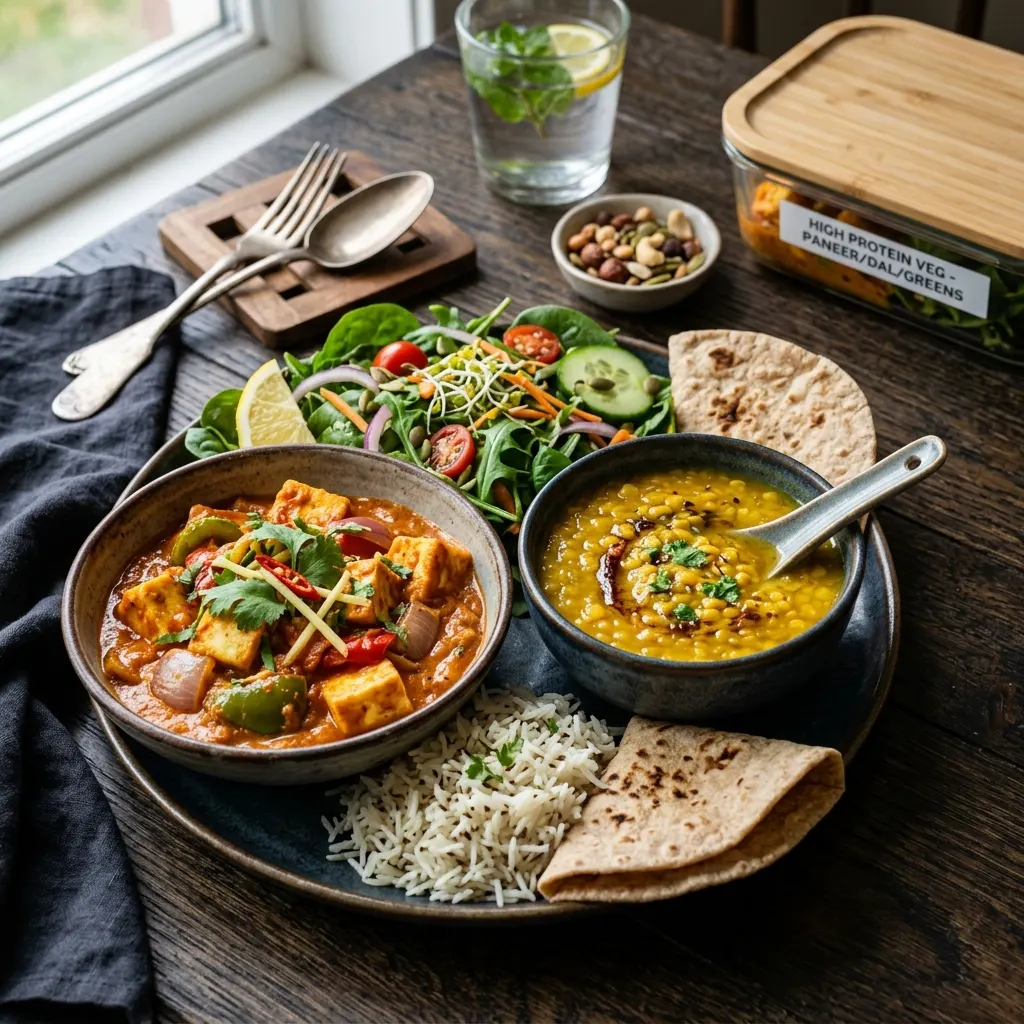
- Half: vegetables and salad (palak, lauki, bhindi, beans, cabbage, cucumber, tomato).
- Quarter: protein (soya, paneer, tofu, hung curd, dal, rajma, chana).
- Quarter: 1–2 phulkas or 1 katori rice.
- Fat: about 1 teaspoon oil per dish; 3–4 teaspoons in the whole day.
Rotis add up fast: four rotis with ghee can cost 500 kcal. See how many calories yours contain in our guide to calories in chapati.
Common Mistakes on a Veg Weight Loss Diet
- Relying on dal for protein: one katori of dal has only about 7 g protein.
- Hidden fat: ghee on rotis, oily tadkas, butter on toast, cream in gravies.
- Liquid calories: sugar in tea, juices, sweet lassi, cold coffee.
- Healthy snacks that are not light: namkeen, trail mix, granola bars, fried makhana.
- Weekend blowouts: a buffet and dessert can undo three days of deficit.
- Too few vegetables: you need volume to feel full.
Exercise Alongside the Diet
Strength training 3–4 times a week helps you keep muscle and look firmer as weight comes off. Walk 8,000–10,000 steps a day. If you are new to the gym, the AI workout planner builds a beginner routine.
Tracking Progress
Weigh yourself 2–3 mornings a week and look at the weekly average. Measure your waist every two weeks. If the average has not moved for 2–3 weeks, cut about 100–150 kcal (for example one roti) or add 2,000 steps a day.
Frequently Asked Questions
What is the best Indian veg diet chart for weight loss?
One that gives about 1,400 to 1,800 kcal and 80 to 110 g protein a day, with a protein food like soya, paneer, tofu, hung curd or dal at every meal, half the plate vegetables, and only 1 to 2 rotis or 1 katori rice per meal.
How can a vegetarian get 100 g protein a day in India?
Combine dense sources: 150 g hung curd (14 g), 40 g soya chunks (21 g), 100 g paneer (19 g), 60 g moong dal for chillas (14 g), a whey scoop (24 g) and grains and milk through the day.
How many rotis can I eat for weight loss?
Most people losing weight do well with 1 to 2 phulkas per meal, or about 4 a day in total. Skip ghee on top, and count rice and rotis together as your carb portion.
Is a 1,400 calorie diet enough?
For many women of average height who are lightly active, 1,400 kcal gives a steady deficit. Larger or very active people, especially men, usually need 1,700 to 2,100 kcal.
How much weight can I lose in a month on this diet?
A realistic rate is 2 to 4 kg a month, about 0.5 to 1 kg a week. The first week often shows more because of water loss.
Set your targets with the free calorie and macro calculator, then build a day of meals with the meal plan generator.
Track Indian Meals in Seconds
Snap a photo of your thali, tiffin or chilla and UltraFit360 estimates calories and protein for Indian dishes, so you can see exactly where your day stands.