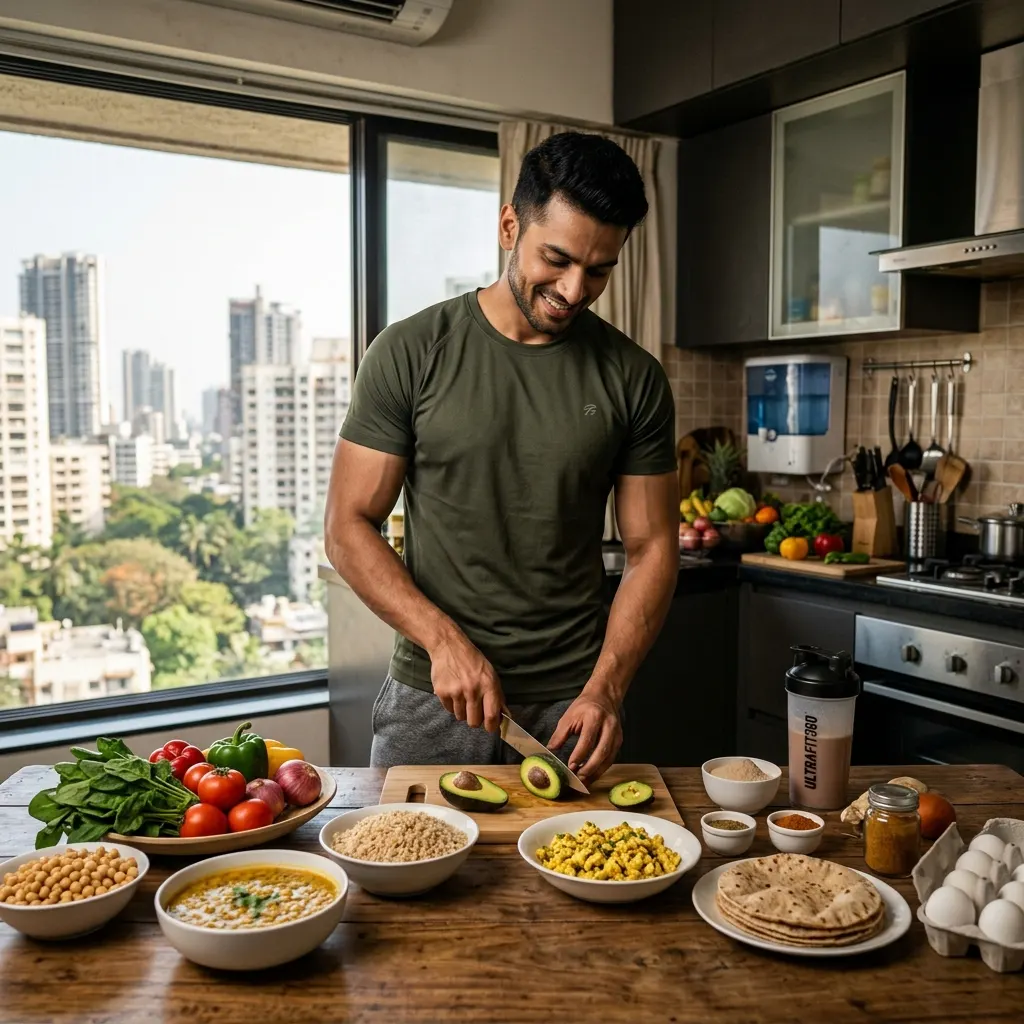
💡 Quick Answer
For a lean bulk, eat about 250–500 kcal above maintenance, get 1.6–2.2 g protein per kg, and aim to gain 0.25–0.5% of bodyweight per week (about 0.7–1.4 kg a month at 70 kg). For a 65 kg Indian lifter that means roughly 2,800–2,900 kcal and 120–140 g protein from roti, rice, dal, paneer or chicken, milk and peanuts.
- A dirty bulk adds muscle slightly faster at best, and a lot more fat.
- Skinny "hardgainers" usually just eat less than they think; liquid calories help.
- A homemade mass gainer (milk, oats, banana, peanut butter, dates) gives about 800 kcal for a fraction of the price of a branded tub.
- Check your weekly average weight and adjust by 100–200 kcal.
"Bulking" in many Indian gyms still means eating everything in sight and buying a 3 kg tub of mass gainer. You'll gain weight, but a lot of it will be fat you have to diet off later. A lean bulk takes a few more weeks and leaves you looking better the whole time.
Lean Bulk vs Dirty Bulk
| Lean bulk | Dirty bulk | |
|---|---|---|
| Calorie surplus | +250–500 kcal/day | +700–1,000+ kcal/day, often untracked |
| Weight gain | 0.25–0.5% bodyweight/week | 1 kg or more per week |
| Food | Mostly home food, measured portions | Anything: sweets, fried snacks, fast food |
| Fat gain | Small | Large |
| Cutting needed after | Short or none | Long cut, some muscle lost |
| Best for | Almost everyone | Hardly anyone |
Your body can only build so much muscle per week. Once your surplus covers that, extra calories mostly become fat. A small surplus gets you nearly all the muscle with far less fat.
How Big Should Your Surplus Be?
A 2019 review of off-season bodybuilding nutrition (Iraki et al.) recommends a surplus of roughly 10–20% above maintenance, targeting 0.25–0.5% bodyweight gain per week for beginners and intermediates, with advanced lifters at the lower end. In practice:
- Skinny beginner (first 1–2 years of training): +350–500 kcal. You can grow faster, and you probably undereat.
- Intermediate (2–4 years of consistent training): +250–350 kcal.
- Advanced or already 18–20%+ body fat: +150–250 kcal, or cut first.
How fast will you gain muscle?
A popular coaching rule of thumb (Alan Aragon's model) puts realistic total gains at about 1–1.5% of bodyweight a month for beginners, 0.5–1% for intermediates and 0.25–0.5% for advanced lifters. For a 65 kg beginner that's 0.65–1 kg a month. Treat these as rough estimates, not promises. A bit of the scale gain is always water, glycogen and some fat.
Calculate Your Lean Bulk Calories
Example: Arjun is 22, 65 kg, 178 cm, a college student who lifts 4–5 days a week.
- BMR (Mifflin-St Jeor) = 10 × 65 + 6.25 × 178 − 5 × 22 + 5 = 1,658 kcal
- Maintenance = 1,658 × 1.55 ≈ 2,570 kcal
- Lean bulk = 2,570 + 300 ≈ 2,870 kcal
- Protein = 1.6–2.2 × 65 = 104–143 g
- Fat ≈ 60–70 g; the rest from carbs
- Target gain ≈ 0.15–0.3 kg a week
Use the calorie calculator for your own numbers and the protein calculator for your protein range.
Indian Lean Bulk Diet Chart (Vegetarian, ~2,900 kcal)
Values use IFCT 2017 and USDA data (paneer 18.9 g protein/100 g, soya chunks 52 g/100 g dry, atta roti of 30 g flour ≈ 100 kcal). Real dishes vary by about ±10%.
| Meal | What to eat (amounts) | kcal | Protein |
|---|---|---|---|
| Breakfast 8:00 am | 2 paneer parathas (60 g atta, 60 g paneer, 2 tsp ghee) + 200 g curd | 593 | 25 g |
| Mid-morning 11:00 am | Homemade mass gainer shake (recipe below, without whey) | 812 | 30 g |
| Lunch 1:30 pm | 150 g cooked rice, rajma (50 g raw, 1 tsp oil), 2 rotis, salad | 640 | 23 g |
| Pre-workout 5:00 pm | Vegetable poha (50 g dry poha, 1 tsp oil) | 220 | 4 g |
| Dinner 9:00 pm | 3 rotis, soya chunk curry (40 g dry, 1 tsp oil), 1 katori dal | 620 | 40 g |
| Total | 2,885 | 121 g |
Want more protein? Add a scoop of whey to the mid-morning shake (+120 kcal, +24 g protein) and the day reaches about 145 g.
Indian Lean Bulk Diet Chart (Non-Veg, ~2,800 kcal)
| Meal | What to eat (amounts) | kcal | Protein |
|---|---|---|---|
| Breakfast 8:00 am | Egg bhurji (3 eggs, 1 tsp oil), 2 rotis, 250 ml toned milk | 606 | 34 g |
| Mid-morning 11:00 am | Homemade mass gainer shake (recipe below, without whey) | 812 | 30 g |
| Lunch 1:30 pm | Chicken curry (150 g raw breast, 2 tsp oil), 200 g cooked rice, salad | 600 | 41 g |
| Pre-workout 5:00 pm | 1 banana + 30 g roasted chana | 215 | 8 g |
| Dinner 9:00 pm | 3 rotis, 1 katori dal, 150 g sabzi, 1 tsp ghee | 570 | 22 g |
| Total | 2,803 | 135 g |
This day reaches 135 g protein with no supplement. On days you train hard or feel hungry, add a fourth roti at dinner or 50 g more rice at lunch (about +100 kcal each).
Weight Gain Diet for Skinny Guys
If you "eat a lot and never gain", you're almost certainly eating less than you think on most days. Fix it with these rules:
- Track for two weeks. Most hardgainers find they eat well on 2–3 days and much less on the rest.
- Eat 4–5 times a day. Three big meals are hard when appetite is low.
- Drink some calories. Milk and the shake below are easier than another plate of rice.
- Use calorie-dense foods. A teaspoon of ghee on dal (45 kcal), 30 g peanuts (170 kcal), a banana (105 kcal) and dates add up without making you feel stuffed.
- Increase by 200 kcal at a time until the scale moves 0.25–0.5 kg a week.
If you're thin but carry fat around the belly, a bulk may not be the right first step; read our skinny fat diet plan.
Homemade Mass Gainer Shake
Blend until smooth. Soak the oats in milk for 10 minutes first if your blender is weak.
| Ingredient | kcal | Protein |
|---|---|---|
| 400 ml toned milk | 232 | 12.8 g |
| 50 g rolled oats | 195 | 7 g |
| 1 medium banana | 105 | 1.3 g |
| 2 tbsp peanut butter (32 g) | 190 | 8 g |
| 4 dates (~32 g) | 90 | 0.8 g |
| Total | ~812 | ~30 g |
| + 1 scoop whey (optional) | +120 | +24 g |
| Total with whey | ~932 | ~54 g |
Variations: swap peanut butter for 20 g almonds plus 1 tbsp flax seeds, use full-cream milk for about +100–130 kcal, or add 2 tbsp sattu for extra protein and a familiar taste.
Mass gainer vs whey + food
| Commercial mass gainer | Whey + home food | |
|---|---|---|
| What it is | Mostly carbs (often maltodextrin and sugar) with some protein | Protein powder; carbs and fat come from regular food |
| Calories per serving | Often 400–1,200+ kcal (check the label) | About 120 kcal per scoop + whatever you eat |
| Cost per gram of protein | Usually high, because you're paying for carbs | Lower |
| Control | Fixed ratio | Adjust carbs and fats to your appetite and goal |
| When it makes sense | Very low appetite and no time to make a shake | Almost always |
If you buy any protein product, choose an FSSAI-licensed brand from an authorised seller and look for third-party lab testing. See our best protein powder in India comparison.
Training on a Lean Bulk
A surplus only builds muscle if training gives your body a reason. Follow a proper program with progressive overload: add reps or weight over time on compound lifts like squats, bench press, rows and deadlifts. Train each muscle with roughly 10–20 hard sets a week; our bro split vs PPL guide helps you pick a split. Take 3–5 g of creatine monohydrate a day; it is the one supplement with strong evidence for extra strength and lean mass.
When to Stop Bulking
- Your waist has grown 4–5 cm or more while your lifts have stalled.
- You've reached roughly 18–20% body fat (men) or 28–30% (women) and don't like how you look.
- You've been bulking for 6+ months and want to see what you've built.
Then run a short cut of 6–12 weeks (see our shredded body guide) or a few weeks at maintenance before the next bulk.
Common Bulking Mistakes
- Gaining too fast. 2+ kg a month after your first few months is usually mostly fat.
- Using sweets and fried food to "hit calories". Fine occasionally; as a habit it makes protein and fibre too low.
- Letting protein drop. Big rice plates without dal, paneer, eggs or chicken don't build much muscle.
- Judging by one weigh-in. Daily weight swings 0.5–1 kg with salt and water. Use the weekly average.
- Doing no cardio at all. 2–3 short sessions a week keep your heart and appetite healthy.
Frequently Asked Questions
What is a lean bulk?
A lean bulk is a muscle-building phase where you eat only slightly above maintenance, usually 250–500 kcal a day, so you gain weight slowly (about 0.25–0.5% of bodyweight a week) and most of it is muscle rather than fat.
How many extra calories should I eat to bulk?
Start with about 250–350 kcal above maintenance if you have been training for a while, and up to about 500 kcal if you are a skinny beginner who struggles to gain. Adjust by 100–200 kcal after 2–3 weeks based on your weekly average weight.
How much weight should I gain per month on a bulk?
About 1–2% of bodyweight per month for most beginners and intermediates, which is 0.7–1.4 kg a month for a 70 kg person. Advanced lifters should aim lower. Gaining much faster usually means you are adding mostly fat.
Is mass gainer good for skinny guys?
It works, but it is usually an expensive way to buy milk powder and sugar. A homemade shake of milk, oats, banana, peanut butter and dates gives about 800 kcal and 30 g protein, and you control what goes in.
Can I bulk on a vegetarian diet?
Yes. Paneer, soya chunks, dal, rajma, milk, curd and peanuts easily give a 65 kg vegetarian 2,900 kcal and 120 g or more of protein a day, as the vegetarian chart on this page shows.
Turn this plan into a tracked program: UltraFit360's free AI workout planner builds your split, and photo meal logging keeps your Indian diet on target. Find your numbers with the calorie calculator.
Bulk Lean, Not Fat
Log your meals with a photo, watch your weekly weight trend, and let UltraFit360 tell you when to add or cut calories.