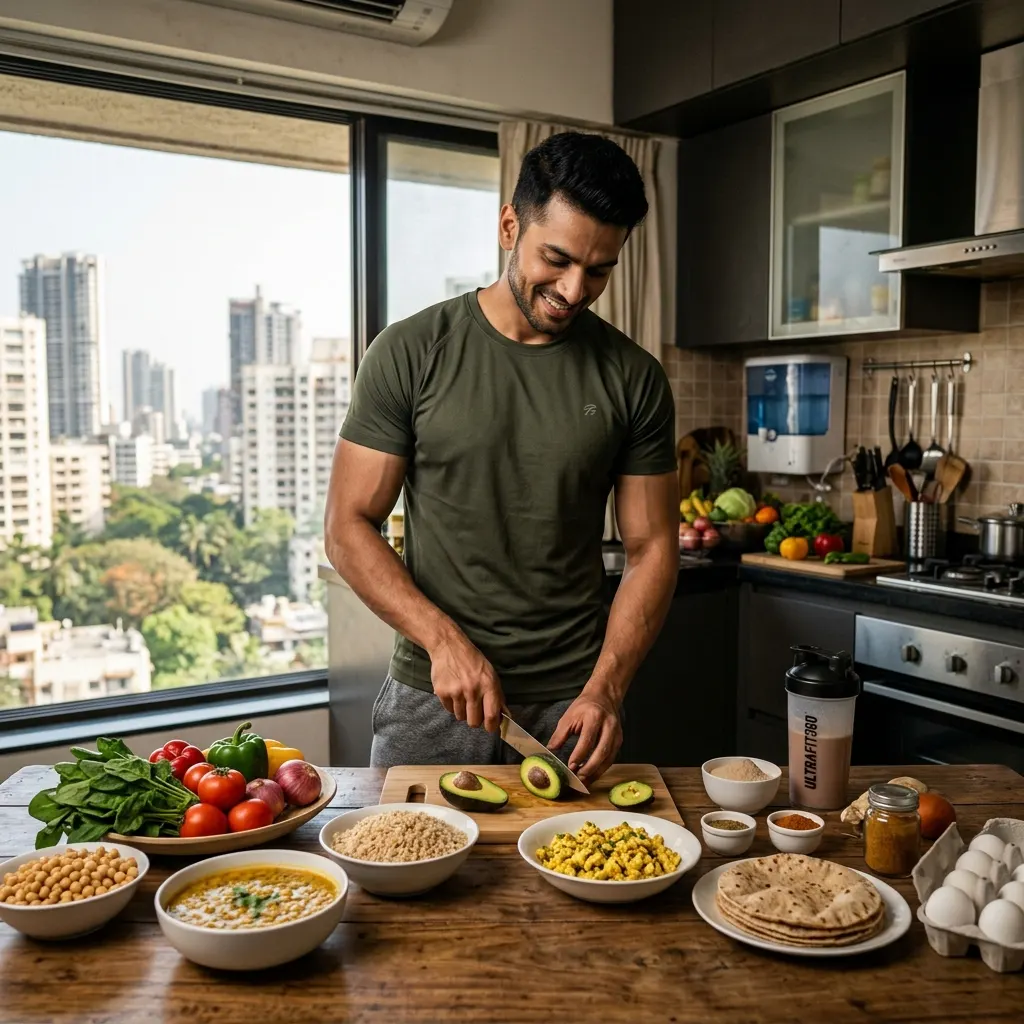
💡 Quick Answer
To gain weight healthily, eat 300–500 kcal more than your maintenance every day and aim for 0.25–0.5 kg a week. For a thin 52 kg man that's about 2,800 kcal of milk, oats, peanuts, banana, rice, roti, dal, paneer or eggs and some ghee over 5–6 meals. Lift weights so the gain isn't just fat.
- Underweight means a BMI below 18.5. Gaining weight and gaining muscle are not the same goal.
- Calorie-dense foods (ghee, peanuts, dry fruits, milk, banana, rice) make a surplus easier with a small appetite.
- Eat every 3 hours and drink some of your calories.
- Get a check-up if you're losing weight without trying or can't gain despite eating well.
This guide is for people who are genuinely thin: friends call you "kamzor", clothes hang loose, and you've heard "khaana kha, mota ho jayega" all your life. It isn't a bodybuilding bulk. If you already lift and want to add muscle with minimal fat, our lean bulk diet plan is the better fit. Here, the aim is to reach a healthy weight with simple Indian food, even if your appetite is small.
Healthy Weight Gain vs Muscle Gain
| Healthy weight gain (this page) | Muscle gain (gym bulk) | |
|---|---|---|
| Who it's for | Underweight people (BMI under 18.5) or those who've lost weight after illness or stress | Normal-weight lifters who want more muscle |
| Surplus | 300–500 kcal a day | 250–350 kcal a day |
| Rate of gain | 0.25–0.5 kg a week | 0.25–0.5% of bodyweight a week |
| Main challenge | Appetite: eating enough every day | Keeping fat gain low |
| Training | Strongly recommended (2–4 days a week) | Essential (4–6 days a week) |
Underweight people can afford a slightly bigger surplus because they start with little body fat. Even so, gaining faster than about 0.5 kg a week is mostly fat and water, and makes the "skinny with a belly" look more likely. If that's already you, read our skinny fat diet plan instead.
How Many Calories to Gain Weight?
- Find your maintenance calories with the calorie calculator. It uses the Mifflin-St Jeor equation with an activity factor.
- Add 300–500 kcal. Start at +300 if your appetite is poor; go to +500 if you're very thin or active.
- Set protein at 1.6–2.2 g per kg bodyweight if you lift (the protein calculator gives your range), or at least 1.2–1.6 g/kg if you don't yet.
- Weigh yourself 3–7 mornings a week. If the weekly average doesn't rise after 2 weeks, add another 200 kcal.
Worked example: Ankit, 52 kg
Ankit is 21, 172 cm tall and 52 kg (BMI 17.6). He walks to college and lifts 3 days a week.
- BMR = 10 × 52 + 6.25 × 172 − 5 × 21 + 5 = 1,495 kcal
- Maintenance ≈ 1,495 × 1.55 ≈ 2,320 kcal
- Weight gain target = 2,320 + 500 ≈ 2,800 kcal
- Protein = 1.6–2.2 × 52 = 83–114 g
A woman of 45 kg and 158 cm with the same lifestyle would need about 2,100–2,300 kcal. She can use the same charts with portions cut by about a quarter.
Weight Gain Diet Chart: Vegetarian (~2,850 kcal)
Values come from IFCT 2017 (NIN India) and USDA FoodData Central: full-cream milk about 88 kcal and 3.2 g protein per 100 ml, paneer 305 kcal and 18.9 g per 100 g, raw peanuts 567 kcal and 25.8 g per 100 g, a 30 g atta roti about 100 kcal. Home cooking varies, so treat totals as ±10%.
| Meal | What to eat (amounts) | kcal | Protein |
|---|---|---|---|
| Breakfast 8:00 am | 50 g oats cooked in 300 ml full-cream milk, 1 banana, 15 g almonds | 651 | 21 g |
| Mid-morning 11:00 am | 30 g roasted peanuts + 3 dates | 238 | 8 g |
| Lunch 1:30 pm | 2 rotis with 1 tsp ghee each, 150 g cooked rice, 1 katori dal (40 g raw) with 1 tsp ghee, 150 g curd, 150 g aloo-gobhi sabzi | 875 | 28 g |
| Evening 5:00 pm | Paneer sandwich: 2 slices whole-wheat bread, 50 g paneer, green chutney | 302 | 15 g |
| Dinner 8:30 pm | 2 rotis, rajma (50 g raw, 1 tsp oil), 100 g cooked rice, salad | 560 | 21 g |
| Bedtime 10:30 pm | 250 ml full-cream milk (haldi or elaichi optional) | 220 | 8 g |
| Total | 2,846 | 101 g |
Notes: 101 g protein is about 1.9 g/kg for Ankit, without any supplement. Swap rajma for chole or soya chunk curry (30 g dry soya adds about 15 g protein; see soya chunks protein). Vegans can use soya milk and tofu in place of dairy and paneer.
Weight Gain Diet Chart: Non-Veg (~2,850 kcal)
| Meal | What to eat (amounts) | kcal | Protein |
|---|---|---|---|
| Breakfast 8:00 am | 3-egg omelette (1 tsp oil), 2 slices whole-wheat bread with 5 g butter, 250 ml full-cream milk | 667 | 33 g |
| Mid-morning 11:00 am | 1 banana + 30 g roasted peanuts | 275 | 9 g |
| Lunch 1:30 pm | Chicken curry (150 g raw chicken, 2 tsp oil), 200 g cooked rice, 1 roti, 150 g curd | 720 | 48 g |
| Evening 5:00 pm | Banana-date milkshake: 250 ml full-cream milk, 1 banana, 4 dates | 415 | 10 g |
| Dinner 8:30 pm | 3 rotis with 1 tsp ghee, 1 katori dal, egg bhurji (2 eggs, 1 tsp oil), 150 g sabzi | 789 | 35 g |
| Total | 2,866 | 135 g |
Notes: Eggs and chicken push protein to 135 g, more than Ankit needs, which is fine for a healthy person. If you eat chicken only on some days, use the veg chart on the rest. Fish curry with 150 g rohu or surmai works in place of chicken. See protein in eggs for egg sizes.
Calorie-Dense Indian Foods for Weight Gain
When appetite is the problem, choose foods that pack more calories into a smaller volume.
| Food (portion) | kcal | Protein | How to use it |
|---|---|---|---|
| Ghee, 1 tsp (5 g) | 45 | 0 g | On dal, roti or rice; 2–4 tsp a day adds 90–180 kcal |
| Roasted peanuts, 30 g | 170 | 7.7 g | Snack, chikki, chutney, poha topping |
| Peanut butter, 2 tbsp (32 g) | 190 | 8 g | On toast or in shakes |
| Banana, 1 medium (118 g) | 105 | 1.3 g | Pre-workout, shakes, with curd |
| Full-cream milk, 250 ml | 220 | 8 g | Bedtime, shakes, oats |
| Paneer, 100 g | 305 | 18.9 g | Bhurji, paratha stuffing, sandwich |
| Almonds, 20 g | 116 | 4.2 g | Soaked in the morning or in shakes |
| Cashews, 20 g | 111 | 3.6 g | Snack or ground into gravies |
| Raisins, 30 g | 90 | 0.9 g | With nuts, in oats or kheer |
| Dates, 4 (~32 g) | 90 | 0.8 g | Snack or shake sweetener |
| Cooked rice, 200 g | 260 | 5.4 g | Easier to eat in volume than roti |
| Boiled potato, 150 g | 130 | 2.9 g | Aloo paratha, sabzi, chaat |
Values per USDA FoodData Central and IFCT 2017. For more foods, see the Indian food calories and protein chart, protein in peanuts, protein in milk and calories in banana.
Weight Kaise Badhaye? Tips for a Poor Appetite
- Eat every 3 hours. Five or six smaller meals are easier than three huge thalis.
- Drink some calories. A milkshake with banana, peanuts and dates gives about 500 kcal and takes two minutes. Our protein shake recipes include several weight gain shakes.
- Add, don't replace. A tsp of ghee on dal, peanuts on poha, an extra spoon of rice, raisins in oats. Small add-ons of 50–150 kcal each add up to 400–500 kcal a day.
- Don't drink lots of water just before meals. It fills your stomach. Drink between meals instead.
- Keep snacks in your bag. Chikki, roasted chana, banana or a small box of dry fruit for college or office.
- Eat a bigger breakfast. Many thin people skip it or have just chai-biscuit. That's 400–600 kcal missed daily.
- Use a routine, not hunger. Eat at fixed times even if you don't feel hungry; appetite usually grows within 2–3 weeks.
- Sleep 7–9 hours and limit smoking and alcohol, which can blunt appetite and recovery.
Do you need a mass gainer? Usually not. Read our mass gainer guide to decide, and try the homemade version first.
Why You Should Lift Weights Too
Without training, a surplus mostly becomes fat, often around the stomach, while your arms and chest stay thin. With resistance training, a large share of the gain can be muscle, which is what makes you look and feel stronger. You don't need a gym membership to start: push-ups, squats, lunges and rows with a backpack work for the first few months. Two to four sessions a week of 45 minutes, adding reps or weight over time, is enough. A simple plan like our 4-day beginner split or the full Indian gym diet plan helps once you're ready to train seriously.
When to See a Doctor
Being naturally thin is common, but see a doctor if you're losing weight without trying, feel tired all the time, have frequent loose motions, heavy sweating, a racing heart or very low appetite. Thyroid problems, diabetes, worm infections, TB, digestive conditions and depression can all cause weight loss. If you have a thyroid condition, diabetes, PCOS or any digestive illness, talk to your doctor or a registered dietitian before changing your diet.
Frequently Asked Questions
How can I gain weight fast in 1 month?
Eat 300–500 kcal above your maintenance every day and lift weights. A healthy, realistic gain is about 1–2 kg in a month. Faster gain is mostly water and fat, and any crash approach of junk food usually adds belly fat, not healthy weight.
What should I eat to gain weight as a vegetarian?
Build every meal around milk, curd, paneer, dal, rajma or soya, plus roti or rice, and add calorie-dense extras: ghee, peanuts, almonds, dates, banana and full-cream milk. The veg chart above gives about 2,850 kcal and 101 g protein.
Is banana with milk good for weight gain?
Yes. One medium banana (105 kcal) with 250 ml full-cream milk (about 220 kcal) gives about 325 kcal and 9 g protein. Add 4 dates or 30 g peanuts to make it a 400–500 kcal snack.
How much ghee should I eat to gain weight?
Two to four teaspoons a day is plenty. Each teaspoon (5 g) adds about 45 kcal. Ghee helps reach your calorie target, but too much displaces protein and other foods, so use it as an add-on to dal, roti or rice.
Why am I not gaining weight even though I eat a lot?
Most people who "eat a lot" eat well on some days and much less on others. Track your food for two weeks; you will probably average below your target. If you truly eat enough and still lose weight, see a doctor to rule out thyroid or digestive problems.
Do I need a mass gainer to gain weight?
No. Food works just as well and costs less. A homemade shake of milk, oats, banana, peanuts and dates gives 500–800 kcal. A mass gainer is only a convenience for people who cannot eat or prepare enough food.
Find out how much you really eat: photo-log your meals in UltraFit360 and see daily calories and protein at a glance. Start with your target from the calorie calculator.
Make Your Weight Gain Plan Stick
Log roti, dal and milk with a photo, see if you hit your calorie target each day, and get a simple workout plan to build muscle.