Quick Answer
Most skinny-fat beginners should recomp, not bulk or cut: eat around maintenance calories (or a small 5 to 10 percent deficit), get 0.7 to 1 g of protein per lb (1.6 to 2.2 g per kg), and lift 3 to 4 days a week with progressive overload. Updated November 2026.
Key Takeaways
- Skinny fat means a normal or low weight with low muscle and a soft midsection. It is a body composition issue, not a weight issue.
- Beginners can gain muscle and lose fat at the same time, which is why recomp usually beats a classic bulk or cut at the start.
- A 3-day full-body plan with progressive overload, 0.7 to 1 g of protein per lb and 8,000 to 10,000 daily steps is a sound starting point.
- Expect slow progress, and track strength, waist and photos, not just scale weight.
1. What does skinny fat mean?
Skinny fat is not a medical term. It describes someone who looks slim in clothes but has little muscle and a relatively high share of body fat, often carried around the stomach. Your weight and BMI may be normal, but your body fat percentage is higher than it looks. Common causes are low protein intake, little strength training, lots of sitting and a diet built on processed food.
The fix is not the scale. The goal is to build muscle and lose some fat, and the best tool is resistance training with enough protein. You can check your estimated body fat with our body fat calculator, but treat the number as rough.
2. Should you bulk, cut or recomp first?
| Option | What happens | Good for | Downside for skinny fat |
|---|---|---|---|
| Bulk (eat in a surplus) | Gain muscle faster, plus some fat | Very lean, underweight lifters | You add fat to an already soft midsection |
| Cut (eat in a deficit) | Lose fat, possibly muscle too | Experienced lifters with excess fat | You end up smaller, still with little muscle |
| Recomp (maintenance or small deficit) | Build muscle while losing fat slowly | Beginners, returners, skinny fat | Slower scale change, takes patience |
For a beginner, recomp makes sense because new lifters respond strongly to training. A 2020 review by Barakat and colleagues in Strength and Conditioning Journal examined the evidence on recomposition and concluded that it is possible, most readily in people new to training or returning after a break, when resistance training is combined with high protein intake. A 2016 trial by Longland and colleagues in the American Journal of Clinical Nutrition found that young men eating a large calorie deficit while training hard did better on high protein (2.4 g per kg) than on lower protein (1.2 g per kg): the high-protein group gained lean mass and lost more fat over four weeks.
The rule of thumb: if your body fat is high (for men, above roughly 20 to 25 percent), start with a recomp that leans toward a small deficit. If you are very thin and underfed, eat at maintenance or a slight surplus. When you stall for several weeks, you can move to a more defined cut or lean bulk. Our guide on body recomposition goes deeper.
3. How much should you eat?
- Calories: start at maintenance. A rough estimate is body weight in lb times 14 to 16 (so 170 lb is about 2,400 to 2,700 kcal), or use the calorie calculator. If your waist is not shrinking after 4 to 6 weeks, drop 200 to 300 kcal.
- Protein: 0.7 to 1 g per lb (1.6 to 2.2 g per kg). A 2018 meta-analysis by Morton and colleagues in the British Journal of Sports Medicine found that the benefit of extra protein for muscle gain leveled off at about 1.6 g per kg (0.73 g per lb) per day, with the upper end of the estimate near 2.2 g per kg (1 g per lb). A 170 lb (77 kg) man would aim for about 125 to 170 g a day.
- Carbs and fat: fill the rest. Most of your carbs should come from whole sources such as rice, oats, potatoes, fruit and beans, and about 25 to 30 percent of calories from fat.
- Steps: 8,000 to 10,000 a day is a simple way to raise energy use without hurting recovery.
If you eat a mostly Indian diet, see our guide on a skinny fat diet plan if you eat an Indian diet. For help with logging, read our guide to tracking macros.
4. A sample 3-day full-body week
Train Monday, Wednesday and Friday (or any three non-consecutive days). RIR means reps in reserve: how many more reps you could have done. RIR 2 means you stop with two reps left. Rest 2 to 3 minutes between heavy sets.
| Day | Exercise | Sets x reps | RIR |
|---|---|---|---|
| Day 1 | Barbell or goblet squat | 3 x 6-8 | 2 |
| Dumbbell bench press | 3 x 8-10 | 2 | |
| Seated cable row | 3 x 8-12 | 2 | |
| Dumbbell Romanian deadlift | 2 x 8-10 | 2 | |
| Lateral raise | 2 x 12-15 | 1 | |
| Plank | 3 x 30-45 sec | 2 | |
| Day 2 | Deadlift (or trap bar) | 3 x 5 | 2 |
| Overhead press | 3 x 6-8 | 2 | |
| Lat pulldown or assisted pull-up | 3 x 8-10 | 2 | |
| Walking lunge | 2 x 10 per leg | 2 | |
| Biceps curl | 2 x 10-12 | 1 | |
| Triceps pushdown | 2 x 10-12 | 1 | |
| Day 3 | Leg press or front squat | 3 x 8-10 | 2 |
| Incline dumbbell press | 3 x 8-12 | 2 | |
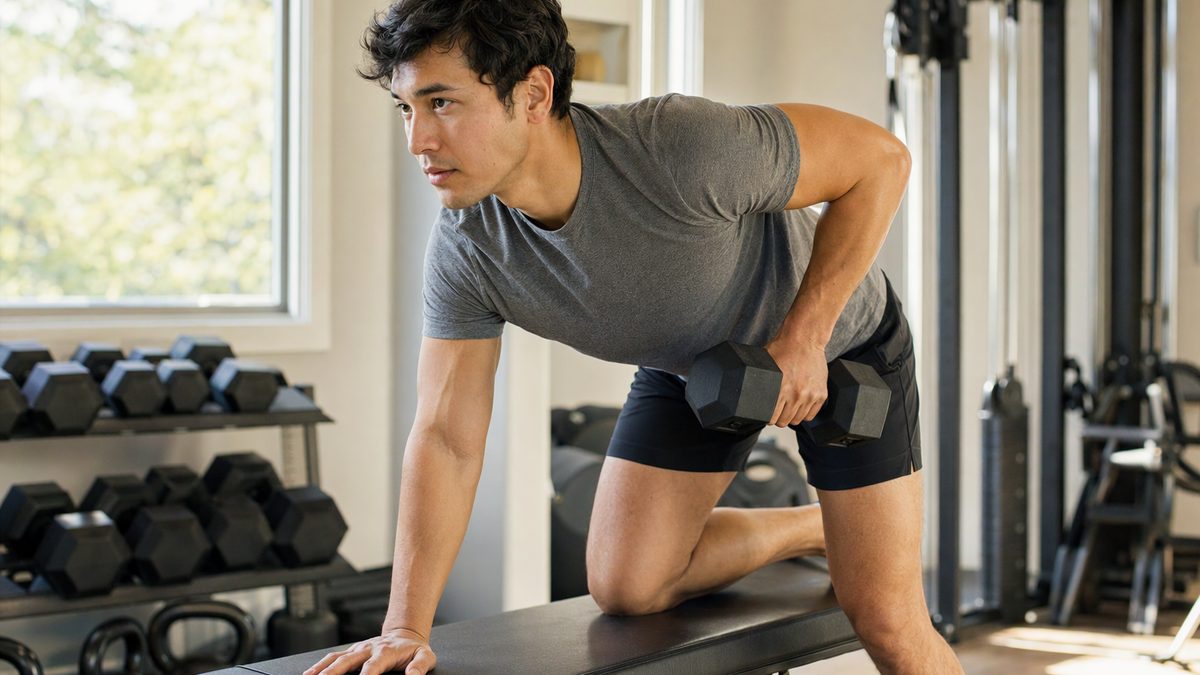
| One-arm dumbbell row | 3 x 10 per arm | 2 | |
| Hip thrust or glute bridge | 3 x 8-12 | 2 | |
| Face pull | 2 x 12-15 | 1 | |
| Hanging knee raise | 3 x 8-12 | 2 |
5. How to progress
Progressive overload is what builds muscle. Use double progression: pick a rep range, such as 8 to 10. When you hit the top of the range on all sets, add 5 lb (2.5 kg) for upper body lifts or 10 lb (5 kg) for lower body lifts next session. If you miss reps, stay at the same weight until you hit them. Log every set so you can see what you did last time. Our progressive overload guide has more detail, and the UltraFit360 app can build and track a plan like this for you.
Start with a weight you can lift with good form for the target reps, and learn the squat, hinge and press patterns first. Sore muscles for a few days are normal in the first two weeks. If you can add a fourth day, make it a short upper-body day or a lighter repeat of Day 1.
6. What results to expect
A beginner on a good plan can gain strength every session in the first couple of months. Visible change takes longer. Many people see their waist trim and shirts fit differently within 8 to 12 weeks, but this depends on consistency, sleep and food. Rates vary widely, so do not compare yourself with online transformations, which often involve camera angles, pumps and long timelines.
Track three things: your key lifts (are they going up?), your waist measured at the navel every two weeks, and a monthly photo in the same light. If your weight, waist and lifts all stay flat for 4 weeks, trim 200 to 300 kcal or add a daily walk. If your lifts are stalling and you feel run down, eat a little more.
7. What if you only have three days and no gym?
You can still follow the same structure at home with a pair of adjustable dumbbells, a bench or chair and a pull-up bar or resistance bands. Swap the barbell squat for goblet squats or split squats, the bench press for push-ups with a weighted backpack, the cable row for one-arm dumbbell rows and the lat pulldown for band pulldowns or pull-ups. Use the same rep ranges and RIR. When an exercise becomes easy, make it harder by slowing the lowering phase to three seconds, pausing at the bottom or moving to a single-leg version. Our bodyweight full-body workout has more options.
8. Common mistakes skinny-fat lifters make
- Doing endless cardio. Lots of running with little lifting leaves you smaller and just as soft. Walk daily and lift three times a week.
- Eating too little. A very low calorie intake plus training leaves you tired and weak, and muscle gain slows. Stay near maintenance at first.
- Doing isolation work only. Curls and crunches do not build much by themselves. Base your week on squats, hinges, presses and rows.
- Changing the plan every week. You need at least 8 to 12 weeks on the same lifts to see strength and size progress.
- Chasing the scale. In a recomp, the scale may barely move while your waist shrinks and your lifts climb.
- Skipping sleep. Muscle is built during recovery, so aim for seven to nine hours.
When you finish 12 weeks, reassess. If you have gained noticeable muscle and still have fat to lose, run a gentler 10 to 15 percent deficit. If you feel lean enough and want to grow, switch to a small surplus of 5 to 10 percent above maintenance.
Bottom line
For most skinny-fat men, a recomp is the best starting point: maintenance calories or a small deficit, 0.7 to 1 g of protein per lb, a 3-day full-body routine with progressive overload, and daily walking. Give it 12 weeks, track strength and waist, then decide whether to cut further or start a lean bulk.
Related reading
9. Frequently Asked Questions
Q1: Should I bulk or cut if I am skinny fat?
A1: Most beginners should recomp instead: eat around maintenance or a small deficit, eat 0.7 to 1 g of protein per lb, and lift 3 to 4 days a week. Bulking adds fat to a soft midsection, and cutting leaves you with little muscle.
Q2: How long does it take to fix skinny fat?
A2: Strength improves within weeks, and many people see visible change in 8 to 12 weeks. Full results often take 6 to 12 months of consistent training and eating.
Q3: How much protein do I need if I am skinny fat?
A3: Aim for 0.7 to 1 g per lb (1.6 to 2.2 g per kg) of body weight per day. A 170 lb (77 kg) man would target about 125 to 170 g.
Q4: Can I build muscle and lose fat at the same time?
A4: Yes, especially as a beginner, returning lifter or someone with higher body fat, provided you lift with progressive overload and eat enough protein.
Q5: How many days a week should a skinny fat beginner train?
A5: Three full-body days is a good start, and four works if you recover well. Take at least one rest day between lifting days.
Q6: Do I need cardio to lose the belly fat?
A6: Not much. Walking 8,000 to 10,000 steps a day and keeping your calories near maintenance or slightly below works well, while lifting builds the muscle.
Scientific References & Clinical Sources
- Barakat C, Pearson J, Escalante G, Campbell B, De Souza EO. Body recomposition: can trained individuals build muscle and lose fat at the same time? Strength Cond J, 2020. Find on PubMed
- Longland TM, Oikawa SY, Mitchell CJ, Devries MC, Phillips SM. Higher compared with lower dietary protein during an energy deficit combined with intense exercise promotes greater lean mass gain and fat mass loss. Am J Clin Nutr, 2016. Find on PubMed
- Morton RW, Murphy KT, McKellar SR, et al. A systematic review, meta-analysis and meta-regression of the effect of protein supplementation on resistance training-induced gains in muscle mass and strength in healthy adults. Br J Sports Med, 2018. Find on PubMed
This article is general information and not medical advice.
Set your targets with the free calorie and macro calculator, then build a day of meals with the meal plan generator.