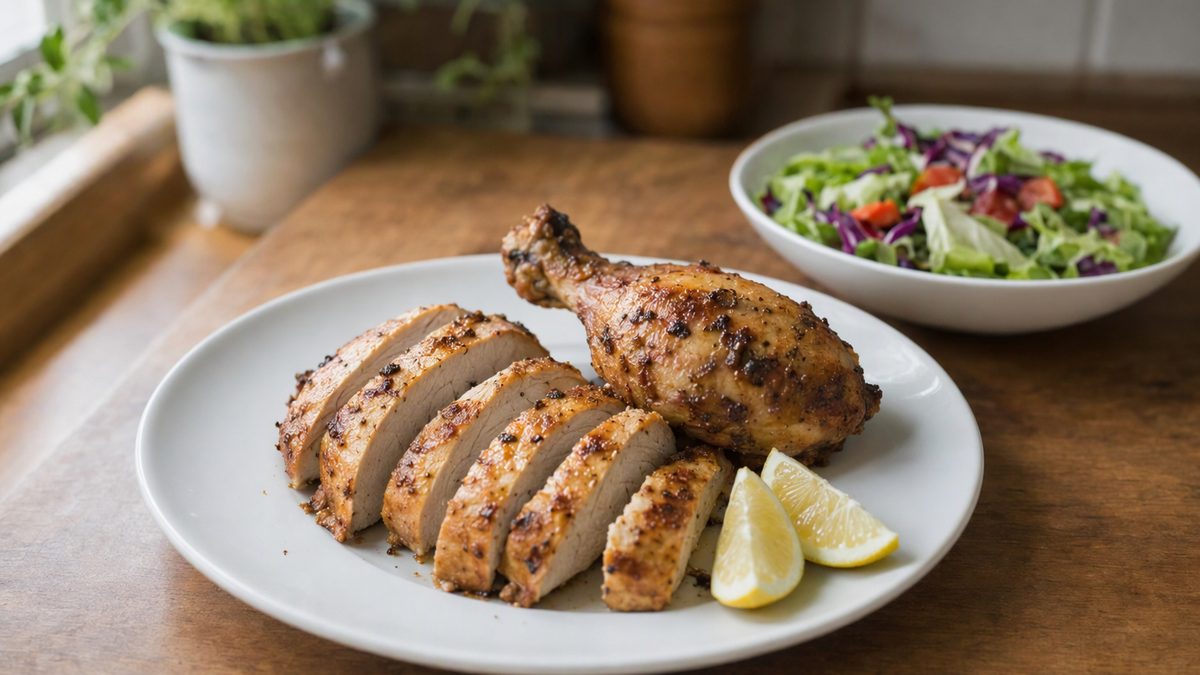
💡 Quick Answer
100 g of cooked chicken breast has 31 g of protein and 165 kcal; 100 g of raw breast has 22.5 g. Dark meat is a little lower in protein per 100 g: cooked thigh gives 24.8 g and cooked drumstick 24.2 g (USDA FoodData Central). Raw weight and cooked weight are different, so always say which one you weighed.
- 200 g cooked breast: 62 g protein, 330 kcal.
- 250 g cooked breast: 77.5 g protein, 412 kcal.
- Half kg raw breast: 112.5 g protein. 1 kg raw breast: 225 g.
- One full leg (drumstick + thigh, edible meat): about 45 g protein.
Portion calculator
150 g of breast, raw, skinless ≈ 33.8 g protein · 180 kcal
Scaled from the figures on this page. Brands and recipes vary.
Counting calories and protein? Snap a photo of your meal and the UltraFit360 app logs both against your daily target. Get UltraFit360 on the App Store or Google Play.
"How much protein in 100 g chicken" gets asked in a dozen ways: 100 g, 200 g, 250 g, half a kilo, a full kilo, one leg piece. The answer changes with three things: which cut, whether the meat is raw or cooked, and whether you are weighing meat only or meat with bone and skin. This page puts every version in one place. If you only eat breast, our shorter protein in chicken breast page goes deeper on that one cut; this page covers the rest.
Chicken Protein per 100 g by Cut
Table 1 lists the figures for 100 g of edible meat. "Edible" means bone removed. Skinless cuts are the default; two rows show what the skin adds.
| Cut and method | Weight | Calories | Protein | Carbs | Fat | Fibre |
|---|---|---|---|---|---|---|
| Breast, raw, skinless | 100 g | 120 kcal | 22.5 g | 0.0 g | 2.6 g | 0.0 g |
| Breast, roasted, skinless | 100 g | 165 kcal | 31.0 g | 0.0 g | 3.6 g | 0.0 g |
| Thigh, raw, skinless | 100 g | 121 kcal | 19.7 g | 0.0 g | 4.1 g | 0.0 g |
| Thigh, roasted, skinless | 100 g | 179 kcal | 24.8 g | 0.0 g | 8.2 g | 0.0 g |
| Drumstick, raw, skinless | 100 g | 116 kcal | 19.4 g | 0.0 g | 3.7 g | 0.0 g |
| Drumstick, roasted, skinless | 100 g | 155 kcal | 24.2 g | 0.0 g | 5.7 g | 0.0 g |
| Leg (drumstick + thigh), raw, skinless | 100 g | 120 kcal | 19.2 g | 0.0 g | 4.2 g | 0.0 g |
| Leg, roasted, skinless | 100 g | 174 kcal | 24.2 g | 0.0 g | 7.8 g | 0.0 g |
| Wing, raw, skinless | 100 g | 126 kcal | 22.0 g | 0.0 g | 3.5 g | 0.0 g |
| Thigh, raw, with skin | 100 g | 221 kcal | 16.5 g | 0.2 g | 16.6 g | 0.0 g |
| Drumstick, raw, with skin | 100 g | 161 kcal | 18.1 g | 0.1 g | 9.2 g | 0.0 g |
| Whole chicken meat, raw, skinless | 100 g | 119 kcal | 21.4 g | 0.0 g | 3.1 g | 0.0 g |
| Breast, stewed (curry-style, no gravy), skinless | 100 g | 151 kcal | 29.0 g | 0.0 g | 3.0 g | 0.0 g |
| Thigh, stewed (curry-style, no gravy), skinless | 100 g | 195 kcal | 25.0 g | 0.0 g | 9.8 g | 0.0 g |
Source: USDA FoodData Central (SR Legacy), per 100 g of edible meat (bone removed). Raw rows are weighed raw; roasted and stewed rows are weighed cooked.
Two patterns stand out. First, cooking makes protein per 100 g go up, not because cooking creates protein but because water leaves the meat: raw breast is 22.5 g per 100 g and roasted breast is 31 g. Second, skin changes calories far more than protein: raw thigh with skin has 221 kcal per 100 g against 121 kcal without it, while protein actually falls from 19.7 g to 16.5 g because fat takes up the weight.
India's own tables agree on the ranking. IFCT 2017 (ICMR-NIN) lists raw skinless chicken breast at 21.8 g protein per 100 g, leg at 19.4 g, thigh at 18.2 g and wing at 17.4 g. The numbers are a little lower than USDA's for thigh and wing because the two surveys sampled different birds and cuts, but breast is clearly the leanest and highest-protein cut in both.
Chicken Protein by Quantity: 100 g, 200 g, 250 g, Half Kg and 1 Kg
This is the table most people are looking for. Pick your cut, then read across to the weight on your scale. Raw rows are for meat weighed before cooking, cooked rows for meat weighed after.
| Cut (skinless, boneless) | 100 g | 200 g | 250 g | 500 g | 1 kg |
|---|---|---|---|---|---|
| Breast, raw | 22.5 g protein 120 kcal | 45.0 g protein 240 kcal | 56.2 g protein 300 kcal | 112.5 g protein 600 kcal | 225.0 g protein 1200 kcal |
| Breast, cooked | 31.0 g protein 165 kcal | 62.0 g protein 330 kcal | 77.5 g protein 412 kcal | 155.1 g protein 825 kcal | 310.2 g protein 1650 kcal |
| Thigh, raw | 19.7 g protein 121 kcal | 39.3 g protein 242 kcal | 49.1 g protein 302 kcal | 98.3 g protein 605 kcal | 196.6 g protein 1210 kcal |
| Thigh, cooked | 24.8 g protein 179 kcal | 49.5 g protein 358 kcal | 61.9 g protein 448 kcal | 123.8 g protein 895 kcal | 247.6 g protein 1790 kcal |
| Leg meat, raw | 19.2 g protein 120 kcal | 38.3 g protein 240 kcal | 47.9 g protein 300 kcal | 95.8 g protein 600 kcal | 191.6 g protein 1200 kcal |
| Leg meat, cooked | 24.2 g protein 174 kcal | 48.4 g protein 348 kcal | 60.5 g protein 435 kcal | 121.1 g protein 870 kcal | 242.2 g protein 1740 kcal |
Source: USDA FoodData Central (SR Legacy). Each cell is protein and calories for that weight of edible meat.
A kilo of raw breast holds about 225 g of protein, which is roughly two days of protein for an average adult at 1.6 g per kg. Remember that a kilo of chicken from the shop usually includes bone, and curry cuts can be a quarter to a third bone by weight, so a "1 kg curry cut" packet will give noticeably less than the boneless figure. As a rule of thumb, take the boneless number and multiply by 0.65 to 0.75 for bone-in curry pieces.
Protein in One Leg Piece, Drumstick or Thigh
People often ask about "1 leg piece" in restaurants and thalis. Pieces differ a lot by bird size, so treat this as a guide. USDA's portion data for raw broiler leg gives these edible-meat weights.
| Leg piece | Weight | Calories | Protein | Carbs | Fat | Fibre |
|---|---|---|---|---|---|---|
| 1 drumstick, edible meat only | 88 g raw meat | 106 kcal | 16.9 g | 0.0 g | 3.7 g | 0.0 g |
| 1 thigh, edible meat only | 147 g raw meat | 176 kcal | 28.2 g | 0.0 g | 6.2 g | 0.0 g |
| 1 full leg (drumstick + thigh) | 235 g raw meat | 282 kcal | 45.0 g | 0.0 g | 9.9 g | 0.0 g |
Source: USDA FoodData Central (SR Legacy): portion weights "drumstick, bone and skin removed 88 g" and "thigh, bone and skin removed 147 g" for raw broiler leg meat.
A bone-in leg quarter from a typical Indian broiler is smaller than the US birds these weights come from, so a restaurant leg piece with bone will usually give less protein than the full-leg row once bone and skin are removed. Scale by the weight of edible meat you actually get. If the dish is a curry, the protein stays in the meat and the gravy adds oil, not protein.
Raw or Cooked: Which Weight Should You Track?
Chicken loses roughly a quarter of its weight as water when cooked (the exact loss depends on the method). That means 100 g raw breast becomes roughly 75 g cooked, and both hold the same 22.5 g of protein (about 22.5 g per 100 g raw, and 31 g per 100 g cooked). Logging 200 g of cooked chicken against a raw database entry would under-count you by about a third.
- Cooking for the week: weigh raw, log raw. It is more repeatable because water loss depends on the pan, the oil and the time.
- Eating out or from leftovers: weigh cooked and use a cooked entry.
- Curry: weigh the raw chicken going in, then log what fraction of the pot you eat.
Which Cut Is Best?
Breast gives the most protein for the fewest calories: 31 g for 165 kcal per 100 g cooked, about 19 g of protein per 100 kcal. Thigh and drumstick sit at 179 and 155 kcal per 100 g, cost less, and stay juicier, which makes them easier to eat consistently. In a fat-loss phase, breast or skinless drumstick fits a calorie budget best. In a bulk, thigh is a perfectly good choice and the extra fat helps hit calories. Wings and skin-on pieces are the least efficient for protein per calorie.
Tandoori, tikka and grilled chicken take the roasted values above, because the cooking method is similar. The marinade adds a little curd and oil, usually 20 to 60 kcal per serving, so a 150 g serving of chicken tikka is close to the roasted figure plus that small margin. Deep-fried or butter-based dishes are different; see calories in butter chicken for how fast the numbers climb.
Chicken Compared With Other Protein Foods
Per 100 g, cooked breast has 31 g of protein, paneer about 19 g and boiled egg about 13 g. Chicken is cheaper per gram of protein than paneer in most cities and far leaner. If you do not eat chicken, see protein in paneer, protein in egg or protein in dal. Our Indian food calorie and protein chart lists 45+ foods side by side.
How Much Chicken Do You Need?
A common target is 1.6 g of protein per kg of body weight for people who lift. For a 70 kg person that is about 112 g a day. If chicken supplies half of that, 56 g, you need roughly 181 g of cooked breast, or about 249 g raw. Spread it over two meals rather than one large portion, and mix in dal, curd or eggs. The protein calculator gives a personal target. For a ready-made recipe, try the chicken tikka bowl, and for batch ideas see high-protein Indian meal prep. Everything here also sits under our nutrition hub.
One safety note: chicken must be cooked through, to a core temperature of 74 C (165 F), and raw chicken should not touch ready-to-eat food. This does not change the protein, but it is why undercooked tikka is never worth it.
Frequently Asked Questions
How much protein is in 100 g of chicken?
100 g of raw chicken breast has 22.5 g of protein and 120 kcal. 100 g of cooked (roasted) breast has 31 g and 165 kcal. Thigh has 19.7 g raw and 24.8 g cooked per 100 g (USDA).
How much protein is in 200 g and 250 g of chicken?
200 g of cooked breast has 62 g of protein (330 kcal) and 250 g has 77.5 g (412 kcal). The same weights of raw breast give 45 g and 56.2 g.
How much protein is in half a kg or 1 kg of chicken?
500 g of raw boneless breast has 112.5 g of protein and 1 kg has 225 g. Bone-in curry cuts have less edible meat, so multiply by about 0.65 to 0.75.
How much protein is in one chicken leg piece?
A full leg of edible meat (drumstick plus thigh, about 235 g raw) has roughly 45 g of protein. One drumstick of edible meat gives about 16.9 g and one thigh about 28.2 g. Bone-in pieces from smaller birds give less, so scale by the edible meat.
Does cooked chicken have more protein than raw?
Per 100 g, yes, because cooking removes water: about 31 g per 100 g cooked breast against 22.5 g raw. The total protein in the piece does not change, only the weight does.
Which part of the chicken has the most protein?
Breast, with 31 g per 100 g cooked and the lowest calories. Thigh and drumstick have 24.8 and 24.2 g, with more fat and more flavour. Wings and skin-on cuts give the least protein per calorie.
Is chicken breast or thigh better for muscle gain?
Both work. Breast gives more protein per calorie, which suits fat loss. Thigh is cheaper and easier to eat in larger amounts, which can help when you need more calories. Total daily protein matters more than the cut.
Sources: USDA FoodData Central (SR Legacy, 2019 release) for all chicken values in the tables, with the food IDs 171077, 171477, 173627, 172388, 173614, 172376, 173619, 172380, 173632, 172385, 172373, 171052, 171478 and 172389; IFCT 2017 (ICMR-National Institute of Nutrition) for the raw skinless protein figures quoted in the text. Values are typical, not lab results for your chicken.
Hitting your protein target on an Indian diet is easier when you can see it: UltraFit360 logs meals from a photo and tracks protein against your goal. Work out your number with the protein calculator.
Track Chicken and Protein Automatically
Snap a photo of your chicken meal and UltraFit360 logs calories and protein against your daily target.