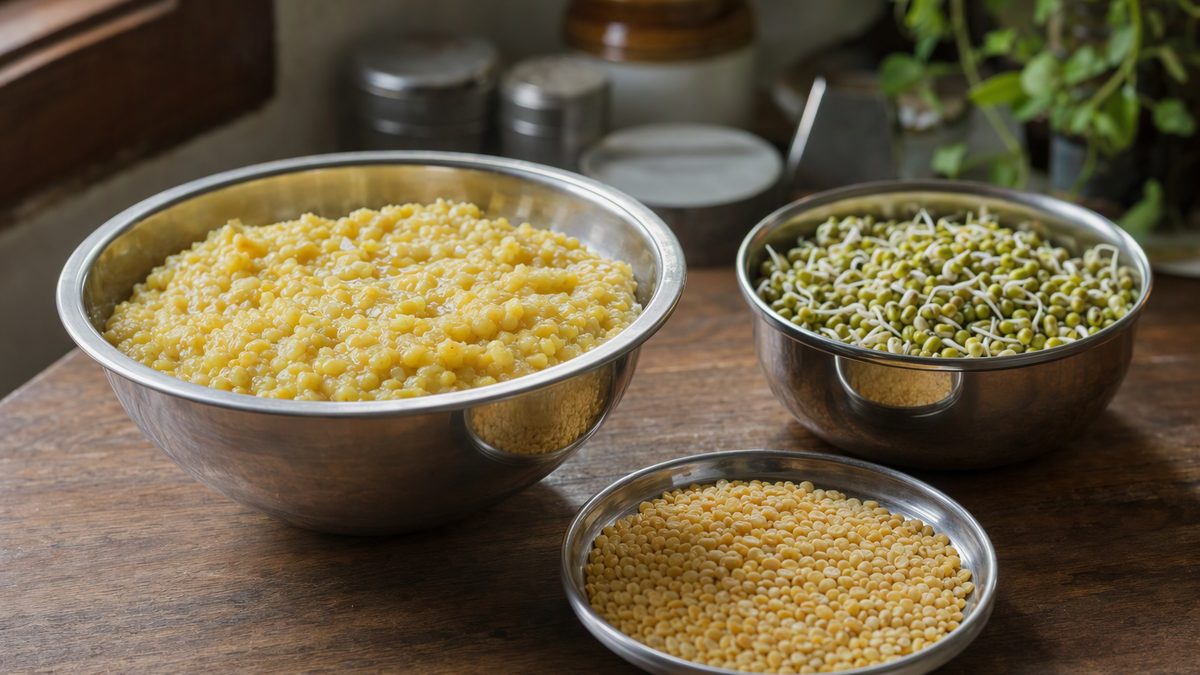
💡 Quick Answer
100 g of dry moong dal has 23.9 g of protein and 326 kcal; cooked moong has only 7 g per 100 g because it is mostly water. A 150 g katori of thick cooked moong gives about 10.5 g of protein, and a cup of raw sprouts about 3.2 g (IFCT 2017 and USDA).
- Dry dal, 30 g serving: 7.2 g protein, 98 kcal.
- Whole green moong, dry, per 100 g: 22.5 g protein, 17 g fibre.
- Sprouts, per 100 g raw: 3 g protein, only 30 kcal.
Portion calculator
30 g of moong dal (split, husked), dry ≈ 7.2 g protein · 98 kcal
Scaled from the figures on this page. Brands and recipes vary.
Counting calories and protein? Snap a photo of your meal and the UltraFit360 app logs both against your daily target. Get UltraFit360 on the App Store or Google Play.
Moong is the lightest of the common Indian pulses, which is why it is the dal doctors suggest first for upset stomachs and why it turns up in khichdi, chilla, soups and salads. "Moong dal protein" means different things depending on whether you weigh the dal dry, cooked, whole or sprouted. The difference is large, because water makes up most of the weight of a cooked pot. This page sets out every form in one place, so you can match what you eat to a number.
Moong Protein per 100 g: Dry, Cooked and Sprouted
| Form | Weight | Calories | Protein | Carbs | Fat | Fibre |
|---|---|---|---|---|---|---|
| Moong dal (split, husked), dry | 100 g | 326 kcal | 23.9 g | 62.0 g | 1.4 g | 9.4 g |
| Moong whole (green gram), dry | 100 g | 294 kcal | 22.5 g | 63.2 g | 1.1 g | 17.0 g |
| Moong, boiled (cooked weight) | 100 g | 105 kcal | 7.0 g | 19.1 g | 0.4 g | 7.6 g |
| Moong sprouts, raw | 100 g | 30 kcal | 3.0 g | 5.9 g | 0.2 g | 1.8 g |
| Moong sprouts, boiled | 100 g | 21 kcal | 2.0 g | 4.2 g | 0.1 g | 0.8 g |
Source: IFCT 2017 (ICMR-NIN) for dry green gram dal and whole green gram (carbohydrate shown as available carbohydrate plus fibre); USDA FoodData Central (SR Legacy) for boiled moong and sprouts (IDs 174257, 169957, 169137).
The dry numbers are the ones to use when you weigh the dal before cooking. Split, husked moong dal has 23.9 g of protein per 100 g, slightly more than whole green moong at 22.5 g, because removing the husk takes out some fibre and raises the share of protein. Whole moong keeps almost double the fibre (17 g against 9.4 g), which is why it keeps you fuller and digests more slowly. Cooked moong holds 7 g of protein per 100 g and 105 kcal, because the dal soaks up roughly twice its own weight in water and swells to about three times its dry weight. Sprouts fall lower still, at 3 g per 100 g, but they are also only 30 kcal.
These figures give the same protein whichever way you count: a 30 g handful of dry dal makes roughly 100 g of cooked dal and has 7.2 g protein either way. Only the weight on the scale changes.
Moong Dal Protein by Portion: 30 g, 50 g, a Katori, a Cup
| Portion | Weight | Calories | Protein | Carbs | Fat | Fibre |
|---|---|---|---|---|---|---|
| Dry moong dal | 30 g (2 tbsp, one serving of dal) | 98 kcal | 7.2 g | 18.6 g | 0.4 g | 2.8 g |
| Dry moong dal | 50 g | 163 kcal | 11.9 g | 31.0 g | 0.7 g | 4.7 g |
| Dry moong dal | 100 g | 326 kcal | 23.9 g | 62.0 g | 1.4 g | 9.4 g |
| Cooked moong, 1 katori | 150 g (1 katori, thick) | 158 kcal | 10.5 g | 28.7 g | 0.6 g | 11.4 g |
| Cooked moong, 1 cup | 202 g (1 US cup) | 212 kcal | 14.2 g | 38.7 g | 0.8 g | 15.4 g |
| Raw sprouts, 1 cup | 104 g (1 US cup) | 31 kcal | 3.2 g | 6.2 g | 0.2 g | 1.9 g |
| Raw sprouts, 1 bowl | 150 g (1 bowl) | 45 kcal | 4.6 g | 8.9 g | 0.3 g | 2.7 g |
Source: IFCT 2017 (ICMR-NIN) (dry dal) and USDA FoodData Central (SR Legacy) (cooked and sprouts). A katori of 150 g is our assumption for thick dal; thin dal has less protein per katori. Cup weights are USDA's.
The table shows why a plate of moong dal looks small in protein terms. A katori of cooked dal gives about 10.5 g of protein, which is about as much as one egg. Dry weight is a better guide to what you actually cooked: 50 g of dry dal, which cooks to about 170 g, a generous katori or two thin ones, gives 11.9 g of protein and 163 kcal. Sprouts add a few more grams per bowl, with very few calories.
Moong Dal vs Whole Moong vs Sprouts
- Split moong dal cooks in 20 minutes with no soaking and is the easiest on digestion. It has the highest protein per 100 g of the three.
- Whole green moong needs soaking and longer cooking but has more fibre, iron and minerals. IFCT lists 17 g of fibre per 100 g, and whole moong is the better choice if you are watching blood sugar.
- Sprouted moong is the lowest in calories and carbohydrates. Sprouting can raise vitamin C and may make minerals easier to absorb, but protein per 100 g raw weight is far lower than in dry dal. Raw sprouts carry a food safety risk, so many doctors advise cooking them lightly, especially for children, older people and during pregnancy.
How Good Is Moong Protein?
Moong protein is rich in lysine but low in methionine, so on its own it is not a complete protein. Rice or roti fixes this: the grain supplies methionine and the dal supplies lysine. That is why dal-chawal and khichdi work so well, and it is why you do not need to combine them at the same meal, only over the day. Dal alone will not reach a gym-level target, so pair it with other protein foods. To raise protein further, stir in curd, add paneer to a chilla, or use whole moong with soya chunks; see protein in dal for other lentils.
Ideas to Raise the Protein in Moong Meals
- Moong chilla with paneer: try the moong dal chilla with paneer recipe.
- Sprouted moong chaat: the sprouted moong chaat is a quick lunch-box protein.
- Khichdi: moong dal khichdi is light and easy; see calories in khichdi for per-katori numbers.
- Dal with a boiled egg or curd on the side: adds 6 to 8 g of protein for about 80 to 100 kcal.
For sprout safety, benefits and chana versus moong, read sprouts benefits. If you want to know how much protein you need in total, use the protein calculator, and browse the nutrition hub for other Indian foods.
A practical note on gas: moong is the pulse least likely to cause bloating, but soaking for two hours and cooking with a pinch of hing and ginger helps further. Cooking does not destroy protein; it just makes it easier to digest.
Frequently Asked Questions
How much protein is in 100 g of moong dal?
100 g of dry split moong dal has 23.9 g of protein and 326 kcal (IFCT 2017). 100 g of cooked moong has only 7 g because of the water it absorbs.
How much protein is in a katori of moong dal?
A 150 g katori of thick cooked moong gives about 10.5 g of protein and 158 kcal. Thin dal gives less.
How much protein do moong sprouts have?
Raw moong sprouts have 3 g of protein per 100 g and 30 kcal. A cup of raw sprouts (104 g) gives about 3.2 g.
Which has more protein: moong dal or whole moong?
Dry split moong dal has slightly more: 23.9 g per 100 g against 22.5 g for whole moong. Whole moong has more fibre.
Is moong dal a complete protein?
No. It is low in methionine, but eating it with rice or roti over the day gives all the essential amino acids.
How much moong dal should I eat for protein?
50 g of dry dal a day (a generous katori or two thin ones cooked) gives roughly 11.9 g of protein. Combine it with curd, eggs, paneer or soya to reach your daily target.
Sources: IFCT 2017 (ICMR-National Institute of Nutrition, Hyderabad) for dry green gram dal and whole green gram; USDA FoodData Central (SR Legacy) for boiled moong and moong sprouts. IFCT energy converted from kJ to kcal; carbohydrate is available carbohydrate plus dietary fibre. Values are typical, not lab results for your packet.
Hitting your protein target on an Indian diet is easier when you can see it: UltraFit360 logs meals from a photo and tracks protein against your goal. Work out your number with the protein calculator.
Track Dal and Protein Automatically
Snap a photo of your dal or sprouts and UltraFit360 logs calories and protein against your daily target.