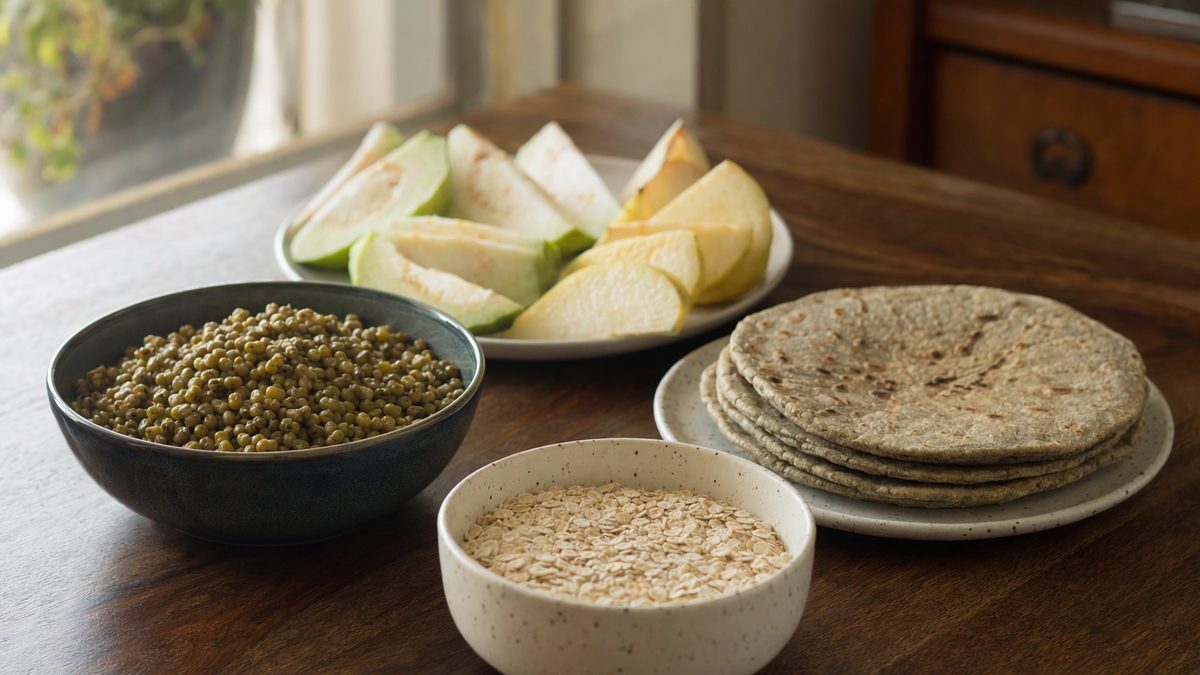
💡 Quick Answer
Per serving, the best Indian fibre sources are guava (12.9 g in a medium fruit), whole pulses such as kala chana (7.6 g in 30 g dry), soya bean, rajma and whole moong (5 to 7 g), quinoa, and 50 g of bajra, atta or ragi flour (5.7 g, about two rotis), against a daily need of 25 g for women and 38 g for men. Refined grains are far lower: 60 g of raw white rice has 1.7 g.
- Fruit: a medium pear 6.7 g, an apple 3.9 g.
- Seeds and nuts: chia 3.4 g per tablespoon, flax 2.6 g, almonds 3.9 g per 30 g.
- Vegetables: peas 6.3 g and drumstick 6.8 g per 100 g.
Counting calories and protein? Snap a photo of your meal and the UltraFit360 app logs both against your daily target. Get UltraFit360 on the App Store or Google Play.
Most adults in India eat less fibre than they need, mainly because polished rice and refined flour have replaced whole grains, and because fruit and pulses are small parts of many plates. "Fibre rich foods" is one of the most searched nutrition lists, and the usual answer is a list of names with no numbers. This page ranks common Indian foods by fibre per realistic serving, from IFCT 2017, so you can see what a katori of rajma, two bajra rotis or a guava actually gives.
Fibre Rich Foods in India: Grams per Serving
| Food and serving | Weight | Calories | Protein | Fibre per serving | % of 25 g daily value |
|---|---|---|---|---|---|
| Guava, white (150 g) | 150 g (1 medium) | 48 kcal | 2.2 g | 12.9 g | 52% |
| Kala chana (whole Bengal gram), dry (30 g) | 30 g dry | 86 kcal | 5.6 g | 7.6 g | 30% |
| Quinoa, dry (50 g) | 50 g dry | 164 kcal | 6.6 g | 7.3 g | 29% |
| Drumstick, tender (100 g) | 100 g | 29 kcal | 2.6 g | 6.8 g | 27% |
| Pear (150 g) | 150 g (1 medium) | 56 kcal | 0.5 g | 6.7 g | 27% |
| Soya bean, dry (30 g) | 30 g dry | 114 kcal | 10.7 g | 6.5 g | 26% |
| Green peas, fresh (100 g) | 100 g | 81 kcal | 7.2 g | 6.3 g | 25% |
| Sweet potato (150 g) | 150 g | 164 kcal | 2.0 g | 6.0 g | 24% |
| Bajra (50 g) | 50 g flour (about 2 rotis) | 174 kcal | 5.5 g | 5.7 g | 23% |
| Wheat atta (50 g) | 50 g flour (about 2 rotis) | 160 kcal | 5.3 g | 5.7 g | 23% |
| Ragi (50 g) | 50 g flour (about 2 rotis) | 160 kcal | 3.6 g | 5.6 g | 22% |
| Moong whole, dry (30 g) | 30 g dry | 88 kcal | 6.8 g | 5.1 g | 20% |
| Jowar (50 g) | 50 g flour (about 2 rotis) | 167 kcal | 5.0 g | 5.1 g | 20% |
| Rajma, dry (30 g) | 30 g dry | 89 kcal | 5.8 g | 5.1 g | 20% |
| Chana dal, dry (30 g) | 30 g dry | 99 kcal | 6.5 g | 4.5 g | 18% |
| Rolled oats (40 g) | 40 g dry (1 bowl) | 156 kcal | 6.8 g | 4.2 g | 17% |
| Lady finger, bhindi (100 g) | 100 g | 28 kcal | 2.1 g | 4.1 g | 16% |
| Almonds (30 g) | 30 g | 183 kcal | 5.5 g | 3.9 g | 16% |
| Apple (150 g) | 150 g (1 medium) | 94 kcal | 0.4 g | 3.9 g | 16% |
| Chia seeds (10 g) | 10 g (1 tbsp) | 49 kcal | 1.7 g | 3.4 g | 14% |
| Masoor dal, dry (30 g) | 30 g dry | 97 kcal | 7.3 g | 3.1 g | 13% |
| Moong dal, dry (30 g) | 30 g dry | 98 kcal | 7.2 g | 2.8 g | 11% |
| Dates, dry (30 g) | 30 g (about 3 dates) | 96 kcal | 0.7 g | 2.7 g | 11% |
| Brown rice, raw (60 g) | 60 g raw | 212 kcal | 5.5 g | 2.7 g | 11% |
| Linseeds, flax (10 g) | 10 g (1 tbsp) | 44 kcal | 1.9 g | 2.6 g | 10% |
| White rice, raw (60 g) | 60 g raw | 214 kcal | 4.8 g | 1.7 g | 7% |
Source: IFCT 2017 (ICMR-NIN) for dietary fibre and energy (IFCT energy converted from kJ) except oats and chia seeds, which are USDA FoodData Central (SR Legacy) (IDs 169705 and 170554). The percentage is of 25 g, the US adequate intake for adult women (38 g for men). Dry or raw weights for grains and pulses. Servings are our assumptions.
The table is sorted by fibre per serving. Guava is the standout: a medium white guava has 12.9 g, about half a day's need, for fewer than 50 kcal. Whole pulses come next: 7.6 g in 30 g of dry kala chana, 6.5 g in soya bean, 5.1 g in rajma and 5.1 g in whole moong. Millets and atta give about 5.7 g for two rotis, while polished white rice gives only 1.7 g for a similar portion, which is why swapping part of the rice for roti, millet or dal makes a visible difference. Split dals (moong, masoor, toor) are lower than whole pulses: 2.8 to 3.1 g in 30 g dry.
How Much Fibre Do You Need?
The US adequate intake is about 25 g a day for adult women and 38 g for men (14 g per 1,000 kcal). Many Indian dietitians use similar numbers. A day that includes one guava (12.9 g), a katori of whole dal (5.1 g from 30 g dry), two bajra or atta rotis (5.7 g), a bowl of oats (4.2 g) and vegetables reaches 25 g without any supplement. Add fibre slowly and drink more water: a sudden jump can cause gas and bloating.
Soluble and Insoluble Fibre, and What Each Does
Insoluble fibre, found in whole wheat, bran and vegetable skins, adds bulk and helps regularity. Soluble fibre, in oats, pulses, guava, apple and chia, forms a gel that slows the absorption of sugar and can lower LDL cholesterol. Most whole foods have both. A varied day with whole grains, pulses, fruit and vegetables is better than adding one fibre source such as bran. Fibre also feeds gut bacteria and keeps you full for longer, which is why it is useful in weight loss and for blood sugar control.
High Fibre Foods in Hindi (Aam Naam)
- Dal aur anaj: kala chana, rajma, sabut moong, soyabean, bajra, jowar, ragi, chokar wala atta, oats.
- Phal: amrood, nashpati, seb, chikoo.
- Sabziyan: matar, sahjan (drumstick), bhindi, gajar, shakarkandi.
- Beej aur sookha mewa: alsi, chia, badam, khajoor.
Simple Ways to Add 10 g More Fibre
- Swap white rice for part brown rice or millets, or have a roti of bajra or ragi in place of one wheat roti; see ragi nutritional value per 100g.
- Choose whole pulses (kala chana, rajma, sabut moong) over split dals a few times a week; see protein in chana and protein in rajma.
- Eat a guava or pear daily; see guava calories and nutrition.
- Keep the skin on potatoes, sweet potatoes and apples.
- Add a tablespoon of chia or flax seed to curd or oats.
Who Should Be Careful With Fibre?
People with irritable bowel syndrome, inflammatory bowel disease, recent gut surgery or swallowing problems may need to limit or change the type of fibre; follow your doctor's advice. Very high fibre can reduce absorption of iron and zinc if the rest of the diet is poor, so pair whole grains with vitamin C foods; see iron rich foods. Children, older adults and people with small appetites may find high-fibre diets too filling.
For more on the gut-health trend see our fibermaxxing guide. To set a protein target alongside your fibre plan, use the protein calculator, and browse the nutrition hub for more food pages. This page is general information, not medical advice.
Frequently Asked Questions
Which Indian foods are highest in fibre?
Per serving: guava (12.9 g in a medium fruit), whole pulses like kala chana (7.6 g per 30 g dry), soya bean, rajma, whole moong, quinoa, and millet or atta rotis (5.7 g for two).
How much fibre should I eat a day?
About 25 g for adult women and 38 g for men (US adequate intakes). Increase slowly and drink water.
Which fruits are high in fibre?
Guava is highest (12.9 g in 150 g), followed by pear (6.7 g) and apple (3.9 g). Dates and chikoo are also high per 100 g.
Does dal have fibre?
Yes, whole pulses more than split dals. 30 g of dry whole moong gives 5.1 g and 30 g of moong dal 2.8 g.
Is roti or rice higher in fibre?
Roti from whole wheat, bajra, ragi or jowar. 50 g of atta (about two rotis) has 5.7 g, while 60 g of raw white rice has only 1.7 g.
Can too much fibre be a problem?
Yes: a sudden large increase can cause gas, bloating or constipation if you do not drink enough water. People with certain gut conditions should follow medical advice.
Sources: IFCT 2017 (ICMR-National Institute of Nutrition) for dietary fibre and energy of all rows except rolled oats (USDA ID 169705) and chia seeds (USDA ID 170554). Adequate intakes are the US Dietary Guidelines figures (14 g per 1,000 kcal; 25 g and 38 g for adult women and men). Servings are our assumptions. This page is general information, not medical advice.
Hitting your protein target on an Indian diet is easier when you can see it: UltraFit360 logs meals from a photo and tracks protein against your goal. Work out your number with the protein calculator.
Track Your Meals and Nutrients Automatically
Log meals from a photo in UltraFit360 and see protein and calories against your daily target.