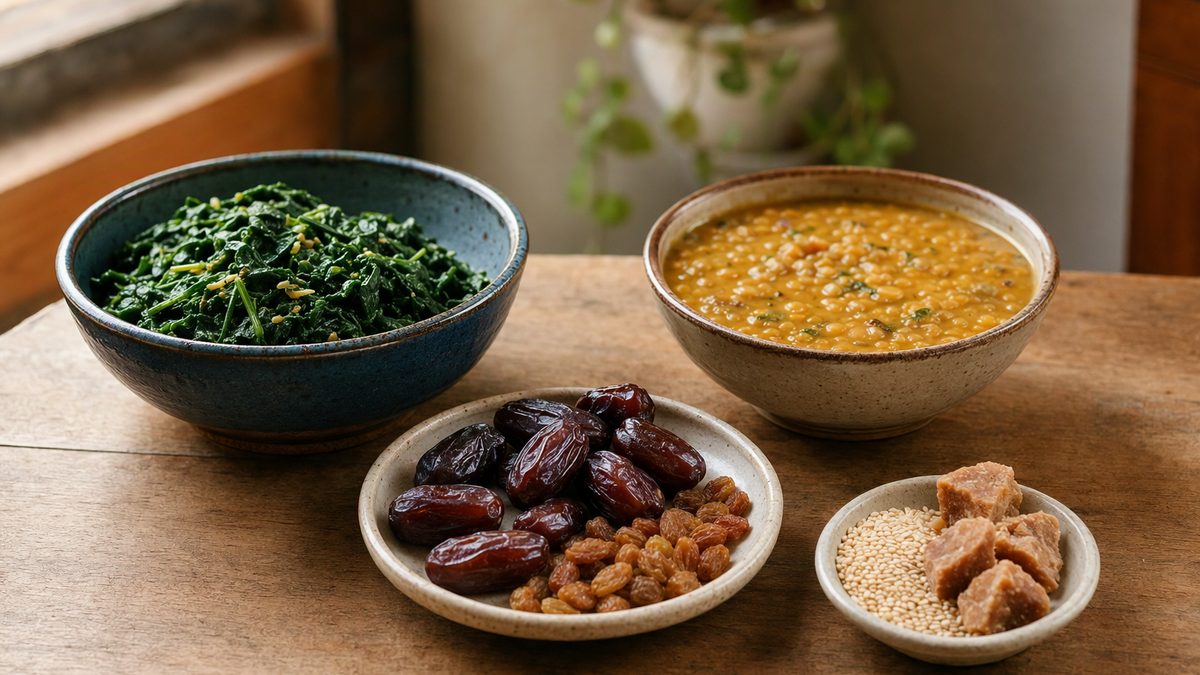
💡 Quick Answer
Per serving, the richest Indian iron sources are leafy greens (100 g of methi has 5.7 mg, green amaranth 4.6 mg and spinach 3.0 mg) and liver (5.0 mg in 50 g of chicken liver), followed by bajra (3.2 mg in 50 g of flour), soya bean (2.5 mg in 30 g), ragi, a plate of poha (2.2 mg) and masoor dal (2.1 mg in 30 g dry). Women aged 19 to 50 need 18 mg a day, men 8 mg (NIH). Plant iron is absorbed less well than iron from meat, so combine it with vitamin C.
- Seeds: halim (garden cress) gives 1.7 mg in just 10 g.
- Dry fruit and jaggery: raisins 2.0 mg per 30 g, jaggery 0.9 mg per 20 g.
- Chicken breast and egg are poor iron sources: 0.8 mg and 0.9 mg.
Counting calories and protein? Snap a photo of your meal and the UltraFit360 app logs both against your daily target. Get UltraFit360 on the App Store or Google Play.
Iron deficiency is the most common nutrient deficiency in India, especially in women, teenage girls and children. The usual answer, "eat spinach", is only part of the story: spinach is good but not the richest: methi and green amaranth give more per 100 g, and everyday foods such as bajra, ragi, poha and masoor dal add up quickly across the day. This page lists Indian foods by iron per serving, both vegetarian and non-vegetarian, and covers how to absorb more of it. Searches like "iron kisme paya jata hai" and "haemoglobin rich foods" are answered by the same list.
Iron Rich Foods in India: mg per Serving
| Food and serving | Weight | Calories | Protein | Iron per serving | % of 18 mg daily value |
|---|---|---|---|---|---|
| Fenugreek leaves, methi (100 g) | 100 g raw | 34 kcal | 3.7 g | 5.7 mg | 32% |
| Chicken liver (50 g) | 50 g raw | 62 kcal | 10.8 g | 5.0 mg | 28% |
| Amaranth leaves, green (100 g) | 100 g raw | 31 kcal | 3.3 g | 4.6 mg | 26% |
| Quinoa (50 g) | 50 g dry | 164 kcal | 6.6 g | 3.8 mg | 21% |
| Goat liver (50 g) | 50 g raw | 63 kcal | 10.2 g | 3.3 mg | 18% |
| Bajra (50 g) | 50 g flour (about 2 rotis) | 174 kcal | 5.5 g | 3.2 mg | 18% |
| Spinach, palak (100 g) | 100 g raw | 24 kcal | 2.1 g | 3.0 mg | 16% |
| Tofu, firm (100 g) | 100 g | 144 kcal | 17.3 g | 2.7 mg | 15% |
| Soya bean, dry (30 g) | 30 g dry | 114 kcal | 10.7 g | 2.5 mg | 14% |
| Ragi (50 g) | 50 g flour (about 2 rotis) | 160 kcal | 3.6 g | 2.3 mg | 13% |
| Rice flakes, poha (50 g) | 50 g dry (1 plate) | 177 kcal | 3.7 g | 2.2 mg | 12% |
| Masoor (lentil) dal, dry (30 g) | 30 g dry | 97 kcal | 7.3 g | 2.1 mg | 12% |
| Wheat atta (50 g) | 50 g flour (about 2 rotis) | 160 kcal | 5.3 g | 2.1 mg | 11% |
| Raisins, black (30 g) | 30 g (a handful) | 92 kcal | 0.8 g | 2.0 mg | 11% |
| Rajma, dry (30 g) | 30 g dry | 89 kcal | 5.8 g | 1.9 mg | 10% |
| Chana dal, dry (30 g) | 30 g dry | 99 kcal | 6.5 g | 1.8 mg | 10% |
| Garden cress seeds, halim (10 g) | 10 g (1 tbsp) | 45 kcal | 2.3 g | 1.7 mg | 10% |
| Sesame seeds, white (10 g) | 10 g (1 tbsp) | 52 kcal | 2.2 g | 1.5 mg | 8% |
| Goat meat, shoulder (100 g) | 100 g raw | 188 kcal | 20.3 g | 1.5 mg | 8% |
| Moong whole, dry (30 g) | 30 g dry | 88 kcal | 6.8 g | 1.5 mg | 8% |
| Moong dal, dry (30 g) | 30 g dry | 98 kcal | 7.2 g | 1.2 mg | 7% |
| Groundnuts (30 g) | 30 g | 156 kcal | 7.1 g | 1.0 mg | 6% |
| Dates, dry (30 g) | 30 g (about 3 dates) | 96 kcal | 0.7 g | 1.0 mg | 5% |
| Egg, boiled (1 egg, 50 g) | 1 large egg | 74 kcal | 6.7 g | 0.9 mg | 5% |
| Jaggery (20 g) | 20 g (small piece) | 71 kcal | 0.4 g | 0.9 mg | 5% |
| Chicken breast, skinless (100 g) | 100 g raw | 168 kcal | 21.8 g | 0.8 mg | 5% |
Source: IFCT 2017 (ICMR-NIN) for all rows except tofu (USDA FoodData Central, ID 172475). IFCT lists minerals in grams; converted to mg, and energy converted from kJ. The percentage is of 18 mg, the NIH adult RDA for women aged 19 to 50 (8 mg for men and for women after menopause). Servings are our assumptions; liver and meat are raw weights.
The table is sorted by iron per serving. Leafy greens such as methi and amaranth lead per serving, with chicken liver close behind (liver is not a daily food). Among other plant foods, bajra and ragi flour, soya bean, lentil dal, rajma, chana dal and, surprisingly, poha at 2.2 mg a plate are all useful; seeds like halim and sesame are small servings that add up. Spinach (palak) has 2.9 mg per 100 g, which is good but less than methi (5.7 mg) or green amaranth leaves (4.6 mg). Jaggery has 4.6 mg per 100 g, so a small piece gives about 0.9 mg, not enough to treat anaemia. Chicken breast and egg are low in iron (0.8 and 0.9 mg); red meat and organ meats are the animal sources that count.
How Much Iron Do You Need?
The NIH recommended intake is 18 mg a day for women aged 19 to 50, 27 mg in pregnancy, and 8 mg for men and for women after menopause. Vegetarian diets may need up to 1.8 times as much iron because plant (non-haem) iron is absorbed less well, a point made by the US Institute of Medicine. A day with a bowl of poha (2.2 mg), two rotis of ragi or bajra, a katori of masoor dal and a leafy sabzi can reach 10 mg or more from plant foods alone, but absorption will be lower than the numbers suggest. Iron needs are individual; a blood test (haemoglobin and ferritin) is the way to know.
How to Absorb More Iron From Plant Foods
- Add vitamin C to the same meal: lemon on dal and greens, amla, tomato, guava or orange. See guava calories and nutrition, since guava is very rich in vitamin C.
- Keep tea and coffee away from meals: tannins can reduce iron absorption; wait an hour. See chai calories per cup.
- Soak, sprout or ferment grains and pulses, which reduces phytates that block iron.
- Cook in an iron kadhai if you can; it adds a small amount of iron to acidic dishes.
- Do not combine heavy calcium supplements with iron-rich meals; space them apart.
Iron and Anaemia: When Food Is Not Enough
If you feel tired, look pale, have hair loss or breathlessness, see a doctor. These can be signs of anaemia, but they can also come from other causes, including low vitamin B12, which is common in vegetarians. Food alone may not correct moderate or severe iron deficiency; doctors often prescribe iron tablets, and you should not take iron supplements without a test, since excess iron is harmful. For the link between iron and B12 in women, read iron and B12 for women and our list of vitamin B12 rich foods.
Iron Rich Foods in Hindi
- Sabziyan: methi, palak, chaulai (amaranth), sarson ke patte.
- Anaj aur dal: bajra, ragi, poha, masoor dal, rajma, chana, soyabean.
- Beej aur sookha mewa: halim, til, kishmish, khajoor, gud.
- Non-veg: kaleji (liver), mutton, machhli.
For ragi and other millets see ragi nutritional value per 100g. Plan your protein with the protein calculator, and browse the nutrition hub. This page is general information, not medical advice.
Frequently Asked Questions
Which foods are highest in iron?
Organ meats such as liver (5.0 mg in 50 g of chicken liver), seeds (halim 1.7 mg in 10 g), soya bean, lentils, rajma, millets like bajra and ragi, poha and leafy greens like methi are the richest per serving (IFCT 2017).
Which vegetables are rich in iron?
Methi leaves (5.7 mg per 100 g), green amaranth leaves (4.6 mg), spinach (2.9 mg). Spinach is good but not the richest.
Iron kisme paya jata hai (in Hindi)?
Iron palak, methi, chaulai, bajra, ragi, poha, masoor dal, rajma, soyabean, til, halim, kishmish, khajoor aur kaleji mein paya jata hai.
Is poha a good source of iron?
Yes: IFCT 2017 lists 4.5 mg per 100 g of dry rice flakes, so a 50 g plate gives about 2.2 mg. Squeeze lemon on it to improve absorption.
How much iron do women need?
The NIH recommends 18 mg a day for women aged 19 to 50, 27 mg in pregnancy and 8 mg after menopause. Men need 8 mg.
Does jaggery cure anaemia?
No. Jaggery has about 4.6 mg of iron per 100 g, so a small piece gives about 0.9 mg. It is a mild contributor, not a treatment.
Sources: IFCT 2017 (ICMR-National Institute of Nutrition) for iron and energy of all rows except tofu, which is USDA FoodData Central (SR Legacy, ID 172475); IFCT lists minerals in grams, converted to mg. Recommended intakes are NIH Office of Dietary Supplements RDAs; the higher requirement for vegetarians is from the US Institute of Medicine. Servings are our assumptions. This page is general information, not medical advice.
Hitting your protein target on an Indian diet is easier when you can see it: UltraFit360 logs meals from a photo and tracks protein against your goal. Work out your number with the protein calculator.
Track Your Meals and Nutrients Automatically
Log meals from a photo in UltraFit360 and see protein and calories against your daily target.